
CS-TopCent: Identifying Social Network Leaders via Compressive Sensing
2015 IEEE/ACM International Conference on Advances in Social Networks Analysis and Mining
The paper introduces CS-TopCent, a novel framework that utilizes Compressive Sensing (CS) to identify the top-k central nodes in social networks. By treating the identification of influential nodes as a sparse signal recovery problem, it achieves high accuracy in detecting degree and betweenness centrality without requiring full network topology or direct measurement of every node.
TL;DR
Determining the most influential people in a massive social network usually requires knowing every single connection—an impossible task for platforms with billions of users. This paper presents CS-TopCent, a method that uses Compressive Sensing to "guess" the top-k most central nodes by looking at just a few mathematical "summaries" of the network. It turns out you don't need the whole map to find the capital cities; you just need the right sparse measurements.
The Bottleneck: The Cost of Centrality
In Social Network Analysis (SNA), metrics like Degree Centrality (how many friends you have) and Betweenness Centrality (how often you act as a bridge between groups) are vital. However, calculating these is a nightmare for large-scale graphs:
- Computational Complexity: Betweenness requires All-Pairs Shortest Paths (APSP), which is or .
- Data Blindness: We rarely have the full "Adjacency Matrix" of a real-world network due to privacy settings or distributed data.
- Sampling Waste: Traditional sampling collects 100% of the data only to throw away 90% of it after sorting for the "Top-K."
The Insight: Influentials are Sparse
The authors ask a provocative question: “Why go to so much effort to acquire all the data when most of what we get will be thrown away?”
Since only a tiny fraction () of nodes are truly "central" in a network of size (where ), the centrality vector is sparse. Compressive Sensing tells us we can reconstruct such sparse vectors from measurements, where is much smaller than .
Methodology: How CS-TopCent Works
The core of the paper is the construction of a feasible measurement matrix (). In standard CS, you use random Gaussian matrices, but in networks, a measurement must follow a physical path or a connected sub-graph.
1. Weighted Traversal
CS-TopCent uses the Local Clustering Coefficient to weight nodes. It prioritizes nodes that are likely to be hubs.
2. Smart Random Walks
Instead of a blind walk, the algorithm:
- Selects starting nodes proportional to their potential importance.
- Avoids visiting the same link more than twice to ensure maximum "coverage" of the network.
- Dynamically updates transition probabilities as links are "removed" from the measurement pool.

3. Reconstruction via LASSO
Once the measurements () are collected, the system uses the LASSO model (L1-norm minimization) to identify the non-zero entries in , which correspond to the IDs of the top-k central nodes.
Experimental Showdown
The authors tested the method on several real-world graphs, including the NetSci co-authorship network and Zachary’s Karate Club.
- Accuracy: In the NetSci dataset, CS-TopCent reached an F-measure improvement of 91% to 99% over the standard Random Walk (RW) baseline for degree and betweenness centrality.
- Efficiency: Even when the number of measurements was less than 50% of the nodes (), the recovery rate remained remarkably high.
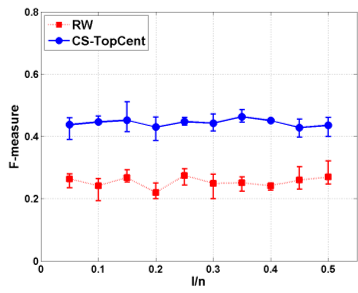 Fig: Testing the effect of the number of measurements on recovery accuracy.
Critical Perspective
Why it works
The "magic" lies in the Graph Constraint. By forcing measurements to be connected paths, the authors exploit the natural topology of social networks (the "Small World" property). The update function in Algorithm 2 prevents the walk from getting stuck in local loops, which is the primary failure mode of earlier RW-based CS methods.
Limitations
The current approach assumes node values are additive in measurements. While this works for centrality scores, it might be harder to implement in networks where node properties are non-linear or where global information flow is inhibited by gatekeepers.
Conclusion
CS-TopCent shifts the paradigm of social network analysis from "Collect then Process" to "Compressive Sensing." For practitioners in marketing, cybersecurity, or epidemiology, this provides a way to find "Key Players" with significantly less data and hardware overhead.
Takeaway: In the era of Big Data, sometimes the best way to see the big picture is to look at a very small, very smart subset of it.