
Balancing the Feed: Using Stochastic Approximations to Fix Content Diversity
2015 IEEE/ACM International Conference on Advances in Social Networks Analysis and Mining
Summary
Problem
Method
Results
Takeaways
Abstract
This paper introduces a dynamical model based on stochastic approximations to describe user posting behavior in Social Networks, specifically addressing negative externalities between topics. The researchers also develop a "Content Active Filtering" (CAF) mechanism designed to enforce content diversity, proving its convergence to a unique rest point where all topics achieve equal visibility.
## TL;DR
Social media feeds are often dominated by a few viral topics, leaving little room for niche or high-quality discourse. This paper provides a rigorous mathematical framework to model this "attention competition" and proposes a **Content Active Filtering (CAF)** mechanism. By treating the social network as a dynamical system, the authors show how administrators can objectively tune the "acceptance rate" of posts to ensure every topic gets a fair share of the spotlight.
## The Visibility Trap: Why Over-Posting Hurts
In a world of limited user attention, information acts like a scarce resource. The authors identify a phenomenon called **Negative Externalities**: the more content exists on a topic, the less "popular" (in terms of likes or comments) a new post in that topic is likely to be.
Current models often treat posting as a vacuum, but this paper recognizes **Self-Censorship**. Users don't just post; they predict if their content will be popular. If the "market" is saturated, they stay silent. This leads to a feedback loop where certain topics can effectively "suffocate" others.
## Methodology: The Math of Social Dynamics
The researchers model the network as a series of arrivals (Poisson Process). Each user brings a topic $c$ and a potential popularity $Z_c$.
### 1. The Posting Probability
The core innovation is the linear impact model. The probability $f_c$ that a user actually hits "Post" decreases as the average number of posts $x$ increases:
$$f _ {c} (x) = g _ {c} ( heta_ {c}) (1 - \sum a _ {c c ^ {\prime}} x _ {c ^ {\prime}})$$
Here, $a_{cc'}$ represents how much topic $c'$ negatively impacts topic $c$.
### 2. The System Architecture
The authors visualize the flow of users through a decision gate, where the social network's state feeds back into the user's decision to participate.
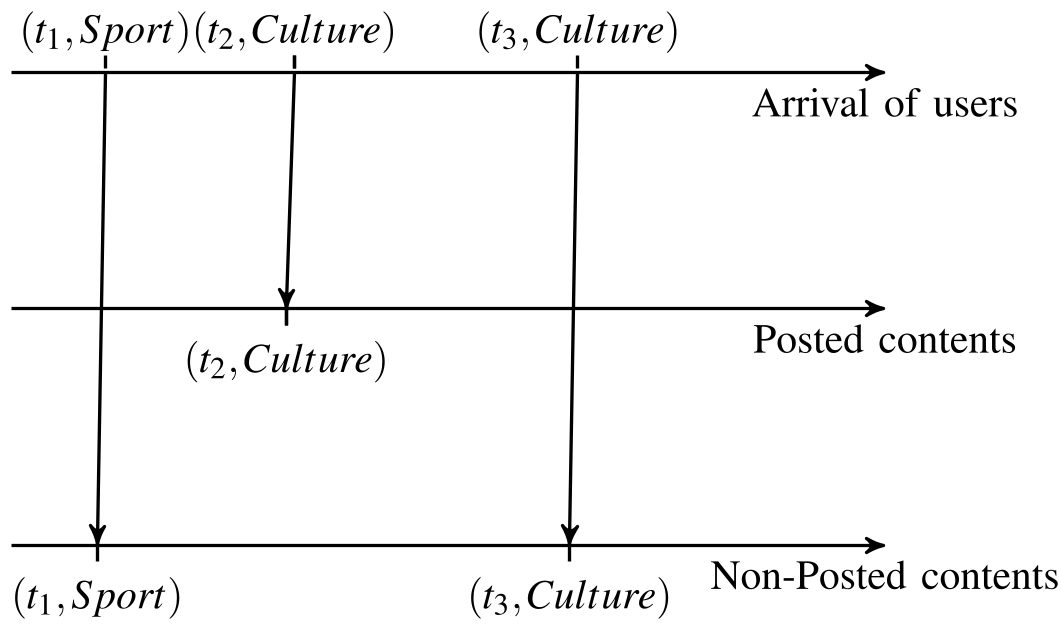
*Fig 1: The flow from user arrival to the decision to post, influenced by the current state of the network.*
### 3. Achieving Stability
Using **Stochastic Approximation**, the authors prove that the random, jittery behavior of millions of users eventually settles into a "Rest Point" ($x^*$). By applying Monotone Operator Theory, they demonstrate that this equilibrium is unique and stable—meaning the network won't spirally out of control into total silence or infinite noise.
## Content Active Filtering (CAF)
How do we fix a skewed equilibrium? The authors propose **CAF**, where the network administrator decides whether to "accept" a post with probability $p_c$.
By solving for $p_c$, they can force the system into a **Diversity Property** where the volume of Sport, Politics, Health, and Culture content are all equal ($x_c = x_{c'}$).
## Experimental Validation
The simulation results highlight the "before and after" of applying CAF. In a 5-topic scenario, the "natural" state of the network is highly uneven due to different arrival rates and popularity thresholds.
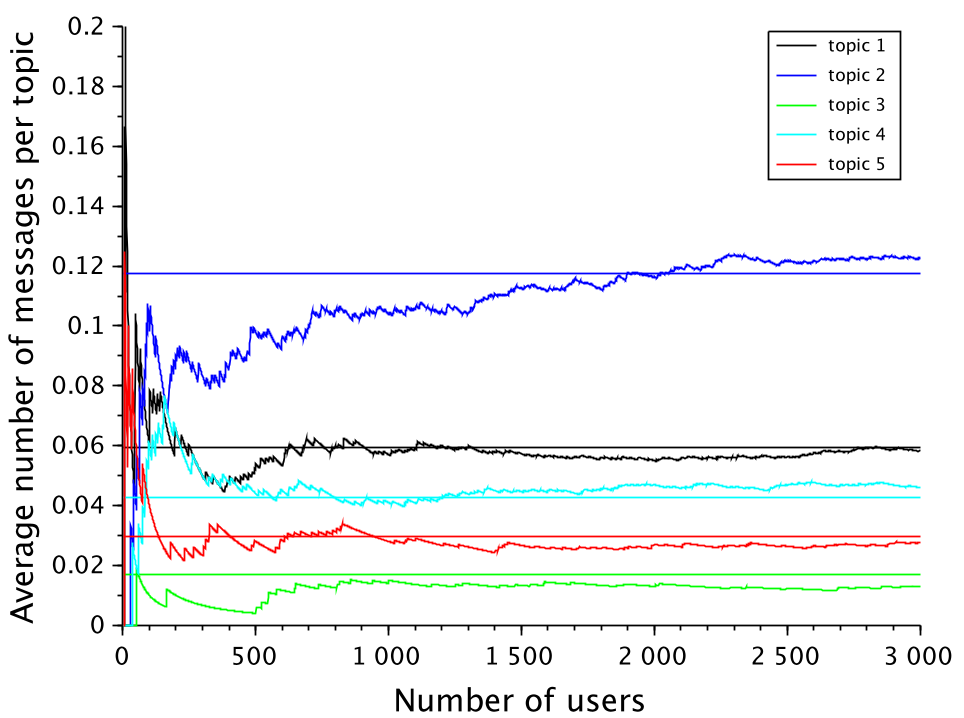
*Fig 2: Convergence of topic averages. Without CAF (top), distributions are skewed; with CAF (bottom), all topics converge to a single horizontal line, representing perfect diversity.*
## Critical Insights & Future Outlook
While the math is elegant, the paper touches on a sensitive nerve: **Network Agency**. By implementing CAF, an administrator essentially "censors" some content to make room for others. The authors argue this is "democratic" in that it prevents information monopolies, but it raises questions about user intent.
**Key Takeaways for Developers and Researchers:**
* **Dynamic Control**: Diversity shouldn't just be a post-processing step (like re-ranking); it can be achieved by controlling the "entry" rates of content.
* **Attention Budget**: Any healthy social algorithm must account for the fact that a user’s attention is a zero-sum game.
* **Stability is Key**: Before implementing a filtering policy, one must prove it won't crash the system's engagement—a proof provided here via Lyapunov functions.
The future of social media may lie in these "Active Filters" that balance the noise, ensuring that while the loudest voices might be filtered, the most diverse voices are always heard.