
Privacy Tips: Can We Empower Users to Reclaim Control Over Inferred Data?
2015 IEEE/ACM International Conference on Advances in Social Networks Analysis and Mining 1449
The paper introduces a personalized "Privacy Tips" framework that identifies and ranks public attributes and social connections that serve as strong predictors for confidential user data. The method utilizes a Social-Attribute Network (SAN) and metrics like Adamic-Adar (AA) and Common Neighbors (CN) to quantify inference risks.
TL;DR
Social network privacy is broken because even if you hide your profile, your public activity (likes, friends, and shared interests) allows AI to "guess" your secrets. This paper introduces a personalized recommendation system that flags which of your public attributes are most dangerous, allowing you to selectively obfuscate them to block AI-driven inference.
The "Pregnancy" Problem: Why Privacy Settings Aren't Enough
The paper opens with a chilling anecdote: a sociologist attempted to hide her pregnancy from the digital world by using Tor and cash. Yet, the sheer weight of social connections and public data makes such "concealment" almost impossible. Most privacy tools focus on Access Control (who can see my photo?), but they ignore Inference Control (what does my "like" on a specific page say about my political views or health?).
The core insight of authors Vladimir Estivill-Castro and David F. Nettleton is that privacy is a trade-off—users want personalization benefits but need to know which specific public data points bridge the gap to their confidential secrets.
Methodology: The Social-Attribute Network (SAN)
To solve this, the researchers use a Social-Attribute Network (SAN). Unlike a standard social graph that only links people, a SAN treats attribute values (like "University of Michigan" or "Living in Paris") as nodes too.
The Engine Under the Hood
The system calculates several graph-based metrics to find "High Informants":
- Common Neighbors (CN): Who do you and a potential "secret" connection both know?
- Adamic-Adar (AA): A weighted metric that gives more importance to shared connections who aren't "social butterflies" (i.e., if you share a rare hobby with someone, it's a stronger predictor than sharing a common interest like "Music").
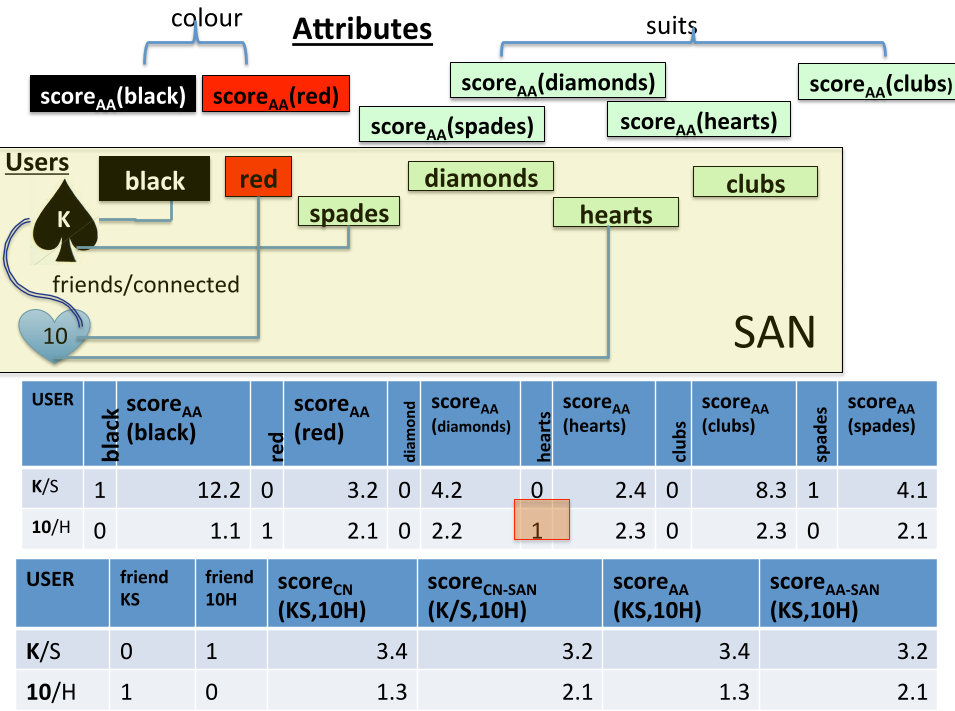
The methodology then builds a Forest of Decision Trees. For a specific user , the system asks: "If an adversary knows about you, with what confidence can they guess your confidential attribute ?"
Real-World Results: Metrics as "Snitches"
Using a real-world IT applicant dataset of 5,000+ users, the study reveals several startling patterns.
1. Attribute Inference
When users tried to hide specific education or employment history, the system found that metrics like mAA(u, a) (the Adamic-Adar score for that attribute) were often the top predictors. Effectively, your position in the social web "leaks" your attributes even if the attribute field itself is empty.
2. Connection Inference
For the top 5 most popular users in the dataset, the system identified that shared topological features were highly sensitive.
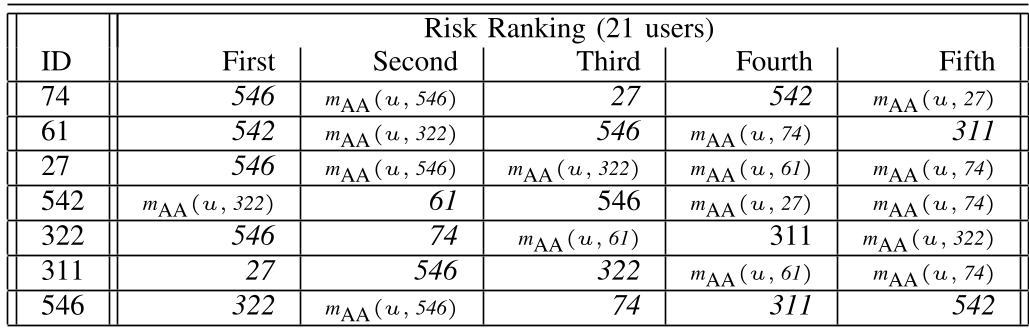 In the table above, we see how specific attributes like '546' and social metrics consistently rank as high-risk predictors across 21 different users.
Critical Insight: Personalization is Key
One of the paper's strongest contributions is the move away from "one-size-fits-all" privacy. In their "Southern Women" dataset illustration, they show that what is a "risky predictor" for one person might be safe for another.
Our traditional privacy settings are static; this proposed system is dynamic and advisory. Instead of just locking a door, it tells you: "Hey, leaving this specific window open allows someone to see into your safe."
Future Outlook and Limitations
While the paper provides a robust framework for identifying predictors, it faces the Hitting Set problem—an NP-complete challenge of finding the minimum number of attributes a user must change to become "safe." The authors use heuristics to solve this, but as social networks grow to the billions, the computational cost of building personalized forests for every user remains a hurdle.
Conclusion
This work shifts the privacy paradigm from passive protection to active Privacy Practice. By identifying "risky associations," we can finally give users a dashboard for their digital identity, allowing them to regulate the benefits of personalization without unknowingly surrendering their most private data to the machines.