
DAIC: Why Ignoring Time Might Be the Secret to Predicting Social Spreads
2015 IEEE/ACM International Conference on Advances in Social Networks Analysis and Mining 178
This paper introduces the Delay-Agnostic Independent Cascade (DAIC) model, a simplified probabilistic framework for learning transmission probabilities in social networks. By focusing on partial infection orders instead of exact timestamps, it achieves state-of-the-art performance in diffusion prediction on real-world datasets like Twitter and Memetracker.
Executive Summary
TL;DR: Modeling exactly when someone tweets is often a fool's errand. The Delay-Agnostic Independent Cascade (DAIC) model proves that by ignoring specific timestamps and focusing on the order of infections, we can identify social influence channels much more accurately than complex, time-sensitive models.
Background: Historically, social diffusion has been modeled as a ticking clock. This paper, presented at ASONAM, shifts the paradigm from "how fast does it spread" to "who is actually influencing whom," achieving massive gains in F1-scores across datasets like Twitter and Digg.
Problem & Motivation: The "Time" Trap
In classical epidemiology, the time between infections follows a predictable biological pattern. In social media, human behavior is chaotic.
- The Step-Size Dilemma: Discrete models like the original IC require a fixed "time step." Too short, and the model sees no connections; too long, and it groups everyone together.
- The Delay Noise: Models like NetRate try to learn continuous time delay distributions. However, human response times to a "meme" or "link" are nearly random, creating noise that drowns out the actual signal of who influenced the action.
The authors' insight: Influence is structural, while delay is incidental.
Methodology: The Core of Delay-Agnosticism
DAIC redefines the probability of a user being infected. Instead of looking at who was infected in the previous minute, it looks at the entire set of users infected anytime before .
1. The Likelihood Function
The model calculates the probability of an infection configuration by considering:
- Every infected user must have been triggered by at least one prior infection.
- Users who weren't infected resisted influence from all infected users in that episode.

2. Robustness via Regularization
Real-world data is imbalanced. If a "noisy" user appears once and is followed by many infections, a standard MLE might wrongly assign them a 100% transmission probability. DAIC solves this using MAP (Maximum A Posteriori) estimation with an exponential prior, favoring sparse, high-confidence influence channels.

Experiments & Results
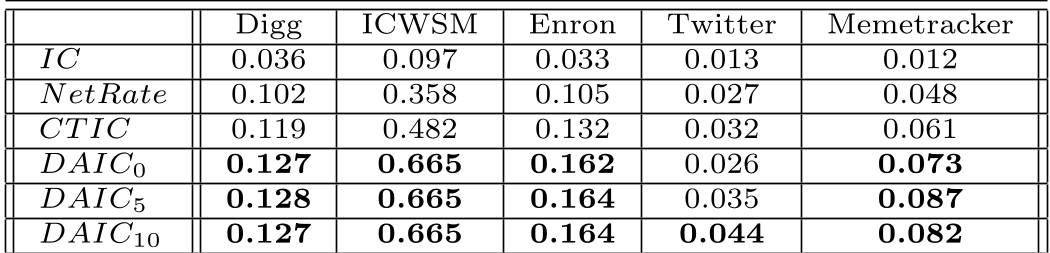
The authors tested DAIC against Continuous-Time IC (CTIC) and NetRate across five diverse datasets.
Significant Performance Gains
On nearly every dataset, DAIC provided a clearer picture of the network's diffusion potential.
- ICWSM (Blogs): DAIC reached 0.665 F1, whereas the time-continuous CTIC only managed 0.482.
- Twitter: High noise from "rare users" made standard models fail. By applying regularization, DAIC recovered the signal, outperforming every baseline.
The Power of Regularization
The "Ablation" of the parameter shows that as we move to larger, noisier networks like Memetracker, the need for the exponential prior increases. It forces the model to ignore coincidental overlaps and focus on repeatable influence patterns.
Critical Analysis & Conclusion
Takeaway: DAIC demonstrates that structural relationships in social data are more resilient than temporal ones. For tasks like Buzz Prediction or Leader Identification, knowing the "social weight" between two people is more valuable than knowing if they react in 5 minutes or 5 hours.
Limitations:
- DAIC is not designed for "Real-time" forecasting (e.g., "how many will be infected by 5:00 PM today?").
- It treats all prior infections as equally likely sources, which might not hold in very long-duration cascades where interest decays.
Future Outlook: This approach paved the way for "representation learning" in social networks (Embeddings), where the focus shifted entirely to the latent topology rather than the clock.