
The Professional's Playbook: Deciphering Cross-Posting Strategies Across Major OSNs
2015 IEEE/ACM International Conference on Advances in Social Networks Analysis and Mining 645
This paper presents a large-scale measurement study of "cross-posting" behavior—publishing identical content across multiple platforms—among 616 professional users (companies, celebrities, politicians) on Facebook (FB), Twitter (TW), and Google+ (G+). Using a hierarchical string-matching algorithm, the authors analyzed 2M+ posts to characterize platform preferences and the impact of cross-posting on user engagement.
TL;DR
Is cross-posting a "lazy" strategy that hurts your brand, or a smart way to maximize reach? This large-scale study analyzes 2 million posts from 616 professional accounts. The verdict: it works wonders for Twitter and Facebook, doubling engagement in some cases, but it effectively "kills" reach on Google+.
Problem & Motivation: The Multi-Platform Dilemma
For professional entities—brands, politicians, and celebrities—social media is a full-time job. With the fragmentation of the digital landscape, the cost of creating unique content for every platform (Facebook, Twitter, G+) is astronomical.
The authors observed that most professionals maintain accounts across all major Online Social Networks (OSNs). This leads to a critical research question: Do these power users treat each platform as a unique community, or do they use them as a synchronized megaphone? Understanding this "cross-posting" behavior reveals the underlying logic of professional digital marketing.
Methodology: Identifying the "Digital Echo"
To track posts across platforms, the researchers implemented a robust hierarchical classification algorithm. Since a tweet might slightly differ from a Facebook post (due to character limits or link formatting), a simple string match isn't enough.
- Fuzzy Matching: Initial sweep to catch near-identical text.
- Dual-Metric Validation: Comparing the remaining posts using both Cosine Similarity (vector-based) and String Similarity.
- Temporal Windowing: Comparing posts within a ±7-day window.
The team validated this against 12,800 manually labeled posts, achieving an impressive 99% accuracy.
 Table: The threshold of 0.5 for similarity metrics provided the optimal balance between False Positives and False Negatives.
Key Insights: Where Does the Content Start?
The study found that cross-posting is a core pillar of professional strategy.
- The Power Duo: 70% of cross-posted content happens specifically between Facebook and Twitter.
- The Source Split: Users are almost equally divided; 50% prefer starting on Facebook and pushing to Twitter, while 45% do the reverse.
- Automation is Real: approximately 5.3% of posts are published at the exact same second across platforms, proving the widespread use of scheduling tools.
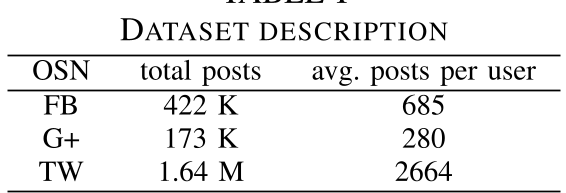 Table: While Twitter has the highest raw volume of posts, Facebook remains a critical hub for cross-post initiation.
The Engagement Trap: Winners and Losers
The most shocking discovery was the disparity in how audiences react to "recycled" content.
- Twitter & Facebook: Cross-posting is a massive win. A cross-post on Twitter attracts 2.47x more likes and 2.1x more retweets than a standard tweet.
- Google+: A complete failure. Non-cross-posts (original content) attract 2x to 3x more engagement than cross-posts.
The data suggests that the Google+ community (at the time of the study) was highly sensitive to "broadcasted" content, while FB/TW audiences rewarded the high-quality, professional-grade information that was typically being cross-shared.
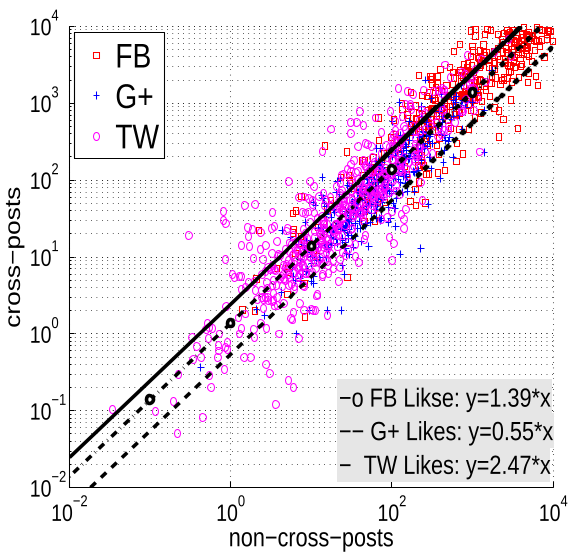 (a) Likes/Favorites: Note the steep upward slope for Twitter and Facebook, indicating higher engagement for cross-posts.
Critical Analysis & Conclusion
This research highlights a significant Inductive Bias in professional social media management: platforms are often treated as technical pipes rather than social communities.
Takeaways for Modern Social Media:
- Synergy is Key: FB and TW have a high degree of "content compatibility." Professional users can safely sync these two platforms to double their footprint without alienating their audience.
- Platform Purism: Platforms like Google+ (and perhaps modern equivalents like Reddit or Discord) require a "native-first" approach. Simply dumping links from other platforms leads to a significant drop in user resonance.
Limitations: The study relies on data from 2013-2015. While the structural behavior of cross-posting remains relevant, the rise of algorithmic feeds (compared to the chronological feeds analyzed here) might penalize unoriginal content more severely today than it did then. Future research should look at the "cross-posting penalty" in the age of AI-curated discovery.