
Beyond the Average: A Non-Linear Perspective on How Opinions Converge
2015 IEEE/ACM International Conference on Advances in Social Networks Analysis and Mining 872
This paper introduces a discrete-time, non-linear, and time-variant model of opinion formation in social networks. By utilizing a weight-updating rule where influence decreases continuously with the distance between agents' beliefs, the authors demonstrate that global interactions lead to a consensus that deviates from a simple arithmetic mean as the number of agents increases.
TL;DR
How does a group of people reach a consensus? Traditional models suggest we simply "average out" our differences. This paper proves that's rarely the case. By introducing a model where trust is a continuous function of how much we agree (homophily), researchers found that consensus in groups of three or more follows a complex third-degree polynomial relationship, meaning initial extremist or moderate positions have a disproportionate impact on the final outcome.
Problem & Motivation: The Flaws of "Binary Trust"
In the study of social dynamics, there are two primary schools of thought:
- Bayesian Rationality: Agents are perfect calculators. (Reality: Humans are not).
- Bounded Rationality: Agents use "rules of thumb" to update beliefs (e.g., the DeGroot model).
However, even bounded rationality models like the famous Hegselmann-Krause (HK) model have a major flaw: they use a binary "confidence threshold." If someone’s opinion is 0.01 beyond your threshold, you ignore them completely; if it’s 0.01 inside, you weigh them fully. This paper rejects this "cliff-edge" logic, proposing instead that trust should fade gradually as opinions diverge.
Methodology: The Homophilous Updating Rule
The authors define a row-stochastic interaction matrix where the weight given to agent by agent is:
eq i} [p_i(t) - p_j(t)]^2}$$ ### Why this matters: * **Global Interaction**: Unlike bounded confidence models, everyone talks to everyone, but the "volume" of their voice depends on how much you already agree with them. * **Non-Linearity**: Because the weights change as opinions move closer, the system is dynamic and non-stationary.  *The core formula representing the non-linear updating rule based on squared distances.* ## Experiments & Results: The Death of the Simple Mean The authors used computational simulations to track how beliefs evolve over time. They found that for $n=2$, the result is a boring arithmetic mean. But for $n=3$ and higher, things get interesting. ### 1. Exponential Convergence By fitting trajectories to exponential functions, they found that agents reach consensus extremely quickly—often within 7 time steps—following a single exponential decay curve ($R^2 > 0.999$). ### 2. The Polynomial Deviation The most striking finding is in the "deviation from the mean." In a three-agent system ($x_0, y_0, z_0$), the final consensus $p^*$ is not $(x_0+y_0+z_0)/3$. Instead, the deviation follows a third-degree polynomial: $$p^* - p_{mean} = \sum P_{kl} u_0^k v_0^l$$ where $u_0$ and $v_0$ are the pairwise differences of initial beliefs. 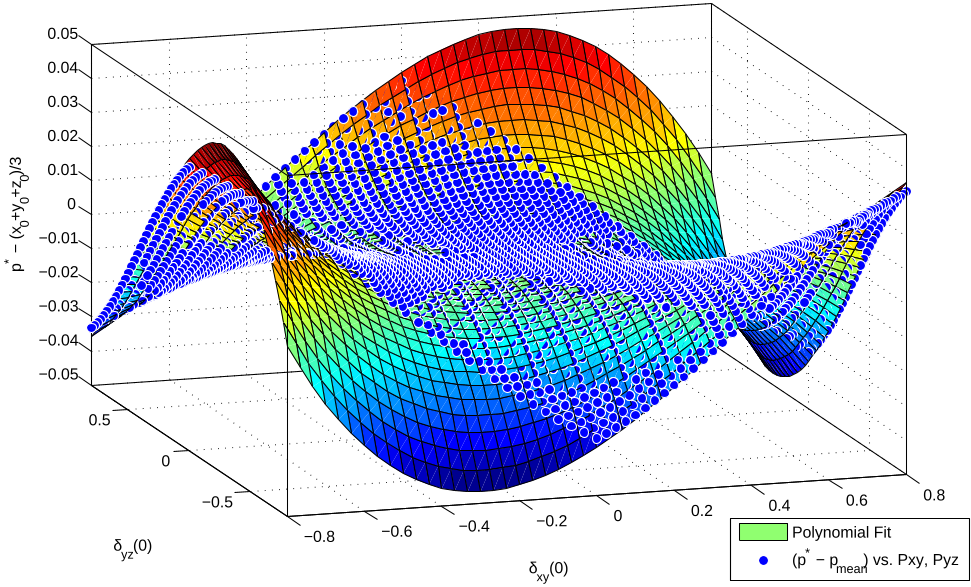 *Visualizing the third-degree polynomial fit of the consensus deviation.* ## Critical Analysis & Conclusion ### Takeaway This research moves us closer to a realistic "Physics of Society." It shows that "who says what" at the start of a debate matters more than we thought, particularly when trust is conditional on agreement. ### Limitations * **Fully Connected Network**: The model assumes a "global interaction" where everyone can see everyone else. In the real world, network topology (who is actually friends with whom) would add another layer of complexity. * **Bounded Opinions**: The model operates in a $[0, 1]$ belief space. Radicalization that goes beyond these bounds (e.g., negative beliefs) is not captured. ### Future Work The authors suggest that providing formal analytical proofs for these experimental polynomial relations is the next "Holy Grail" in opinion dynamics research. If we can solve the polynomial for $n$ agents, we can mathematically predict the "inevitable" conclusion of a group discussion before it even begins.