
Disruptive Event Detection: Boosting Situational Awareness via Twitter Analytics
2015 IEEE/ACM International Conference on Advances in Social Networks Analysis and Mining 934
The paper presents an optimized framework for identifying "disruptive events" (e.g., labor strikes, fires, terrorist attacks) using Twitter data. By employing an unsupervised feature selection algorithm and evaluating temporal, spatial, and textual dimensions, the authors achieved a SOTA identification accuracy of 83.27% on a real-world dataset.
TL;DR
In the era of instant information, social media has become a primary "signals intelligence" source. This paper introduces an optimized framework to filter the noise of Twitter and identify Disruptive Events—incidents that threaten social safety or order. By refining feature selection across temporal, spatial, and textual domains, the researchers achieved an 83.27% accuracy, providing a blueprint for emergency managers to react to real-world crises in real-time.
Problem & Motivation: Finding the Signal in the Noise
Emergency managers and policy makers face a "data deluge." While Twitter offers real-time updates on fires, strikes, or attacks, most tweets are mundane. The challenge lies in differentiation: How can we distinguish a "normal" event (like a scheduled concert) from a "disruptive" one (like a riot or a natural disaster)?
Previous methods often struggled with the high dimensionality of social media data, leading to overfitting or high computational costs that prevent real-time response. The authors suggest that by identifying the specific "DNA" of a disruptive event—how it moves through time, where it happens, and the specific language used—we can build more efficient and accurate detectors.
Methodology: The Three Pillars of Detection
The core of the paper is the optimization of feature selection using the Maximal Information Compression Index (MICI). The authors categorize features into three types:
- Temporal Features: They discovered that a 1-hour time window is the "sweet spot." It provides a sufficient lead-in time to capture event dynamics while drastically reducing processing time compared to one-minute intervals.
- Spatial Features: Surprisingly, City-level geolocation data performed better than neighborhood-level data. Users often use city hashtags (#AbuDhabi) rather than hyper-local landmarks, making intermediate granularity more reliable for event identification.
- Textual Features: Beyond simple word counts, the model looks at Retweet ratios (diffusion speed), Hashtag/URL ratios (credibility and discoverability), and Negative Sentiment.
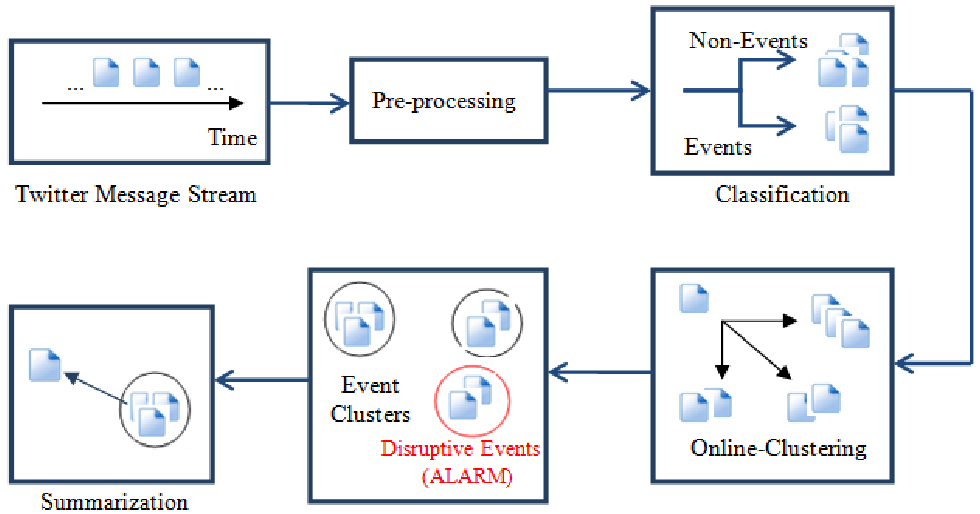 Figure 1: The five-step framework used to process the Twitter stream for situational awareness.
Experiments & Results: The Power of Negative Sentiment
The researchers tested their framework on a dataset of nearly 1.7 million tweets surrounding the 2013 Abu Dhabi Grand Prix.
Key Insights:
- Temporal Dominance: Temporal features alone outweighed spatial or textual features in predictive power.
- The "Disruption" Marker: Negative sentiment was far more predictive for disruptive events than positive or neutral sentiment. This confirms the intuition that crises are articulated through language describing "danger," "delay," or "horror."
- Optimization Success: By discarding low-impact features (like "favorite ratio"), the authors created an "Optimized Model" that outperformed the dense model, proving that in real-time systems, less is often more.
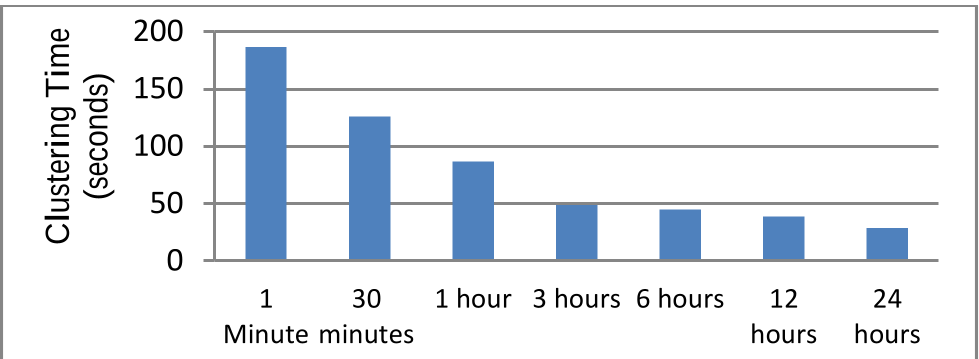 Figure 2: The trade-off between clustering accuracy and running time across different temporal granularities.
| Feature | F-measure Improvement over Baseline |
|---|---|
| Retweet Ratio | +3.43 |
| Dictionary-based (Trigger words) | +3.29 |
| Hashtag Ratio | +2.99 |
| Negative Sentiment | +1.69 |
Critical Analysis & Conclusion
This work highlights that Situational Awareness is not just about what is being said, but how fast it spreads and the emotional intensity of the crowd.
Takeaway: For tech leaders building monitoring tools, the focus should be on Negative Sentiment + Rapid Diffusion. If a cluster of tweets in a specific city suddenly turns negative and the retweet count spikes within an hour, it is a high-probability disruptive event.
Limitations: The study relies on users providing accurate locations, but only about 12.7% of users provide city-level data. Future work needs to bridge this "geospatial gap" perhaps through improved Named-Entity Recognition (NER) or IP-based estimation.
Future Outlook: Integrating these algorithms with official "terrestrial" intelligence could create a hybrid system that is both grounded in fact and responsive to the real-time pulse of the public.