
Beyond Ratings: Dynamic Entropy-Weighted Multi-Source Information Fusion
2016 IEEE International Conferences on Big Data and Cloud Computing (BDCloud), Social Computing and Networking (SocialCom), Sustainable Computing and Communications (SustainCom)
This paper introduces an advanced Multi-Source Information Fusion recommendation framework that integrates collaborative filtering, temporal behavior modeling, and trust evaluation. By employing an Entropy-based weighting mechanism, the system dynamically balances different data sources to significantly improve recommendation precision and F1-score.
TL;DR
This research tackles the stagnation in recommendation accuracy by moving beyond simple matrix factorization. It introduces a tripartite fusion framework—incorporating Collaborative Interest, Temporal Decay, and User Trust—all governed by an innovative Entropy-based weighting mechanism that dynamically adjusts to data quality.
Context & Motivation
Most industrial recommenders face the "Cold Start" and "Noisy Data" dilemma. If a user has few ratings, similarity-based models fail. If a user provides inconsistent feedback, the model's reliability plummets. The authors argue that recommendations should be viewed through the lens of Information Theory: we shouldn't just aggregate data; we should weight it based on its "certainty" or information gain.
Methodology: The Fusion of Three Pillars
The core of the paper lies in the unified predicted rating formula:
1. Refined Collaborative Similarity
The methodology starts by enhancing the Pearson Correlation Coefficient with a factor that accounts for the density of common ratings () and review frequency ().

2. The Temporal Dimension
Interests fade and evolve. The paper models the time interval using a Log-Normal Distribution. This captures the "burst" nature of user activity more accurately than simple linear decay functions.

3. Trust-Aware Filtering
By calculating a reputation score (), the system can down-weight users who exhibit erratic behavior or anomalous rating patterns, making the system robust against manipulation.
4. Adaptive Entropy Weighting (The Secret Sauce)
The most technical contribution is the use of Shannon Entropy to determine the weights (). If a specific data source (e.g., temporal data) is highly chaotic, its entropy is high, and the system automatically reduces its influence.

Experimental Validation
The authors validated the framework using standard Precision-Recall and F1-score metrics. The results indicate that the fusion of three sources consistently surpasses single-source or dual-source models.
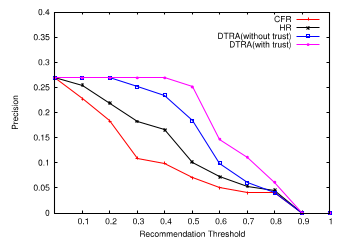 Figure: The precision increases as the number of fused sources (M) optimizes, demonstrating the effectiveness of the entropy-driven approach.
Critical Analysis & Conclusion
Takeaway
The paper effectively demonstrates that "more data" isn't enough; "smarter weighting" of that data is what drives SOTA performance. The use of Entropy to handle uncertainty is a mathematically grounded solution to the variance found in real-world user data.
Limitations
- Computational Overhead: Calculating entropy-based weights in real-time for millions of users may require significant optimization.
- Parameter Sensitivity: The factor in the similarity formula requires careful tuning to balance rating value versus rating frequency.
Future Outlook
This framework provides a solid foundation for Cross-Domain Recommendations, where entropy could be used to decide how much knowledge from a "Source Domain" (e.g., Book reviews) should be transferred to a "Target Domain" (e.g., Movie reviews) based on the clarity of the user's signal.