
Against the Others! Detecting Moral Outrage Through the Lens of Linguistic Shifts
2020 IEEE/ACM International Conference on Advances in Social Networks Analysis and Mining (ASONAM)
The paper introduces a novel change detection framework to identify "online firestorms" (outbreaks of moral outrage) on Twitter. By combining network metrics like maximum in-degree with linguistic cues from the LIWC tool, the authors achieve early and precise detection of negative social dynamics.
TL;DR
Online firestorms—those sudden, aggressive bursts of collective outrage—can devastate reputations and incite real-world harm. This paper presents a methodology to detect these outbreaks early by monitoring not just volume, but the subtle "linguistic fingerprints" of the crowd. By tracking the decline of "I" and "positivity" alongside the rise of "netspeak," the researchers can pinpoint the start of a firestorm within minutes.
The "Linguistic Flare": Why Traditional Monitoring Fails
Most social media monitoring tools wait for a hashtag to trend or a volume spike to occur. However, by the time a topic is "trending," the firestorm is already at its peak. The authors argue that the true transition happens in the psychology of language.
Before a firestorm, users speak from an individual perspective ("I think..."). As outrage takes hold, they move toward a collective, aggressive stance ("Against the others!"). This transition leaves a measurable trail in lexical choices that precedes the massive surge in tweet volume.
Methodology: Monitoring the Pulse of the Crowd
The study analyzed 21 verified Twitter firestorms using two distinct lenses:
- Network Metrics: Specifically monitoring the
maximum in-degree(how many people are mentioning/attacking a single user). - Linguistic Cues: Using the LIWC (Linguistic Inquiry and Word Count) tool to categorize words into psychological dimensions.
The Change Point Detection Algorithm
To handle real-time data, the researchers employed the Pruned Exact Linear Time (PELT) method. This allows the system to analyze 15-day sliding windows in half-hour increments without the computational lag of traditional segmentation algorithms.
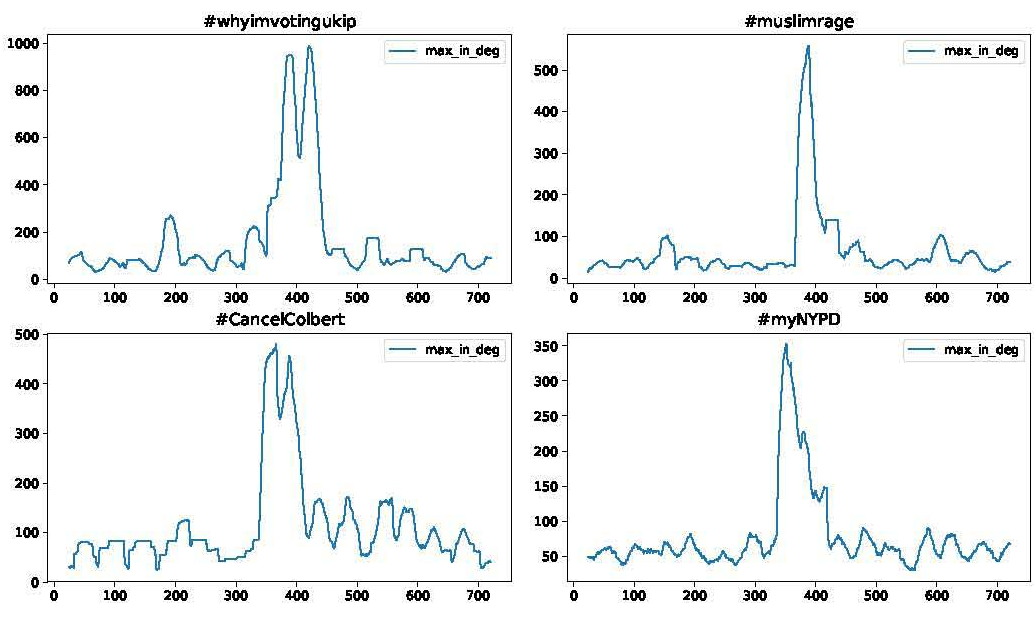 Above: The sharp spikes in Maximum In-Degree indicate the moment a specific target is "set upon" by the crowd.
Key Findings: The Anatomy of Outrage
The study revealed a fascinating and consistent pattern across nearly all 21 firestorms:
- The Vanishing "I": Use of first-person singular pronouns (me, my, mine) drops significantly. People stop being individuals and join the mob.
- The Death of Positivity: Words like 'nice', 'love', and 'sweet' (the
posemocategory) vanish almost entirely. - The Rise of Netspeak: Informal, rapid-fire language and "netspeak" (idk, lol, etc.) surge as the emotional tempers flare, indicating high-arousal states.
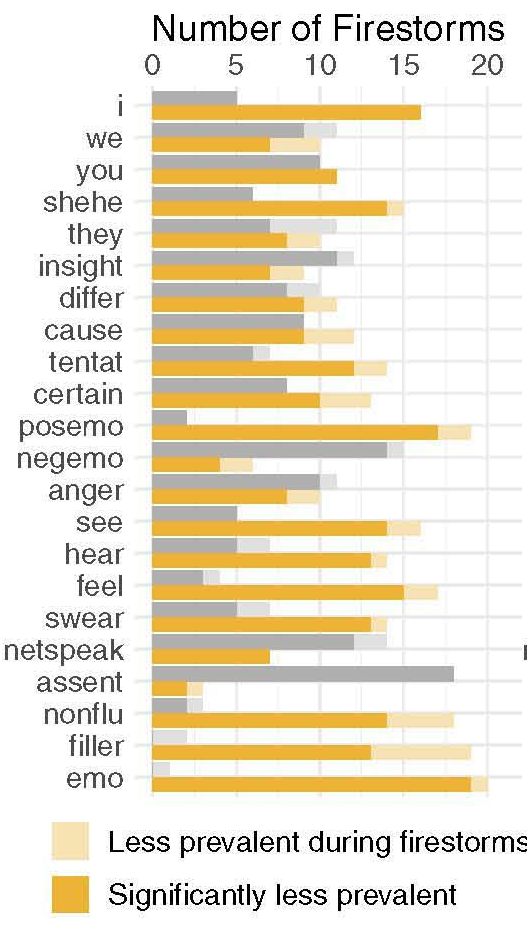 Fig 2: Grey bars show increases in frequency, orange shows decreases. Note the overwhelming significant decrease in 'I' and 'posemo' during outrages.
Experimental Results
The PELT-based detection was remarkably precise. By simulating a streaming environment, the authors found that identifying change points in categories like netspeak and I allowed them to approximate the "firestorm peak" within 0.14 ± 1.30 hours.
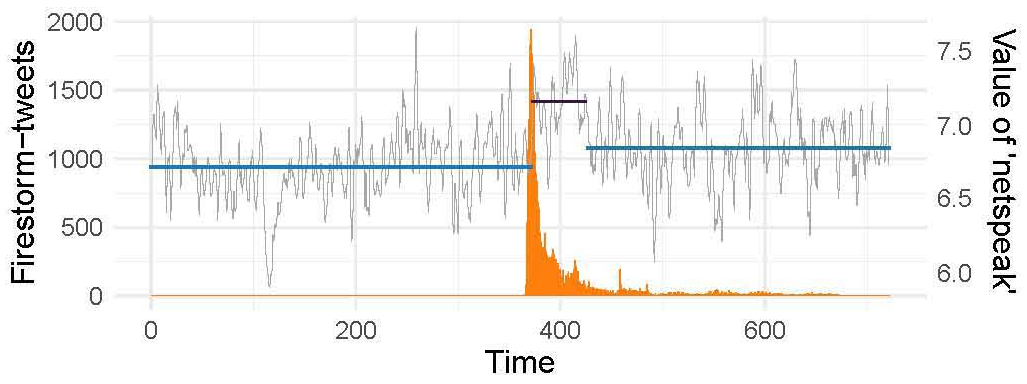 The PELT algorithm identifying the exact moment of linguistic shift just as the firestorm (blue bars) begins to climb.
Critical Insight & Conclusion
The significance of this work lies in its efficiency. Monitoring lexical features requires constant, low memory overhead, making it ideal for "edge" social sensors.
Takeaway: If you want to know if a crisis is brewing, don't just count the tweets—look at the pronouns. When the "I" disappears and the "Positive Emotion" fades, the "Moral Outrage" has already begun.
Limitations: The study relies on the "decahose" (10% sample), which might miss smaller, niche firestorms. Furthermore, while the detection is "early," the authors acknowledge that identifying why a firestorm is happening still requires human-in-the-loop qualitative analysis.