
Local Government on Facebook: Passive Broadcasting or Active Engagement?
2329_An Empirical Analysis of Social Media Usage by Local Governments in Portugal.
This paper presents an empirical analysis of Facebook usage by all 308 Portuguese local governments to identify determinants of social media activity and engagement. Using a political market framework, it establishes that larger, wealthier municipalities with left-wing leadership and higher transparency levels are the most active on Facebook.
TL;DR
Local governments are flocking to Facebook, but they aren't necessarily "talking" to you. Analyzing all 308 Portuguese municipalities, this study reveals that while the majority have an online presence, they use it primarily as a digital bulletin board. The true drivers of social media activity aren't just money; they are political competition, transparency commitments, and mayoral age.
Problem & Motivation: The Digital Divide in Governance
Governments worldwide have adopted Social Networking Sites (SNS) under the promise of "Open Government"—a paradigm of transparency and collaboration. However, the reality is often less revolutionary.
The authors identify a gap in the literature: we know that governments use social media, but we don't fully understand why some are hyper-active while others remain silent. They propose that this activity is a result of a Political Market:
- Supply-side: Do mayors want to share information? Does the institution have the capacity?
- Demand-side: Is the local population tech-savvy and demanding transparency?
Methodology: Mapping the Political Market
The study utilized a dataset of 55,781 posts from 290 active Portuguese municipalities over three months in 2016. The researchers employed a multi-variable OLS regression to test 13 hypotheses.
Key Metrics:
- Activity: Post count (Natural log).
- Engagement: Number of Likes, Comments, and Shares.
- Supply Determinants: Municipal Transparency Index (MTI), Political Partisanship, Margin of Victory, and Mayoral characteristics (Age, Education, Gender).
- Demand Determinants: Population size, Purchase Power, and Education.
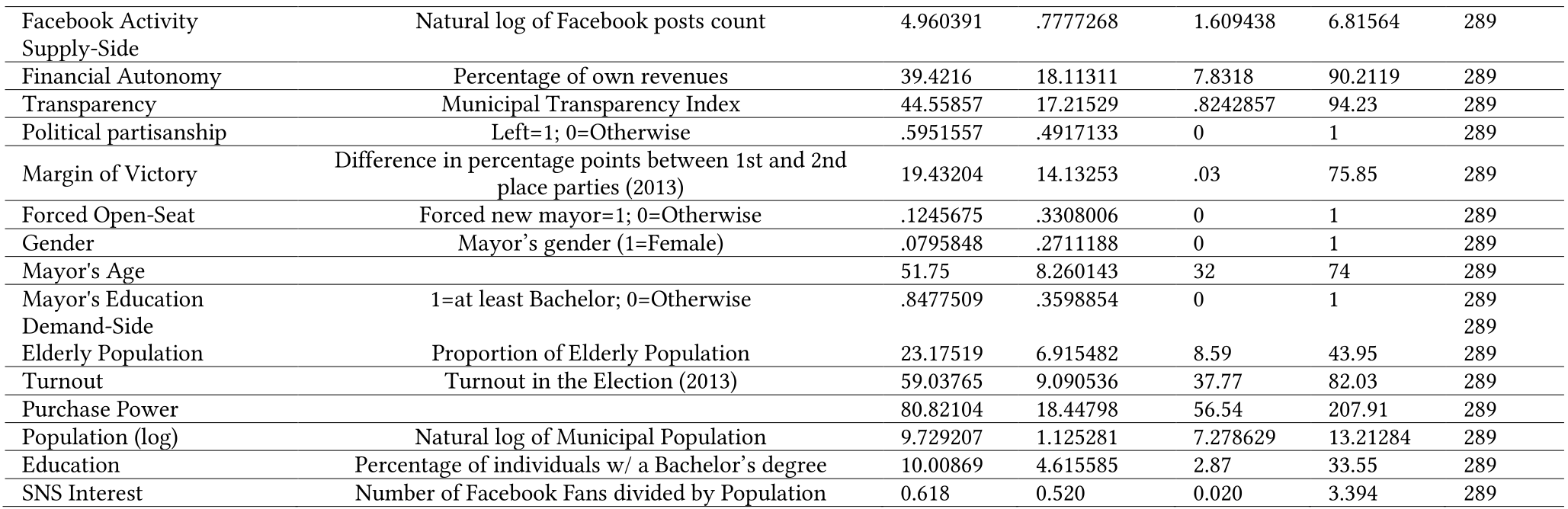
Findings: Who Posts More?
The empirical results challenge some common assumptions while confirming others:
- Transparency Breeds Activity: Municipalities that already prioritize transparency (high MTI scores) are significantly more active on Facebook. It acts as an extension of their existing institutional culture.
- The "Lazy" Incumbent Effect: Politics matters. When a mayor wins by a large margin (low competition), they post less. High political competition forces incumbents to use Facebook as a tool for visibility and accountability.
- Partisanship Matters: Left-wing governments in Portugal were found to be approximately 13% more active on Facebook, often viewing it as a tool for public service and social inclusion.
- Age over Budget: Interestingly, a municipality's "Financial Autonomy" (its own revenue) was not a strong predictor. Instead, younger mayors were significantly more likely to drive higher social media activity.
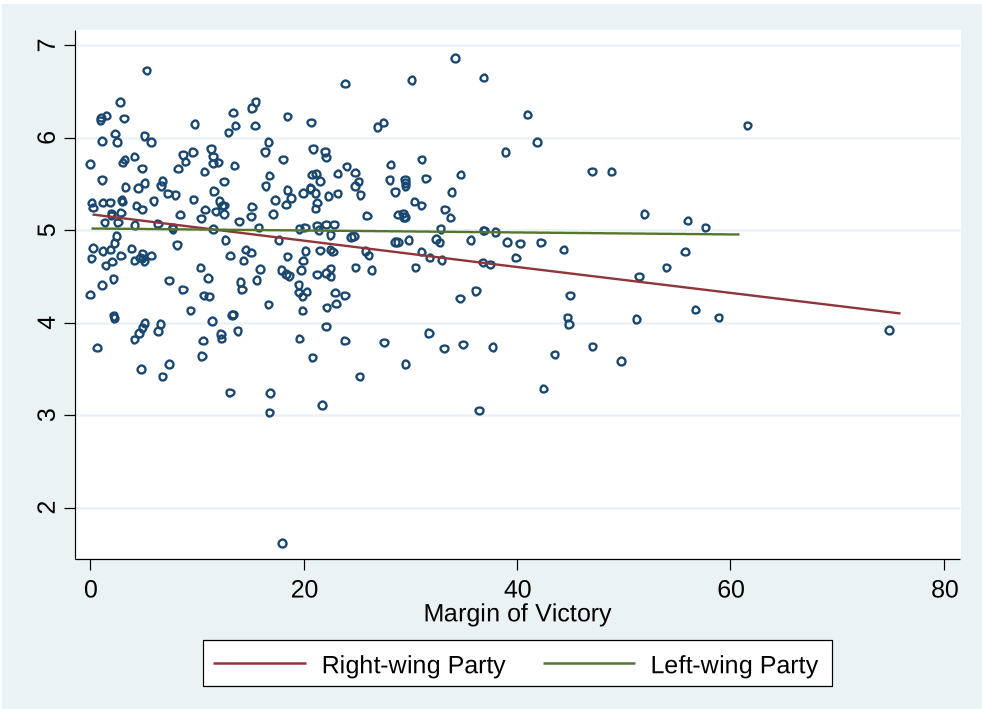 Above: The interaction between political competition and partisanship shows that right-wing governments are particularly sensitive to electoral pressure.
The Engagement Reality Check
Despite the volume of posts, "Engagement" remains shallow. The average number of comments per post across Portugal was less than one.
- Likes and Shares are the dominant forms of interaction.
- Only 5.6% of posts focused on actual civic participation (like participatory budgeting).
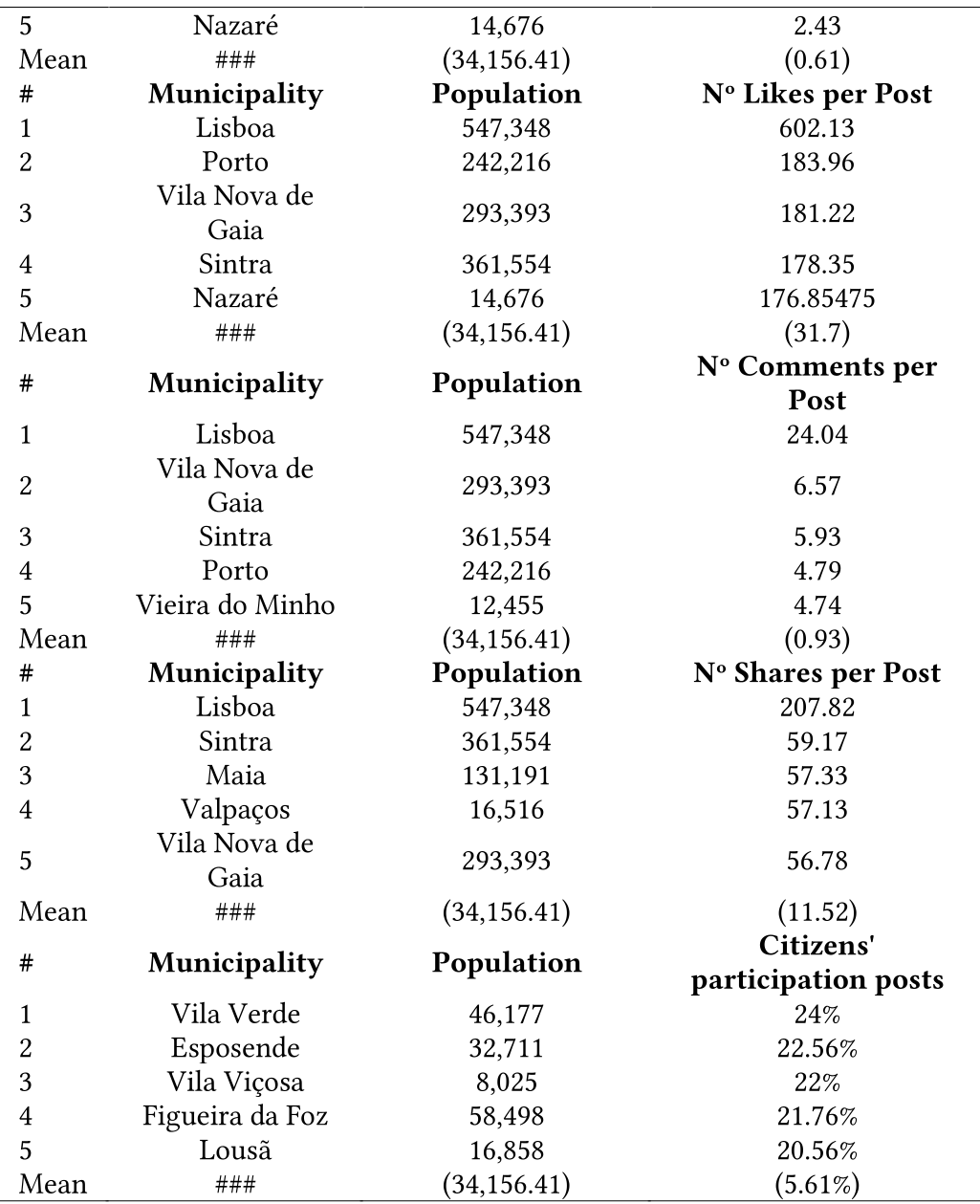 Lisbon stands as a major outlier, dominating engagement metrics in terms of Likes, Comments, and Shares.
Critical Insights & Takeaways
This research provides a sobering look at "E-charade" vs. "E-participation."
Key Takeaways:
- Facebook as a Mega-phone: Local governments are currently using SNS for one-way information dissemination. The "social" in social media is largely missing from the government side.
- Incentives for Innovation: If we want more active digital governments, we need healthy political competition and a culture of transparency. Wealth alone doesn't make a government more communicative.
- Limitations: As a single-country study, local Portuguese political culture (such as the Socialist vs. Social Democratic dynamics) heavily influences the results.
Future Outlook: The next frontier of research will be analyzing the content of these posts using Natural Language Processing (NLP) to determine if the quality of information correlates with citizen trust.