
Evolution Matters: Why Growing Networks Disseminate Content Faster
2507_Evolution Matters Content Transmission in Evolving Wireless Social Networks.
This paper presents the first comprehensive study of content transmission time in Evolving Wireless Social Networks (EWSNs). Using the Affiliation Network model to capture real-world structural dynamics like densification and shrinking diameters, the authors derive theoretical bounds for transmission time in both static and mobile scenarios, demonstrating that network evolution significantly accelerates information diffusion.
TL;DR
While most researchers treat network growth as a challenge to be managed, this paper proves it is actually an advantage. By analyzing "Evolving Wireless Social Networks," the authors demonstrate that as social ties densify and diameters shrink, content transmission time drops significantly compared to static models. They provide a rigorous mathematical framework covering both static and mobile users, backed by real-world data.
The Evolution Trap: Why Static Models Fail
In the world of wireless social networks (like sharing a viral video via D2D in a crowded stadium), we usually assume the "graph" is fixed. But real networks like Facebook or Instagram grow constantly. This growth isn't just about adding more dots; it’s about densification (edges grow faster than nodes) and shrinking diameters (everyone gets "closer").
The authors argue that if we ignore these evolution properties, our transmission schemes are inefficient. They ask a fundamental question: Does a network getting bigger actually make it faster at spreading information?
Methodology: The Social-Physical Coupling
The researchers use a dual-layer approach:
- Social Layer (Affiliation Model): Uses a bipartite graph of users and groups. New users join by picking "prototypes," leading to a power-law degree distribution.
- Physical Layer (Protocol Model): Users occupy a space that expands as new users join (extended network).
The Static Scheme: Highway to Efficiency
For static users, they design a "Request Tree" system. When you want a video, you check your social neighbors within hops. If a neighbor has it and is physically within distance , you request it. To prevent popular users from being overwhelmed, a balanced binary tree handles load balancing.
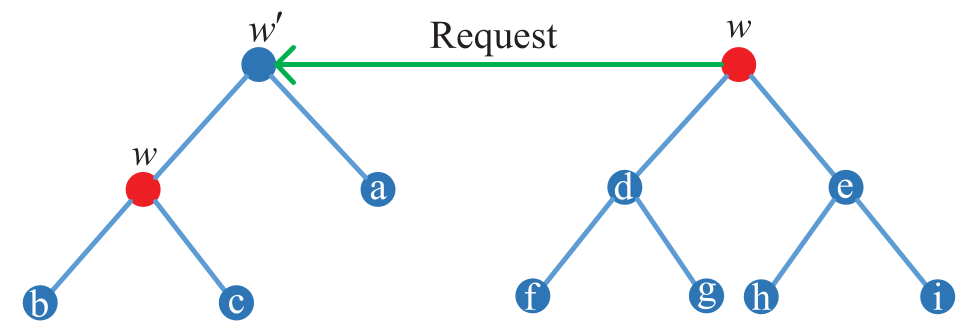 Fig 1: The load-balancing request tree ensures no single node becomes a bottleneck.
The physical transmission is handled by a Highway System—a grid of relay nodes that treat the network like an interstate, moving data across long distances at constant rates.
Mathematics of Intuition: The Microscopic Property
The paper’s core breakthrough is proving the "microscopic property." They found that the number of neighbors within hops in an evolving network is drastically larger than in a static one ( vs. ).
The physical intuition: Because you have more social neighbors in an evolving network, you are more likely to find one who is physically close to you. This allows the system to use a smaller geographic range (), which reduces interference and allows more "conversations" to happen simultaneously across the network.
Experimental Validation
Using synthetic data and real-world check-in data from Gowalla and Brightkite, the authors validated that:
- Social Depth () is king: Searching just 2 or 3 hops away socially reduces transmission time exponentially.
- Evolution Gain: Evolving networks consistently beat "BA-model" (non-evolving) networks.
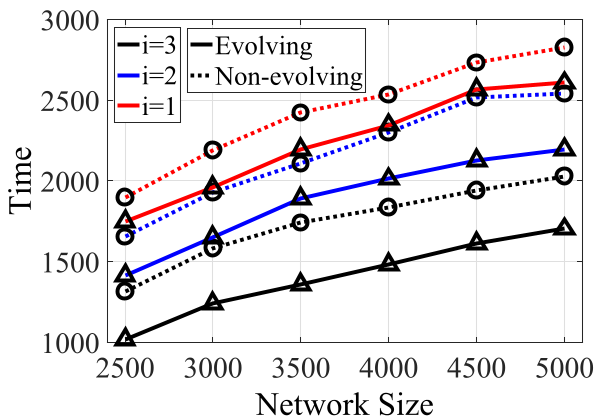 Fig 2: Transmission time comparison showing the consistent advantage of evolving networks.
Critical Insight & Conclusion
This paper shifts the perspective from viewing network growth as a scaling problem to viewing it as a diffusion opportunity. By bridging the gap between graph theory (Affiliation Networks) and wireless physics (Protocol Model), it provides a blueprint for next-generation D2D sharing protocols.
Limitations: The model assumes users only join. In reality, users leave (churn), and social interests shift. Future work needs to address "network decay" alongside "network evolution" to complete the picture of human interaction.