
WisPaper: Redefining Academic Discovery with Agentic Reasoning and Closed-Loop Curation
2512.06879v1
WisPaper is an integrated academic retrieval and literature management platform that combines agent-powered "Deep Search," systematic library organization, and automated "AI Feeds." It introduces WisModel, a specialized LLM trained via Group Relative Policy Optimization (GRPO), achieving state-of-the-art performance in complex scholarly query understanding and paper-criteria validation.
TL;DR
The Fudan NLP Lab has unveiled WisPaper, an intelligent scholar search engine that bridges the gap between searching for papers and managing a research library. Unlike standard keyword search tools, WisPaper features an autonomous agent powered by WisModel, which can decompose complex research questions into structured criteria and evaluate papers with superhuman nuance. It achieves a staggering 93.7% overall accuracy in paper validation, far surpassing proprietary giants like GPT-5 and Gemini-3-Pro.
Background: The Fragmented Researcher Workflow
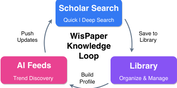
Most researchers currently inhabit a fragmented digital ecosystem: searching on Google Scholar, visualizing networks on Connected Papers, and managing citations in Zotero. This "stitching" of tools is inefficient. Moreover, keyword-based search fails when a researcher seeks conceptual insights (e.g., "how does X affect Y?") rather than specific titles. WisPaper aims to consolidate this into a single "Knowledge Loop".
Methodology: High-Precision Agentic Search
The scientific heart of WisPaper is its Deep Search module. This is not just a chatbot interface; it is a multi-stage reasoning agent:
- Query Understanding: The model decomposes a natural language query into specific Validation Criteria (e.g., Task, Methodology, Dataset) and weighted importance levels.
- Paper Validation: The agent scans metadata and abstracts, judging each paper against the criteria using a four-tier taxonomy: Support, Somewhat Support, Reject, or Insufficient Information.
The Secret Sauce: GRPO Training
To achieve this level of accuracy, the developers used Group Relative Policy Optimization (GRPO). This reinforcement learning technique optimizes WisModel's ability to distinguish between "Full Support" and "Somewhat Support"—a boundary where most general-purpose LLMs fail.
Experimental Results: Nuance is the New Frontier
WisPaper was tested across 10 academic disciplines, from Computer Science to Psychology. The results highlight a critical weakness in current SOTA models: nuance.
- The "Nuance Gap": While models like Gemini-3-Pro are excellent at finding "Perfect Matches" (91.1%), they are terrible at identifying papers that only partially address a topic (only 15.9% accuracy).
- WisModel's Dominance: WisModel maintained over 91% accuracy across all categories, including the difficult "somewhat support" cases.
(Note: Table 3 in the paper shows WisModel's 93.7% overall accuracy vs. the 73.2% of the best baseline.)
Beyond Search: AI Feeds and Library Management
WisPaper isn't just a search bar; it’s a living repository.
- Library: A hierarchical system that supports direct PDF uploads and automatic metadata extraction.
- AI Feeds: A personalized recommendation engine that learns from your library. It filters the 50-100 daily papers in your field down to the ~5 most relevant matches based on your "interest profile."
Critical Insight: The Shift from Retrieval to Reasoning
The true value of WisPaper lies in its transition from Retrieve-then-Rank to Reason-then-Verify. By allowing researchers to "collaborate" with the agent—refining the validation criteria in real-time—it transforms the search process into an active dialogue.
Limitations & Future Work
While WisModel is powerful, it currently relies on metadata (abstracts/titles) for validation. Future iterations that incorporate full-text parsing could resolve "Insufficient Information" cases. However, as it stands, WisPaper represents a major step toward a world where AI doesn't just find papers, but understands the research intent behind the query.
Senior Editor's Take: WisPaper is a masterclass in applying specialized RL fine-tuning (GRPO) to a high-stakes professional domain. It proves that for academic work, "generalist" models are no longer sufficient; we need "scholarly" agents that can navigate the gray areas of scientific evidence.