
Beyond Triads: Generating Realistic Social Networks with Hierarchical Communities
2894_Model for generating artificial social networks having community structures with small-world and scale-free properties
The paper introduces a novel network generation model designed to create artificial social networks that simultaneously exhibit small-world properties, scale-free degree distributions, and explicit community structures. The method moves beyond simple triad formation by using a clique-based initialization and a cluster-tree guided merger process.
TL;DR
While most artificial network models focus on the "Small-World" (short paths) or "Scale-Free" (power-law) phenomena, they often miss the "Community Structure" typical of real human groups. This paper proposes a model that starts with Cliques and uses a Cluster Tree to merge them, creating realistic, dense social groups that scale effectively.
The "Clustering Coefficient" Fallacy
In network science, a high Clustering Coefficient (CC)—the "friend of my friend is my friend" logic—is often used as a proxy for community structure. However, the authors argue this is a misconception.
One can have a high CC in a network where triads are uniformly distributed without any distinct "natural groups." Conversely, a cluster of nodes connected in rings (quads) might have a CC of zero but represent a perfectly valid, compact community. The motivation for this work is to build a model where communities exist by construction, not by statistical accident.
Methodology: The Three-Step Recipe
The authors propose a process that mirrors how humans actually join social structures (e.g., joining a sports club or an office project).
1. Clique Generation
Instead of adding one node at a time, the model adds groups of nodes (cliques) of variable sizes. This ensures high transitivity from the start.
2. Scale-Free Attribute Association
Each node is assigned a target degree based on a power-law distribution. This "capacity for connection" represents individual personality traits (Extraversion vs. Introversion) or professional seniority.
3. Hierarchical Merger via Cluster Trees
This is the most innovative step. A Cluster Tree is generated where each leaf represents a clique.
- Cliques close to each other in the tree have a high probability of merging nodes.
- This creates "Natural Groups" (clusters) that are densely connected internally and sparsely connected to distant branches.
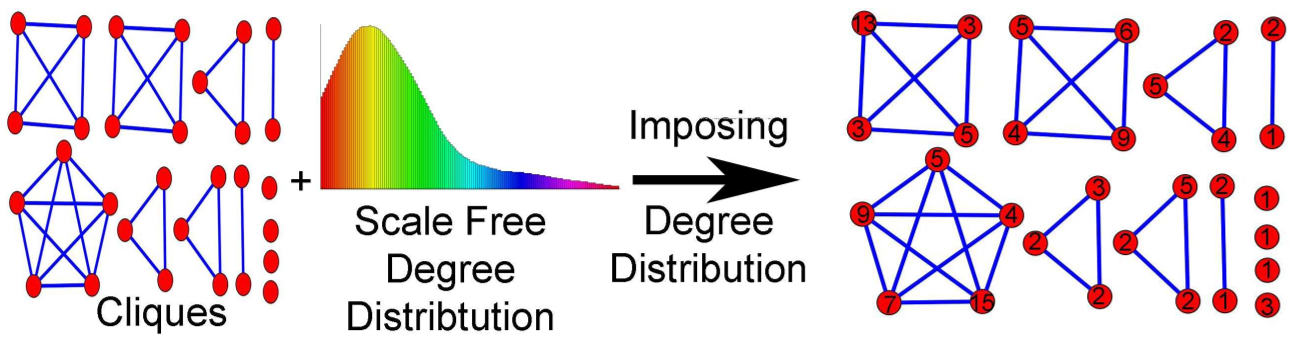 Figure 1: The Cluster Tree T guides how independent cliques merge into a unified community structure.
Why It Works: Contextual Similarity
The methodology relies on an extension of Assortativity. In real life, an actor doesn't just connect to a "high-degree" star; they connect to the entire cast of a movie (a clique) within a specific genre (the context/community). By using the Cluster Tree, the model simulates this contextual similarity, preventing the "scalability collapse" seen in models like Holme-Kim.
Experiments and Benchmarking
The researchers compared the proposed model (Zaidi et al.) against several SOTA generators and three real-world social datasets.
| Metric | Geometry (Real) | Zaidi et al. | Holme-Kim | Klemm-Eguiluz |
|---|---|---|---|---|
| Avg Path Length | 5.31 | 5.4 | 7.3 | 2.27 |
| Clustering Coeff | 0.53 | 0.66 | 0.79 | 0.72 |
| Community Structure | Yes | Yes | No | No |
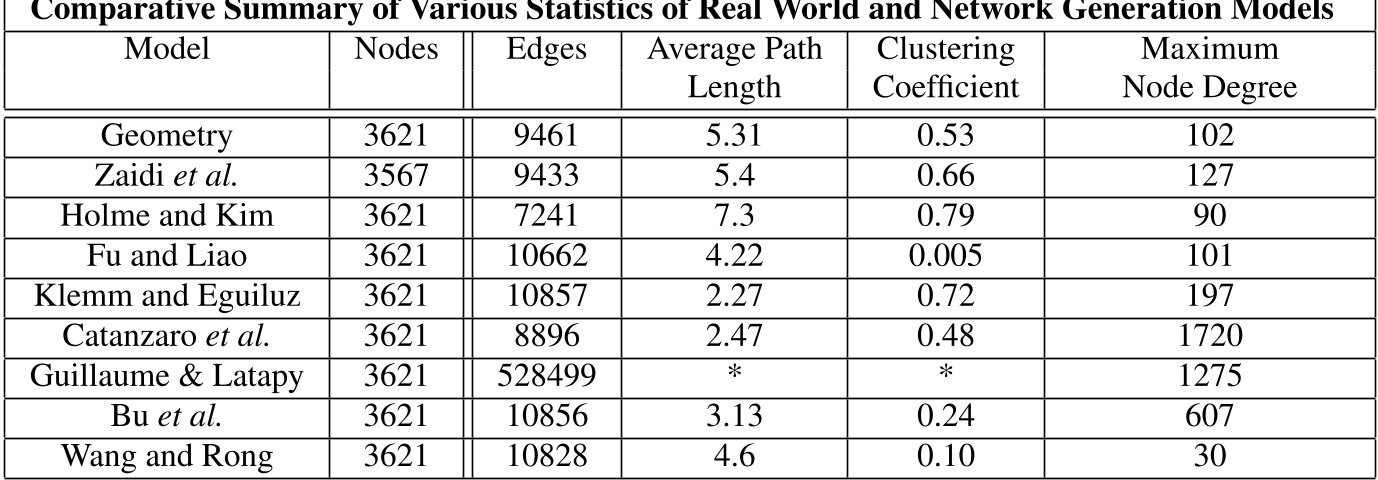 Figure 2: Statistical comparison showing the proposed model's superior ability to mirror real-world Geometry collaboration networks.
Critical Insight & Conclusion
The beauty of this model lies in its controllability. Because it is modular, researchers can independently tune:
- The Group Density (by adjusting initial clique sizes).
- The Global Connectivity (by adjusting the depth/branching of the Cluster Tree).
- The Degree Skewness (by swapping the underlying scale-free distribution).
Future Outlook: While currently focused on Social Networks, this hierarchical merger approach could be a game-changer for simulating biological pathways or modular software architecture graphs where "functional modules" are more important than individual nodes.
Takeaway for Practitioners
If you are testing a community detection algorithm, stop using simple Barabasi-Albert models. They lack the modularity of real systems. The clique-merger approach described here provides a much more rigorous "stress test" for grouping-based AI tasks.