
Sun Signs vs. Social Reality: A Big Data Validation of Astrology
2963_Validation of astrology through relationship between sun signs using social network data.
This paper investigates the scientific validity of astrology by analyzing large-scale social network data from Xiami Music and Facebook. By applying chi-square tests to friendship and romantic relationships, the study explores whether sun sign pair frequencies deviate from random distributions.
TL;DR
Does your zodiac sign influence who you follow or who you marry? Researchers from Beijing University of Posts and Telecommunications analyzed millions of social connections to find out. The verdict: While people on music apps tend to follow others with their same sun sign (a "weak" relationship), your zodiac sign has zero statistical impact on who you choose as a romantic partner (a "strong" relationship).
Problem & Motivation: Beyond the Horoscope
Despite being categorized as a pseudoscience, astrology remains a cultural powerhouse. Most previous scientific attempts to debunk it were limited by small sample sizes or manual surveys. The authors of this paper saw an opportunity to use Social Network Analysis to test the "relationship" aspect of astrology—the popular idea that certain signs (like Aries and Sagittarius) are naturally more compatible.
The researchers hypothesized that if astrology holds water, we should see non-random patterns in birth dates among friends and couples in the digital age.
Methodology: Weak vs. Strong Ties
The study split its investigation into two distinct social contexts:
- Weak Relationships (Xiami Music): A dataset of ~1.9 million users where "following" someone involves low emotional investment.
- Strong Relationships (Facebook): A dataset of over 81,000 confirmed romantic couples.
They applied a Chi-Square Test to determine if the distribution of sign-to-sign pairings was independent. A high chi-square value would suggest that something (potentially astrological compatibility) is pulling people together more than mere chance.
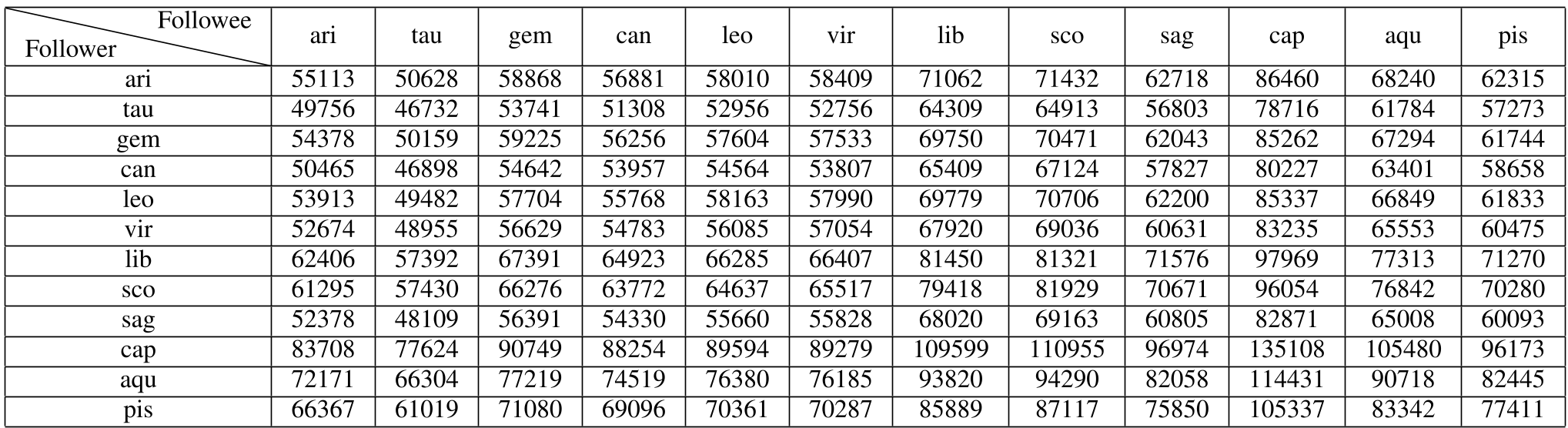
Results: The "Same-Sign" Surprises
The findings presented a fascinating dichotomy:
1. The Xiami Effect (Weak Ties)
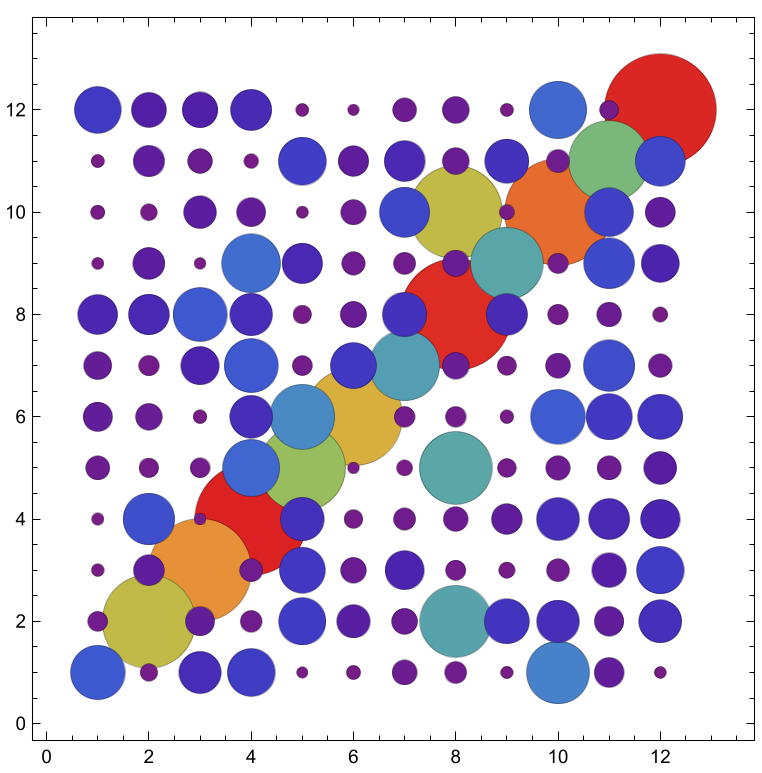
The Xiami dataset yielded a chi-square value of 337.662, far exceeding the significance threshold of 147.67. Interestingly, the biggest "deviations" from randomness occurred on the diagonal of the matrix.
- Insight: Users were significantly more likely to follow people with the same sun sign.
- Interpretation: This isn't necessarily proof of celestial influence. Instead, it likely reflects a "social labeling" effect where people identify with their own sign and consciously or subconsciously seek out others like them in a low-stakes environment.
2. The Facebook Reality (Strong Ties)
When it came to romantic couples, the results were devastating for astrology. The chi-square value plummeted to 20.33—indicating no statistical significance whatsoever.
- Insight: In real-world, high-intensity relationships, birth dates are effectively random. The complex "Aries-Leo" or "Gemini-Libra" blueprints touted by astrologers do not manifest when actual life choices are made.
Critical Analysis & Conclusion
This paper provides a refreshing, data-driven look at an old debate. The core takeaway is that astrology's "validity" is likely a psychological byproduct of social networks. In weak networks (like music sharing), users might lean into their "Astro-identity." However, when the relationship is "strong" (marriage/coupling), human complexity and real compatibility override the arbitrary 12-sign system.
Limitations: The study does not account for the "Moon" or "Rising" signs, which professional astrologers claim are crucial. Furthermore, the Xiami data might be skewed by users displaying their signs on profiles, leading to homophily (the tendency of individuals to associate with similar others) based on shared interests rather than cosmic alignment.
Future Outlook: The next step for this research should be to isolate users who actively believe in astrology versus those who don't. Does belief create the correlation, or does the correlation exist independently? Until then, you might want to stop checking the stars before your next date!