
NITP: Beyond Discrete Labels to Structured Latent Geometry
3
The paper introduces Next Implicit Token Prediction (NITP), a novel pre-training objective that supplements traditional discrete Next-Token Prediction with continuous latent-space supervision. By predicting "implicit tokens"—contextualized representations from the model's own shallow layers—NITP consistently improves downstream performance across dense and MoE models (up to 9B and 45B scales).
TL;DR
Standard Next-Token Prediction (NTP) is the bedrock of modern LLMs, but it has a "geometric blind spot." By only supervising discrete token IDs, the latent representation space often collapses into a narrow, low-rank state. This paper introduces Next Implicit Token Prediction (NITP): an auxiliary objective that forces the model to predict the latent semantic essence of the next token using its own shallow layers as anchors. The result? Significant boosts in reasoning (e.g., +5.7% on MMLU-Pro) with nearly zero overhead.
The Problem: The "Geometric Blind Spot" of NTP
Why do LLMs sometimes struggle with generalization despite high next-token accuracy? The authors argue that the standard Cross-Entropy loss is under-constrained.
When a model predicts a token like "bank," the NTP loss only cares if the logit for "bank" is higher than others. It doesn't care how the internal hidden state is structured, as long as the projection works. This freedom allows hidden states to drift into degenerate configurations—specifically, an anisotropic "cone" where all tokens look similar in the latent space.
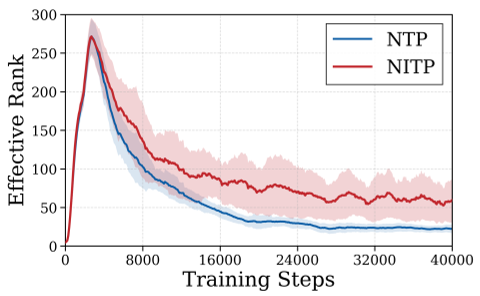 Figure 1: Standard NTP (red) shows a rapid drop in Effective Rank and a rise in Cosine Similarity, indicating geometric collapse.
The Solution: Next Implicit Token Prediction (NITP)
The core insight is to provide dense, continuous supervision to complement the sparse, discrete feedback of NTP.
1. Shallow Layers as Semantic Anchors
Instead of using external models or static embeddings (which suffer from polysemy), NITP uses the model's own shallow layers (approx. 20% of total depth) as a target. Research shows these early layers are "semantically rich" and stable, while deeper layers become specialized and "sparse" for the final prediction task.
2. The Mechanism
For a token at time , the model must:
- Predict the identity of token (Standard NTP).
- Predict the hidden state of token at a shallow layer (NITP).
The second task is optimized using Cosine Similarity through a small MLP projection head. A crucial stop-gradient is applied to the shallow target to prevent the "target" from moving to accommodate the "prediction" (avoiding trivial collapse).
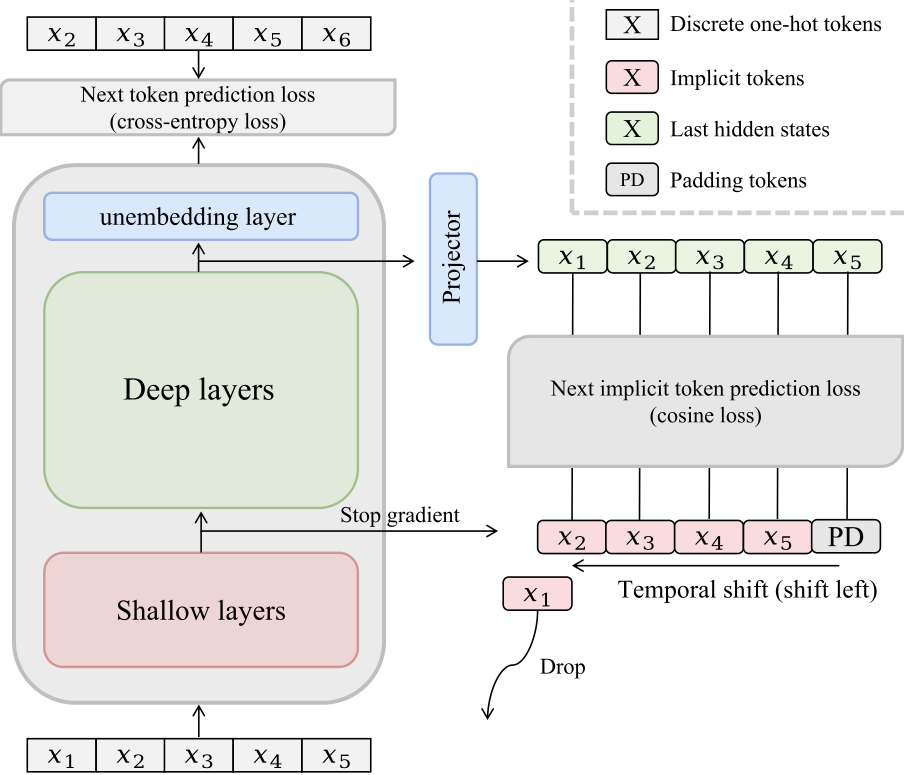 Figure 2: The NITP framework—predicting the future context in the latent space.
Methodological Deep Dive: Why Cosine Similarity?
The authors provide a formal proof (Lemma 3.1) showing that the NITP objective introduces positive curvature in the semantic subspace that NTP ignores.
- Radial Invariance: NITP doesn't interfere with the norm of the vector (preserving the model's ability to adjust softmax temperature).
- Angular Spectral Lifting: It effectively "lifts" the flat regions of the optimization landscape, penalizing the model if its hidden states drift into the degenerate "null space" of the NTP objective.
Experimental Results: Scaling and Reasoning
The authors tested NITP on Dense and MoE models from 0.5B to 45B parameters.
- 9B MoE Model: NITP delivered massive improvements in complex reasoning benchmarks:
- MMLU-Pro: 15.29% → 21.00% (+5.71%)
- C3 (Reading Comp): 56.65% → 63.01% (+6.36%)
- CommonsenseQA: 45.70% → 49.96% (+4.26%)
 Table 1: Consistent performance gains across all model scales and benchmarks.
Efficiency
One of the most impressive aspects of NITP is its efficiency.
- Training Overhead: Only ~2% additional FLOPs (just one extra small MLP head and a loss calculation).
- Inference Overhead: 0%. The projection head is discarded after training, leaving the backbone identical to a standard Transformer.
Critical Analysis & Conclusion
NITP is a highly "elegant" solution. It doesn't require extra data, massive compute, or complex multi-token scheduling. It simply fixes the geometry of the representations we are already learning.
Key Takeaways:
- Temporal Shift is Key: The authors found that aligning current-step hidden states (layer-wise alignment) actually hurts performance. The "predictive" nature (predicting the next state) is what creates the useful signal.
- Projection Matters: Using an MLP to bridge the gap between shallow and deep layers is necessary; direct alignment is too restrictive.
NITP proves that even in the era of massive scaling, the objective function still has room for fundamental improvement. By enforcing a semantically structured geometry, we can extract more "intelligence" from the same amount of data and parameters.