
Near Cloud: Bridging the Digital Divide with DIY Fog Computing
3013_Near Cloud Low-cost Low-Power Cloud Implementation for Rural Area Connectivity and Data Processing.
This paper introduces Near Cloud, a novel decentralized fog-based platform designed specifically for rural areas with limited internet infrastructure. By leveraging a Mesh-Network of IoT devices and Raspberry Pi nodes, the system provides offline local web services and distributed data processing capabilities, including image recognition and machine learning at the edge.
TL;DR
In many rural parts of the world, "Cloud Computing" is a luxury hindered by poor infrastructure. Near Cloud is a decentralized solution that turns local IoT devices into a "mini-cloud." By using a Mesh Network of Raspberry Pis, it allows rural communities to access web services, educational content, and even AI-powered image recognition—all without a single byte of data leaving the local area.
The Problem: The "Internet-Dependent" Barrier
Most modern AI and data services are built on a "Thin Client - Thick Server" model. This assumes you have a stable, high-speed pipe to a data center. However, in rural geography (like the mountainous regions of the Philippines or Indonesia), building such infrastructure is prohibitively expensive.
Current solutions like 3G/4G are often patchy. When the signal drops, the service dies. The authors identify a critical need: How do we provide the benefits of the cloud (storage, processing, services) to a community that is effectively offline?
Methodology: Bringing the Cloud Closer (Fog Computing)
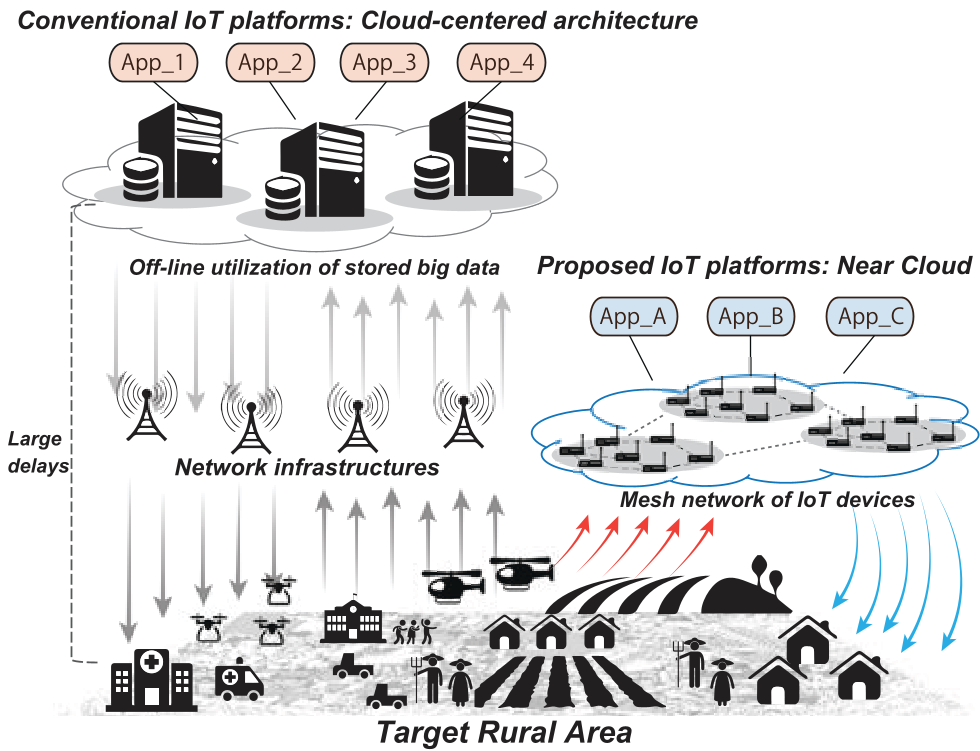
The core philosophy of this work is a shift from Cloud to Fog. Instead of sending data to a remote server, the computation happens on "Near Devices" located right in the village.
1. The Architecture
The system utilizes Raspberry Pi 3 Model B nodes running Raspbian. These nodes are connected via the 802.11s Mesh Networking protocol, allowing devices to talk to each other and extend the network range without complex cabling.
2. Dual-Layer Functionality
- Web Services: Each node can act as a web server, hosting local versions of Wikipedia, health portals, or educational tools.
- Distributed Edge Processing: The "Master Node" can distribute heavy tasks. For example, if a farmer needs to identify a crop disease from a photo, the image is sent to the "Near Cloud," where a node running a lightweight machine learning model (SSD MobileNet) processes it locally.
Experimental Results: Performance in the Field
The researchers tested the system for both connectivity and computational throughput.
- Network Stability: Within a 15-meter radius, the mesh nodes maintained zero packet loss. Even as the number of "hops" (jumps between nodes) increased, the system maintained sufficient bandwidth for web browsing and file transfers.
- Distributed AI: The system successfully demonstrated object detection and ML model training using the MQTT protocol. By distributing data across nodes, the system avoids bottlenecks on a single low-power Raspberry Pi.
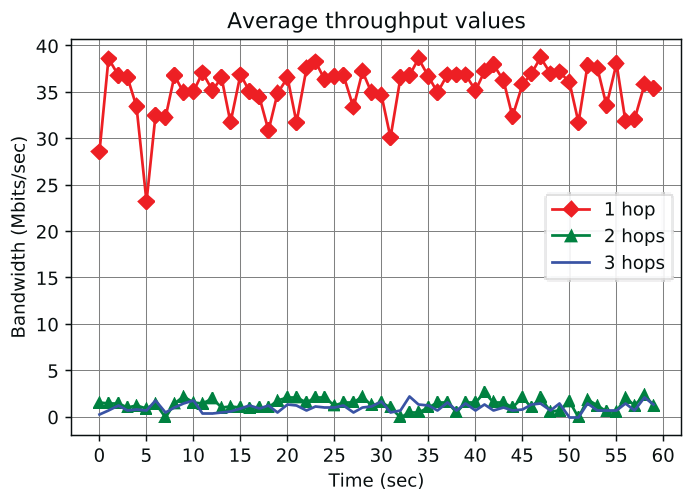 Figure: Throughput and Latency comparison across multiple hops in the Near Cloud mesh.
Critical Insight & Conclusion
The genius of Near Cloud isn't in creating a faster processor, but in its architectural empathy. It acknowledges that for much of the world, the "Internet" isn't a global highway—it's a local utility.
Limitations
- Range: While 15-30 meters is fine for a small cluster of houses, larger villages would require directional antennas or higher-power nodes.
- Power: Relying on Raspberry Pis still requires a power source (solar/battery), which must be managed.
Takeaway
Near Cloud is a blueprint for technological sovereignty. It shows that with sub-$50 hardware and open-source Mesh protocols, we can democratize access to information and computing power, proving that you don't need a fiber-optic cable to have a "smart" community.