
Delite: Elevating High-Level DSLs to Hardware-Level Performance
306_Delite A Compiler Architecture for Performance-Oriented Embedded Domain-Specific Languages.
Delite is a compiler framework for creating performance-oriented embedded Domain-Specific Languages (DSLs) in Scala. It provides a unified architecture that automatically parallelizes high-level abstractions for heterogeneous hardware, including CPUs and GPUs, achieving performance competitive with C++.
TL;DR
The abstraction gap between high-level productivity languages (like Scala) and heterogeneous hardware (GPUs/Multi-core) has historically forced a trade-off: write slow, readable code or fast, unmaintainable low-level code. Delite bridges this gap by providing a compiler framework that allows developers to build "Embedded DSLs" that capture high-level intent and automatically compile them into highly optimized C++ or CUDA kernels.
The "Performance-Productivity" Gap
Modern software development is moving toward higher abstractions, while hardware is becoming increasingly complex with heterogeneous elements (CPUs, GPUs, and accelerators). Standard compilers often fail here because they operate on low-level instructions where the "big picture" of the algorithm is lost.
If you write a vector addition in a generic library, the compiler sees a loop; it doesn't know it's linear algebra. This prevents optimizations like loop fusion across different library calls, leading to massive memory overhead. Delite targets this specific pain point by retaining domain semantics through the compilation pipeline.
Methodology: The Core of Delite
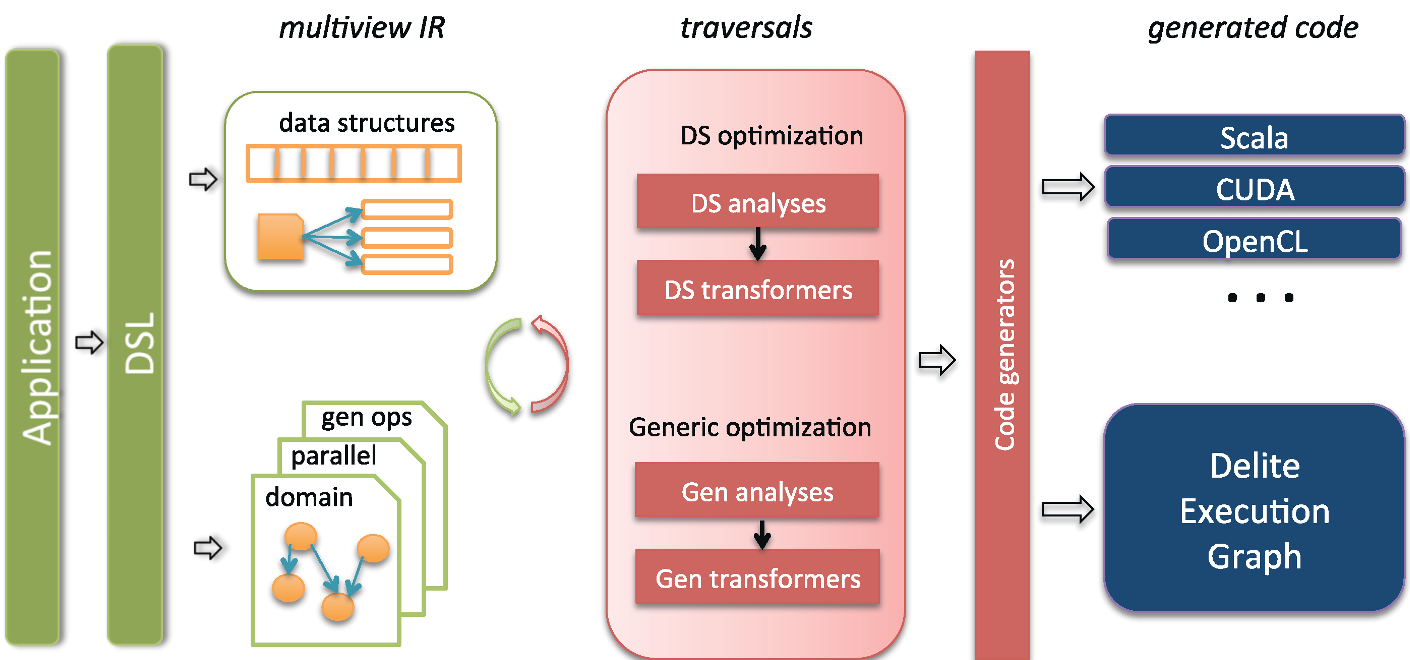
Delite's magic lies in its three-stage pipeline. Unlike traditional libraries that execute code immediately, Delite DSLs use Staging. When you run a Delite program, it doesn't just do the math—it builds an Intermediate Representation (IR) of the math.
1. Lightweight Modular Staging (LMS)
Using Scala's type system, Delite "lifts" operations into expressions. A variable doesn't just hold a Vector; it holds a Rep[Vector], which acts as a placeholder in a dependency graph.
2. The IR (Sea of Nodes)
Delite represents programs as a "sea of nodes." This avoids the rigid constraints of a traditional control-flow graph, making it easier for the compiler to find parallel opportunities.
3. Reusable Parallel Patterns
Instead of reinventing the wheel for every DSL, Delite provides Parallel Ops like Map, Reduce, Filter, and GroupBy.
- Loop Fusion: If a programmer writes
v1.map(f).filter(g), Delite fuses these into a single pass over the data, eliminating intermediate memory allocations. - AoS to SoA: It automatically converts "Arrays of Structs" into "Structs of Arrays," which is critical for maximizing memory bandwidth on GPUs.
Diverse Applications: From ML to Mesh Physics
The authors proved the framework's versatility by implementing four distinct DSLs:
- OptiML: For Machine Learning (vectors and matrices).
- OptiQL: For SQL-like data querying.
- OptiGraph: For large-scale graph analysis.
- OptiMesh: For PDE calculations.
A key insight is the high rate of reuse: 77% of the parallel operators were shared across at least two DSLs.
Experimental Validation
The performance metrics indicate that Delite-based DSLs are not just "fast for a high-level language," but truly competitive with hand-tuned C++.
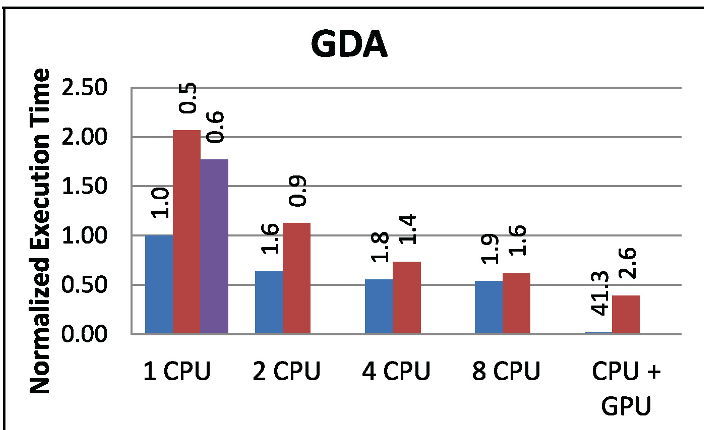
- GPU Acceleration: In the Shallow Water Simulation (OptiMesh), Delite's ability to automatically transform code for the GPU resulted in a 28x speedup over sequential C++.
- Domain Optimization: In OptiQL (Querying), Delite performed "dead field elimination," removing columns from the data structures that weren't being used in the specific query, a feat typically reserved for high-end database engines.
Critical Insight: The Modular Future
Delite's true value isn't just in the speed of its generated code, but in the division of labor. It allows:
- Domain Experts to focus on language design.
- Compiler Experts to focus on optimization.
- Hardware Experts to optimize the code generators for new chips.
Limitations: While powerful, Delite requires the DSL to be "embedded" in Scala, which might be a barrier for users used to Python or R. Furthermore, inter-operation between different DSLs remains a complex challenge.
Conclusion
Delite represents a significant milestone in compiler research. By treating the compiler as a framework of reusable components rather than a monolithic black box, it paves the way for a future where high-performance computing is accessible through elegant, domain-specific abstractions.