
Social-Networks Connect Services: Breaking the Walled Gardens of the Social Web
3089_Social-Networks Connect Services.
This paper explores Social-Networks Connect Services (SNCS), such as Facebook Platform, Google Friend Connect, and MySpaceID, which enable third-party websites to integrate social features without building independent networks. It provides a comparative analysis of these platforms and identifies critical security and privacy challenges inherent in the "Social Web" ecosystem.
TL;DR
Social-Networks Connect Services (SNCS) transform third-party websites into social hubs by leveraging the user graphs of giants like Facebook and Google. This paper analyzes the architectural split between proprietary centralized ecosystems and decentralized open standards, while warning of the looming security and privacy debt created by these integrations.
Background: Beyond the Walled Garden
In the early days of the Social Web, your digital identity was a prisoner of the platform where it was created. If you wanted to share news on Digg or music on iLike, you had to build a new profile from scratch. SNCS frameworks—most notably Facebook Platform, Google Friend Connect, and MySpaceID—changed this by providing APIs for authentication and data sharing.
The SNCS Framework: Four Pillars of Connectivity
The authors identify a core architecture required to make these services reliable:
- Identity Authentication: Using existing social credentials to prove who you are.
- Authorization: Managing granular access rights (e.g., via OAuth) so sites can read your data without knowing your password.
- Streams: The "nervous system" of the social web, allowing activities to flow between third-party sites and main profiles.
- Applications: The tools that allow developers to build rich, embedded social features.
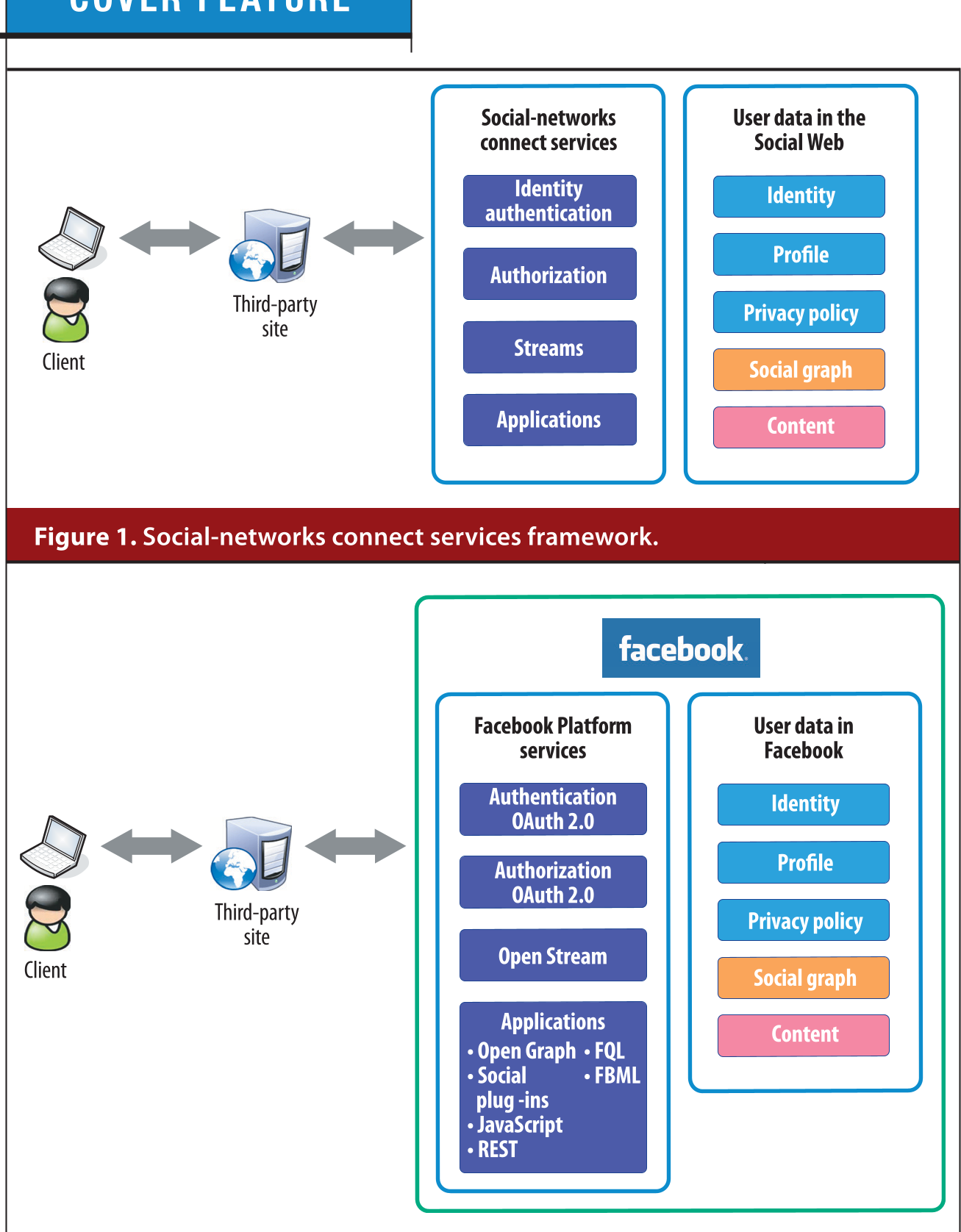 Figure: The Facebook Platform service model illustrating the flow of Identity, Profile, and Content data.
Methodology: Centralized Power vs. Decentralized Standards
The paper draws a sharp contrast between two industry philosophies:
- The Facebook Model (The Giant): Facebook utilized a proprietary approach (later adopting OAuth 2.0) to serve 400 million users. Its strength is its "mass"—third-party sites crave its massive user base, but it creates a single point of failure for privacy.
- The Google/MySpace Model (The Open Web): These players leaned on OpenID, OAuth, and OpenSocial. This approach allows users to pick their identity providers, promoting a decentralized web, but leads to "Identity Mapping" nightmares where one person accidentally creates multiple disconnected identities across services.
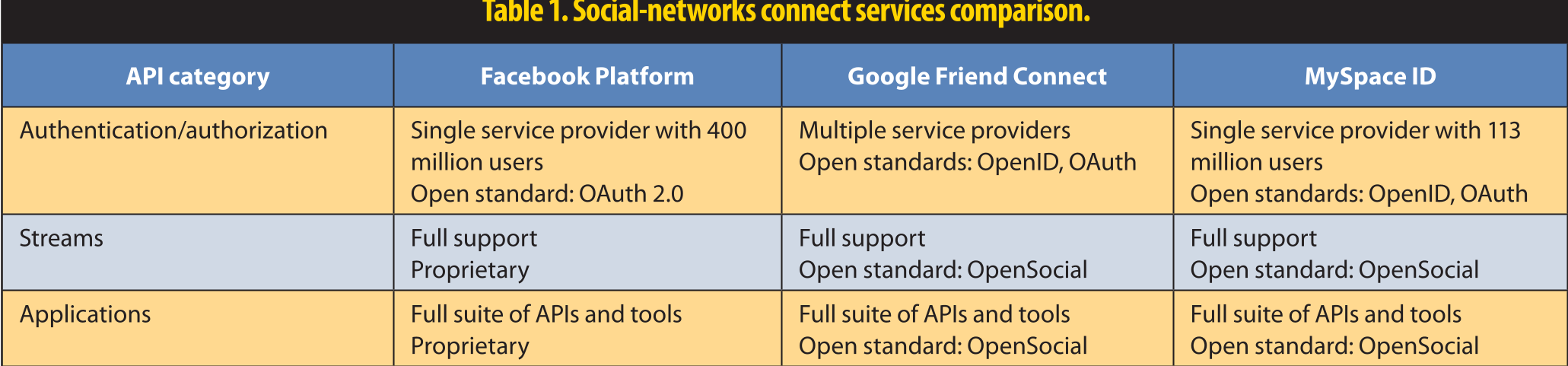 Table: A systemic comparison of API categories and standards across major SNCS providers.
Critical Research Challenges
The authors point out that while connectivity is increasing, our security tools are lagging:
1. Identity Mapping & Fragmentation
When you log in with Google today and Facebook tomorrow, most third-party sites see two different people. Mapping these via email hashes is unreliable. The paper suggests OpenID as a global unique identity, but notes its slow mainstream adoption.
2. Cascaded Authorization
Modern web services are "Mashups." If Site A uses data from Site B, which in turn relies on Site C, the user is currently bombarded with constant consent pop-ups. The authors call for a recursive delegation mechanism where trust can flow securely through the service chain.
3. Data Integrity in Social Plug-ins
The "Like" button is a powerful endorsement, but it's technically fragile. If you "Like" a video and the owner later replaces that video with malicious content, the integrity of your endorsement is compromised. Current SNCS protocols lack the mechanisms to detect or prevent this "bait-and-switch" on shared objects.
Conclusion: A Call for Common Frameworks
The "Social Web" is growing exponentially, but its foundations are fragmented. The paper concludes that while SNCS has successfully broken down the initial garden walls, we now face a second-order problem: building a Common Enhanced Privacy Policy Framework. Without standardized, compatible policy languages that work across all social graphs, user privacy remains at the mercy of individual developer implementation.
Deep Insight
The real takeaway here is the trade-off between administrative cost and user freedom. Centralized providers (Facebook) reduce the "chore" of managing profiles but at the cost of platform hegemony. Decentralized standards (OpenSocial) offer freedom but require solving the complex math of cross-provider identity reconciliation—a challenge we are still solving today with technologies like Web3 and DIDs.