
From Page to Screen: Decoding the Quantitative DNA of Film Adaptation
3111_Analysis of Adapted Films and Stories Based on Social Network.
This paper presents a social network analysis (SNA) framework to quantify the structural deviations between original novels and their film adaptations. By utilizing weighted graph centrality metrics and the Mantel test on case studies like Harry Potter and Charulata, the authors objectively measure how filmmakers reinterpret character relationships for the visual medium.
TL;DR
Adaptation is more than just translating words into images; it is a structural re-engineering of social relationships. This study uses Social Network Analysis (SNA) and graph theory to mathematically prove how directors like Satyajit Ray and Chris Columbus alter character "centrality" to create more impactful visual narratives, while maintaining a high core correlation (over 90%) with the original source.
The "Cinematic Liberty" Problem
Film critics have long debated the "fidelity" of adaptations, but their conclusions are often subjective. The core challenge is that literature is abstract and imaginative, whereas film is concrete and visually oriented. Until now, there was no objective way to measure the "tug of war" between a novel's character dynamics and those of its film version.
The authors argue that by viewing stories as social networks—where nodes are characters and edges are dialogues—we can see the "skeletal" differences between these art forms.
Methodology: Mapping Dialogue to Data
The researchers built interaction networks based on two iconic works: Rabindranath Tagore’s Nastanirh (adapted as Charulata) and J.K. Rowling’s Harry Potter and the Philosopher’s Stone.
Key Metrics Used:
- Weighted Degree Centrality: Measuring the immediate volume of interaction.
- Betweenness Centrality: Identifying "bridge" characters who control the flow of the narrative.
- Weighted Edge Contribution Factor (WECF): A specialized metric introduced to see how a character’s neighbors strengthen their influence in the graph.
- Mantel Test: A statistical test used to compare the similarity of two matrices (Book vs. Film).
Centrality Shift: The Protagonist's Power
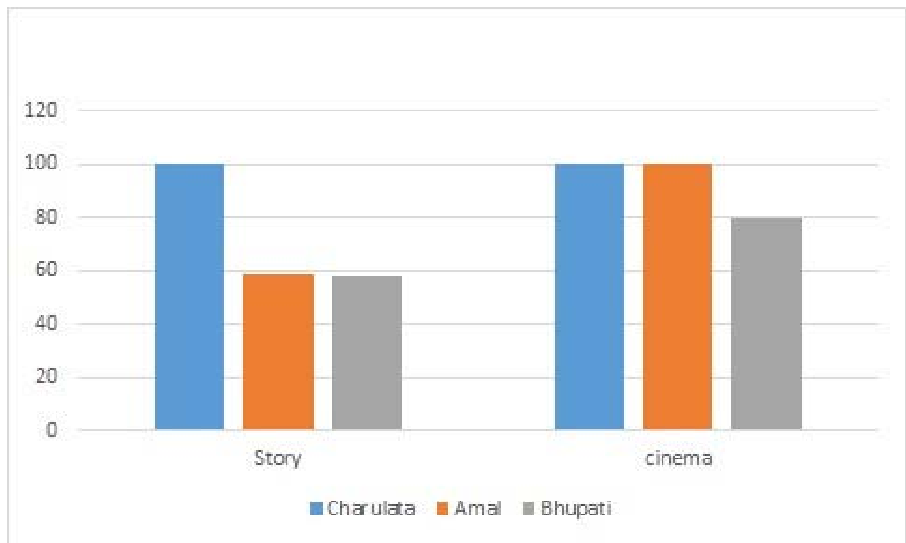
One of the most striking findings is that protagonists become more "central" in films. In the novel Nastanirh, the characters Amal and Bhupati have relatively balanced influence. However, in Ray’s film Charulata, the centrality metrics for Amal and the protagonist Charulata become nearly identical.
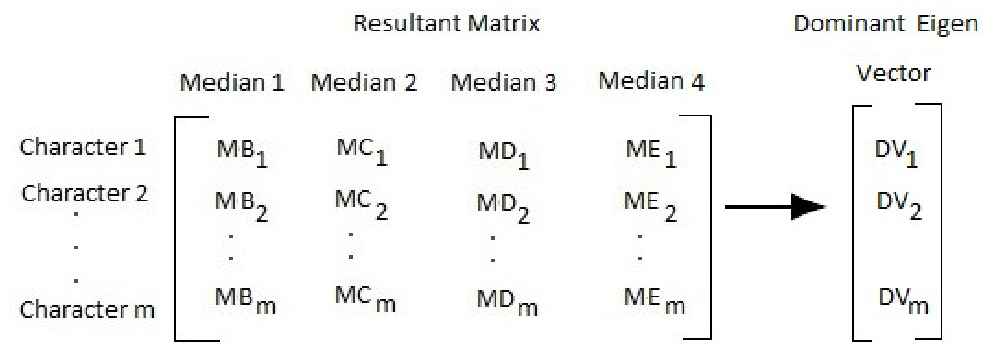
Satyajit Ray refashioned the relationship to add cinematic value, sympany, and realism. The math confirms this: the dominant eigenvector (representing overall influence) spikes for supporting leads in a film to create a "heroic" visual focus.
Structure vs. Theme: The 90% Rule
The research utilized the Mantel Test to find the correlation coefficient ().
- For Charulata, the closeness centrality correlation was 0.975.
- For Harry Potter, it was 0.943.
This high correlation suggests that the "underlying theme" remains intact. However, when the authors used Hierarchical Graph Partitioning to look at scene-by-scene character distribution, the similarity dropped drastically. In Harry Potter, only 5 out of 17 scenes matched the character clustering of the book chapters.
The Insight: Great directors maintain the thematic soul of a book (high matrix correlation) while radically restructuring the social geometry (low partitioning similarity) to fit the time constraints and pacing of cinema.
Real-World Beyond Hollywood
The authors extended this methodology to Journalism, analyzing how different newspapers (The Hindu, The Telegraph, Deccan Chronicle) report the same FIFA World Cup matches. By treating keywords as nodes, they found that The Hindu and The Telegraph share a high correlation in their "word-networks," proving this SNA approach works for any form of information adaptation.
Conclusion
This study bridges the gap between humanities and computational science. It proves that a "successful" adaptation isn't a carbon copy of the book; it is a structural evolution where character importance is amplified for the eye, even as the heart of the story remains mathematically consistent with the source.
Future Outlook: Could we one day use these graph metrics to predict if a screenplay will be a "hit" based on its network structural integrity compared to a beloved novel?