
Ensemble Bag-of-Audio-Words: Taming Stochasticity in Paralinguistic Classification
3120_Ensemble Bag-of-Audio-Words Representation Improves Paralinguistic Classification Accuracy.
The paper introduces an Ensemble Bag-of-Audio-Words (BoAW) representation for paralinguistic tasks such as emotion and cognitive load detection. By repeating the stochastic codebook construction process and combining the resulting classifiers, the authors significantly improve classification robustness and reach a new SOTA UAR of 86.2% on the iHEARu-EAT corpus.
TL;DR
Bag-of-Audio-Words (BoAW) is a powerful tool for converting variable-length speech into fixed-length vectors, but its reliance on random sampling for codebook generation introduces massive, hidden instability. This paper demonstrates that a simple "Ensemble BoAW" approach—running the stochastic process multiple times and averaging the results—can reduce error rates by up to 33% and sets a new world record on the iHEARu-EAT benchmark.
The "Hidden" Problem: The High Cost of Randomness
In paralinguistics, we often care about how something is said (emotion, stress, fatigue) rather than what is said. BoAW has become a go-to method because it clusters frame-level features (like MFCCs) into "audio words," creating a histogram representation of an utterance.
However, the community has pivoted toward random sampling or k-means++ for building these codebooks to save time. The authors found a startling reality: the choice of the random seed alone can swing results by 3% to 11% UAR. Even worse, a configuration that looks "optimal" in cross-validation often provides mediocre results on the test set because the noise is independent across data splits.
Methodology: The Power of the Ensemble
The researchers' insight is elegant: if the randomness in BoAW is essentially "noise," we can treat the different random codebooks as various "projections" of the data.
The Workflow:
- Multiple Projections: Instead of generating one codebook, generate codebooks using different random seeds.
- Parallel Classifiers: Train an SVM for each specific BoAW representation.
- Posterior Fusion: Average the posterior probability estimates from all SVMs.
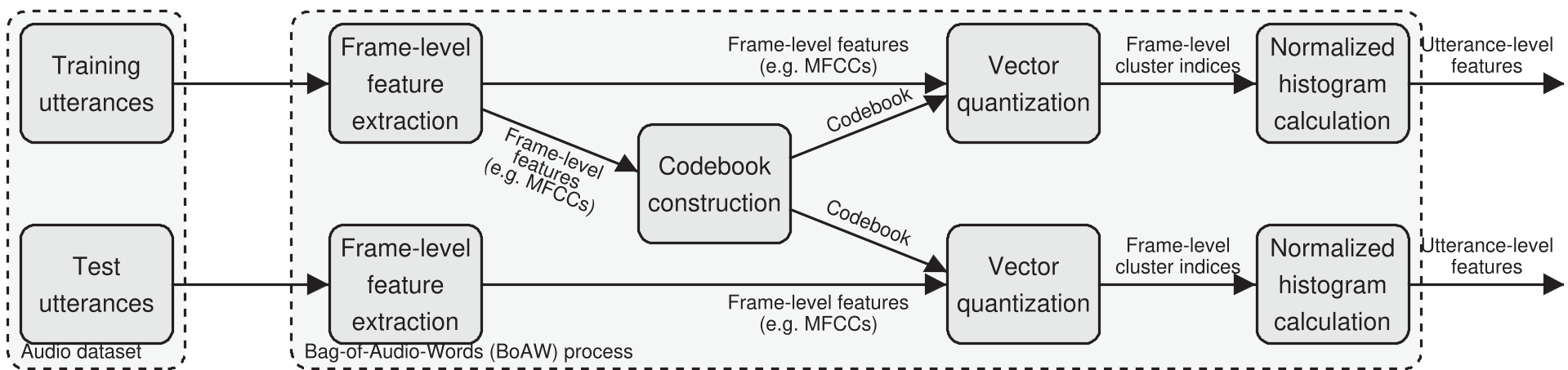 Figure 1: The standard Bag-of-Audio-Words pipeline, which the authors extend through an ensemble of Vector Quantization and Classification.
By using an ensemble of 10 models (), they effectively smooth out the "unlucky" cluster centers that fail to represent the acoustic space accurately.
Experimental Proof: Variance and Performance
The authors tested their hypothesis across three distinct languages and tasks (German eating conditions, Hungarian emotions, and English cognitive load).
Visualizing the Noise
The error bars in the original BoAW experiments show massive fluctuation. Simply picking one seed (the standard practice) is a gamble.
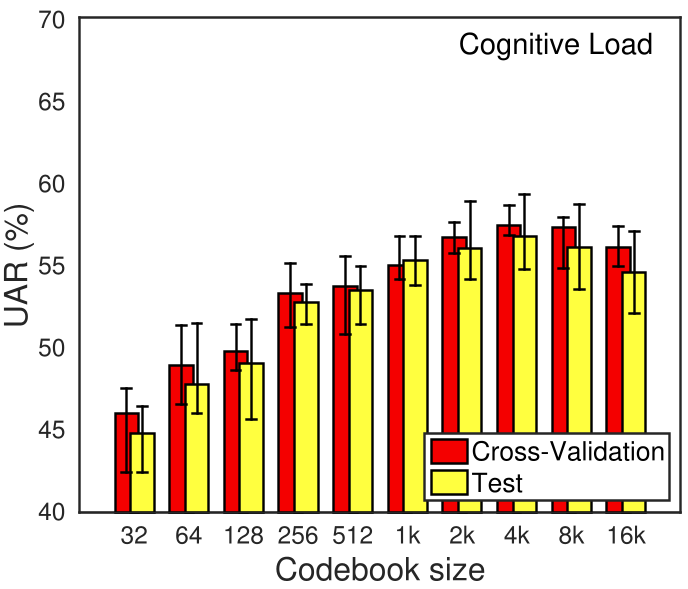 Figure 2: UAR scores across different codebook sizes (N). The high variance (error bars) proves that individual BoAW models are highly unstable.
Final Results Comparison
The ensemble method consistently outperformed the "single seed" baseline and the simple average of individual models. When combined with traditional acoustic functionals (ComParE), the results set new benchmarks:
| Feature Set | Eating Condition (UAR) | Emotion (UAR) | Cognitive Load (UAR) |
|---|---|---|---|
| BoAW Single (Baseline) | 78.2% | 52.1% | 53.6% |
| BoAW Ensemble | 85.1% | 67.8% | 58.6% |
| ComParE + Ensemble | 86.2% | 68.2% | 65.3% |
Critical Insight & Takeaways
The core value of this work is the realization that stochasticity in feature representation is as important as stochasticity in model weights. While many researchers focus on ensemble methods for deep learning (like Bagging or Dropout), this paper shows that for "shallow" pipeline methods like BoAW, the ensemble should happen at the representation layer.
Key Takeaways:
- Stop trusting single random seeds: If your feature extraction involves clustering or sampling, your results might be a fluke.
- Ensemble is the solution: By averaging 10 models, the authors achieved a 31% relative error reduction on eating condition detection.
- New Benchmarks: The achievement of 86.2% on the iHEARu-EAT corpus suggests that older methods, when refined for robustness, can still outperform complex modern architectures.
Future Outlook
While this study focused on SVMs and BoAW, the logic suggests that other stochastic representations—like Fisher Vectors—could benefit from similar ensemble strategies. As paralinguistics moves toward more clinical applications (detecting Alzheimer's or Parkinson's), this kind of robustness is not just a high-score chase; it's a requirement for reliability.