
Harnessing Social Collective Intelligence: An SNA-Based Framework for OER Recommendation
3131_OER Recommendation for Entrepreneurship Using a Framework Based on Social Network Analysis.
This paper introduces a recommendation framework that extracts Open Educational Resources (OERs) from Twitter to support entrepreneurship education. By combining Social Network Analysis (SNA) metrics with Linked Data expansion, it identifies influential users and high-quality URLs to populate learning paths for the "StartUp" project.
TL;DR
Discovering relevant Open Educational Resources (OERs) usually feels like finding a needle in a haystack. This paper presents a framework that transforms Twitter from a noisy social stream into a curated engine for entrepreneurship education. By leveraging Social Network Analysis (SNA) and Linked Data, the researchers identified influential experts and high-quality educational links, filtering out the noise of social media to find "hidden gem" resources for the European Commission's StartUp project.
The Problem: The Static Repository Bottleneck
Open Educational Resources (OERs) are essential for lifelong learning, but they suffer from a discovery problem. Most learners rely on institutional repositories or Google, which often miss the "living web"—the thousands of valuable tutorials, articles, and tools shared daily on social media.
However, recommending content from Twitter is notoriously difficult:
- Cold Start: New URLs have no rating history.
- Data Noise: Most links are promotional or irrelevant.
- User Privacy: We often don't have deep profiles of the learners to perform traditional collaborative filtering.
Methodology: From Keywords to Influential Links
The authors propose a multi-stage pipeline that shifts the focus from "what the user likes" to "who the experts are and what they share."
1. Semantic Expansion via Linked Data
Instead of just searching for "Business," the system uses DBpedia (the structured version of Wikipedia) to find related terms like Marketing, Operations Research, and Business Intelligence. This ensures the "net" cast into the Twitter stream is wide enough to catch relevant variants.
2. The SNA Engine
This is the heart of the paper. Content is filtered through three distinct graph structures:
- Hashtag Co-occurrence Networks: Identifies which topics are trending together.
- Retweet & Mention Networks: Maps the flow of authority.
By using Betweenness Centrality, the system finds "gatekeeper" users. These are individuals who sit at the intersection of information flows. The intuition is simple: if an influential educator in the "Project Management" sphere retweets a link, that link has a high probability of being a quality OER.
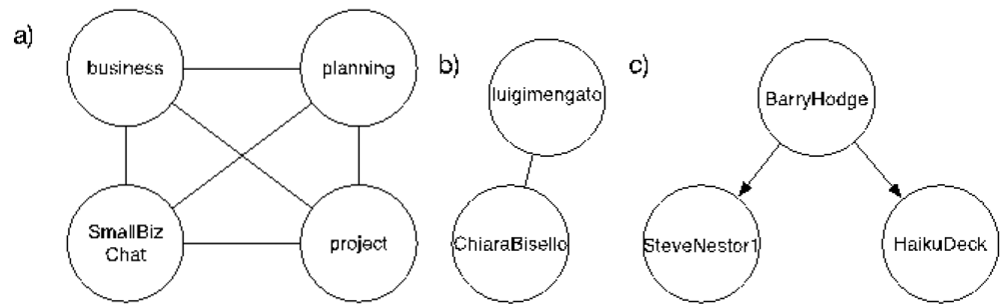 Figure 1: Visualization of (a) Hashtag networks, (b) Retweet paths, and (c) Mention interactions.
Experiments & Results: Project Management Case Study
The researchers tested the framework on the "Project Management" competence area over a 30-day window.
- High Precision: While Twitter is messy, 80.85% of the extracted tweets contained valid URLs (HTTP 200).
- Expert Filtering: Out of over 2,400 users, the system narrowed the field down to 112 influential sources.
- Curated Output: The final result was a list of 206 "Gold Standard" URLs, including high-value resources from platforms like Edutopia and specialized certification training sites.
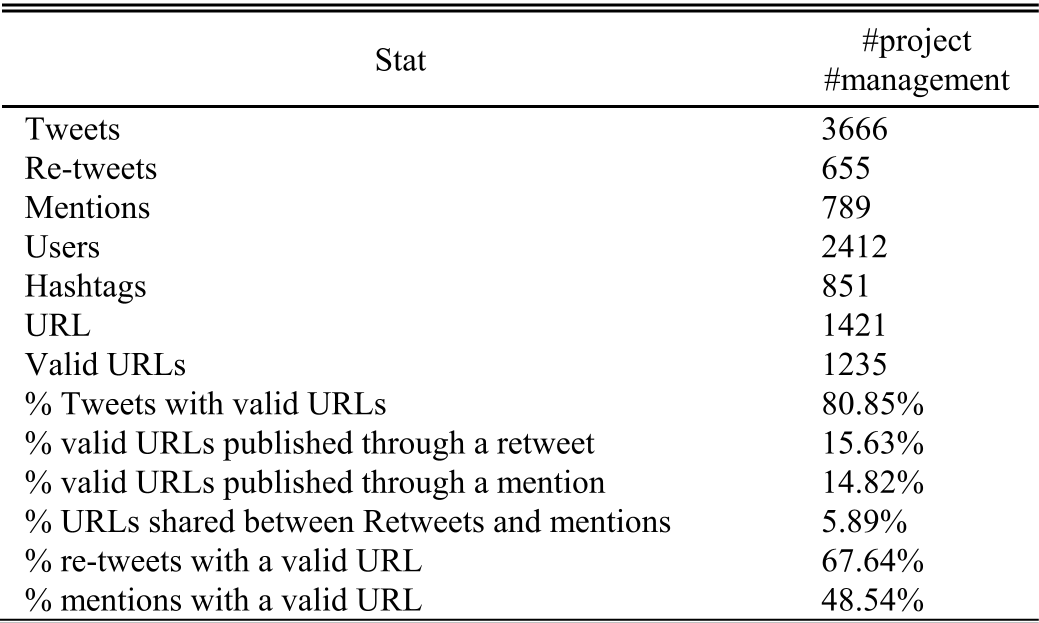 Table 1: Quantitative breakdown showing the high percentage of tweets with valid educational links.
Critical Insight: Quality through Authority
The standard "Recommender Systems" paradigm often asks: "What did users like?" This paper asks: "What did the authorities share?"
By leveraging Betweenness Centrality, the framework creates a self-correcting quality control mechanism. In the volatile world of social media, authority acts as a proxy for pedagogical value. This approach is particularly powerful for fast-moving fields like entrepreneurship, where a textbook might be outdated by the time it's printed, but a Twitter thread by a successful founder is current.
Conclusion & Future Outlook
The "StartUp" project demonstrates that social networks are more than just distraction machines—they are real-time, decentralized libraries. While the current ranking algorithm still heavily relies on HTML metadata (which is sometimes missing), the fusion of SNA and Collective Intelligence offers a promising path for automated curriculum building.
Future iterations could benefit from integrating Natural Language Processing (NLP) to automatically categorize the sentiment and complexity of the shared resources, moving closer to a fully autonomous AI librarian.