
Leveraging Collective Intelligence: A Social Network Analysis Approach to OER Recommendation
3131_OER Recommendation for Entrepreneurship Using a Framework Based on Social Network Analysis.
This paper introduces a recommendation framework that discovers Open Educational Resources (OERs) for entrepreneurship by mining social media data. Leveraging Social Network Analysis (SNA) and Linked Data (DBpedia), the system identifies influential users and relevant URLs on Twitter to build customized learning paths for the "StartUp" project.
TL;DR
The explosion of Open Educational Resources (OERs) has created a "paradox of choice" for learners. This paper addresses the discovery bottleneck by mining Twitter using Social Network Analysis (SNA) and Linked Data. By identifying domain experts through their interaction patterns (retweets and mentions), the framework extracts high-quality educational links that would otherwise be lost in the noise of social media.
Problem & Motivation
While platforms like OpenCourseWare provide structured material, the most current and practical resources for fields like Entrepreneurship are often shared dynamically on social networks. However, searching for these is difficult because:
- Dynamic Content: Relevant URLs are buried under millions of daily tweets.
- Cold Start: Traditional recommendation systems require user history, which is often unavailable for new learners.
- Quality Control: Automated systems struggle to distinguish between high-quality educational content and marketing spam.
The authors' insight is that structural influence in a network (who is being retweeted or mentioned in a specific context) serves as a reliable proxy for content quality.
Methodology: The Core Framework
The system operates through a multi-stage pipeline that transitions from raw social data to refined educational recommendations.
1. Semantic Query Expansion
To avoid "keyword silos," the system uses DBpedia and SPARQL. If a user searches for "Business," the system expands this to include "Marketing," "Finance," and "Business Intelligence," ensuring a broader harvesting of resources.
2. The SNA Engine
This is the heart of the paper. The authors build three distinct types of networks:
- Hashtag Co-occurrence Network: To find related sub-topics.
- Retweet Network: To identify "Broadcasters" who share valuable content.
- Mention Network: To identify "Thought Leaders" or experts acknowledged by others.
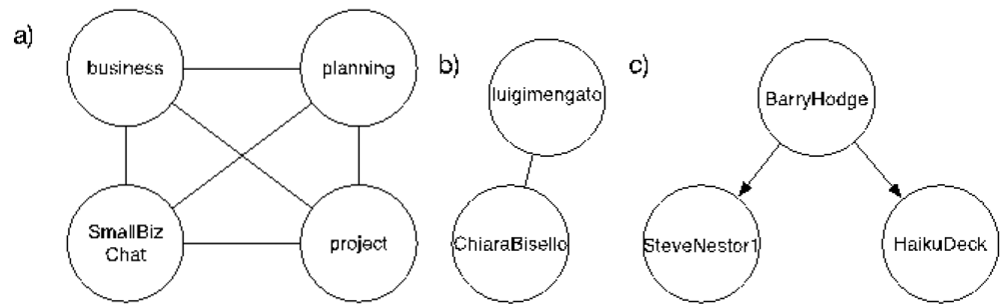 Figure 1: Visualizations of (a) Hashtag networks, (b) Retweet networks, and (c) Mention networks used to rank influence.
By applying Betweenness Centrality, the system identifies "bridge" nodes—users or tags that sit on the path of information flow. URLs shared by these high-centrality users are then extracted as potential OERs.
Experiments & Results
The implementation was tested within the StartUp project, focusing on the "Project Management" competency area.
Key Statistics
The system achieved a high efficiency rate in filtering noise. In the Project Management domain, while there were 2,412 unique users, the system narrowed this down to the top 112 influential experts, whose shared content formed the core of the recommendation engine.
 Table 1: Statistical breakdown of the Project Management hashtag crawl, showing valid URL rates.
The Discovery Output
The final output is a ranked list of URLs with metadata (titles and descriptions) extracted from the source pages. Experts validated that these resources (ranging from Edutopia articles to online training modules) were highly relevant to entrepreneurial training needs.
 Table 2: Sample of top-ranked OER URLs discovered via the SNA framework.
Critical Analysis & Conclusion
Takeaway
The paper successfully proves that connectivity is a valid proxy for credibility. By moving away from content-based filtering (which can be gamed by SEO) to topology-based filtering (SNA), the authors provide a more robust way to discover educational value in "noisy" environments.
Limitations
- URL Longevity: Twitter content moves fast; the "validity" of a URL (200 OK status) is no guarantee of its long-term pedagogical utility.
- Manual Mapping: The initial mapping of entrepreneurial competencies to hashtags still requires human intervention.
Future Outlook
As the Web moves toward Decentralized Social Networks, this SNA-driven approach could be applied to platforms like Mastodon or Nostr, where "reputation" and "content discovery" remain critical challenges for learners seeking decentralized education.