
CDBLSTM: Elevating Building Energy Efficiency through Deep Temporal Feature Learning
3157_Building Occupancy Estimation with Environmental Sensors via CDBLSTM.
The paper introduces CDBLSTM (Convolutional Deep Bidirectional Long Short-Term Memory), an end-to-end deep learning framework for estimating building occupancy ranges using nonintrusive environmental sensors (CO2, temperature, humidity, and pressure). By integrating 1-D CNNs with stacked bidirectional LSTMs, the model achieves a SOTA estimation accuracy of 76.04% and a presence detection accuracy of 95.42%.
TL;DR
Building energy management systems often fail due to a lack of accurate occupancy data. This paper presents CDBLSTM, a deep learning architecture that combines 1-D Convolutional Neural Networks (CNN) with Deep Bidirectional LSTMs. By learning features automatically from low-cost environmental sensors (like CO2 and humidity), it achieves 76.04% accuracy in occupancy range estimation, significantly outperforming traditional methods that rely on manual feature extraction.
The Problem: The High Cost of "Blind" Feature Engineering
In the quest for "Smart Buildings," knowing how many people are in a room is vital for HVAC and lighting control. However, using cameras is intrusive, and PIR sensors are often binary. Environmental sensors (CO2, Temperature, Humidity) are nonintrusive, but their data is notoriously difficult to interpret:
- Manual Labor: Previous SOTA methods (HMM, Decision Trees) required researchers to manually design "features" (moving averages, first-order derivatives).
- Temporal Lag: CO2 levels change slowly; a spike might be an occupant walking past a sensor rather than a room full of people.
- Noise: Low-cost environmental sensors are prone to transient fluctuations.
Methodology: Synergy of Translation Invariance and Temporal Context
The proposed CDBLSTM approach moves away from manual heuristics toward Automatic Feature Learning.
1. The local "Lens": 1-D Convolutional Layer
Instead of hand-picking statistical features, a 1-D CNN slides across the sensor sequence.
- Why? It captures robust local patterns (slopes, peaks) that are invariant to small shifts in time.
- Architecture: Filter size of 100, window size of 3, and a pooling size of 2 to compress the sequence into a more informative representation.
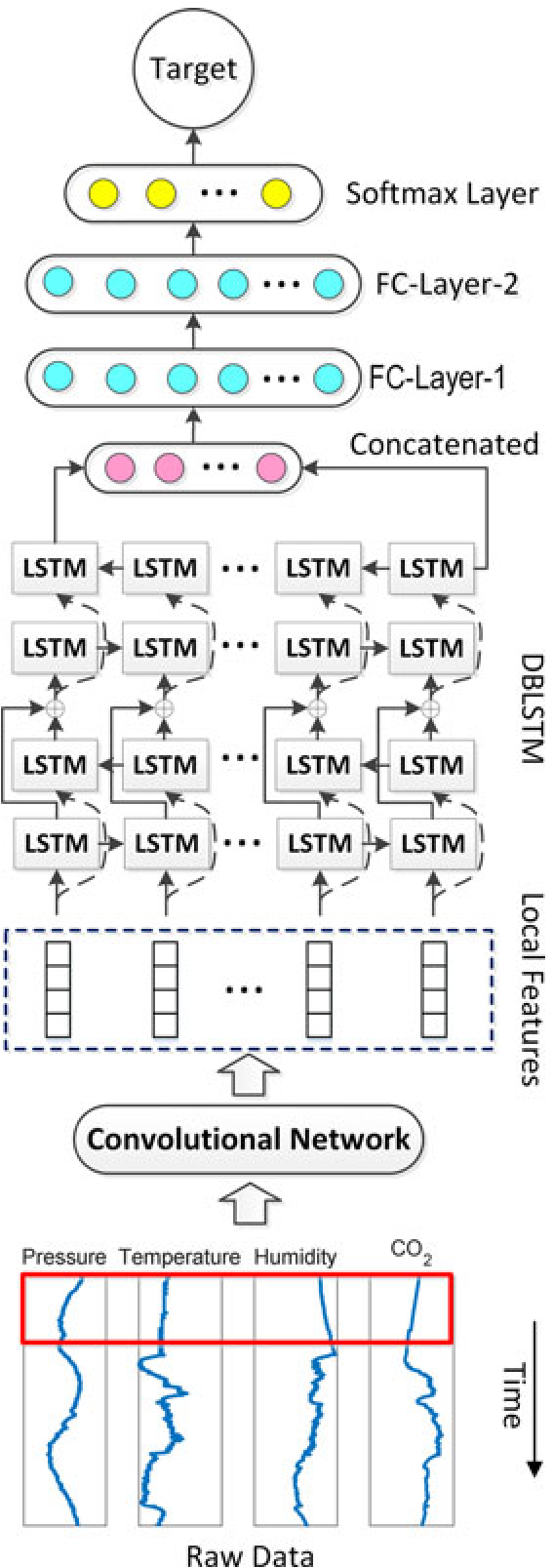 Fig 1. Schematic of the CDBLSTM framework showing the progression from raw sensor input to softmax classification.
2. The Global "Context": Deep Bidirectional LSTM
Standard LSTMs only look at the past. However, in building data, a "future" trend can help retroactively clarify an ambiguous "past" signal.
- Bidirectionally: The model processes the data in two directions (forward and backward), allowing the system to understand that a CO2 spike followed by a rapid drop is different from a sustained increase.
- Depth: By stacking multiple layers (sizes 100, 150, 200), the model learns higher-level semantic hierarchies of occupant behavior.
Experimental Battleground
The model was tested in a real-world Ph.D. lab in NTU, Singapore, against four major baselines (Dong et al., Yang et al., Masood et al., and Candanedo et al.).
Key Performance Metrics:
- Estimation Accuracy: 76.04% (Top Performance).
- NRMSE: 0.1169 (Lowest Error).
- Presence Detection: 95.42% (Robust binary detection).
 Table 1. CDBLSTM vs SOTA methods. Notice the significant drop in NRMSE compared to traditional machine learning.
Robustness Against Noise
One of the paper's strongest insights is its Noise Effect analysis. Because the model relies on temporal dependencies rather than instantaneous values, its performance degrades much more slowly than traditional Decision Trees or ELM methods when sensory noise increases (lower SNR).
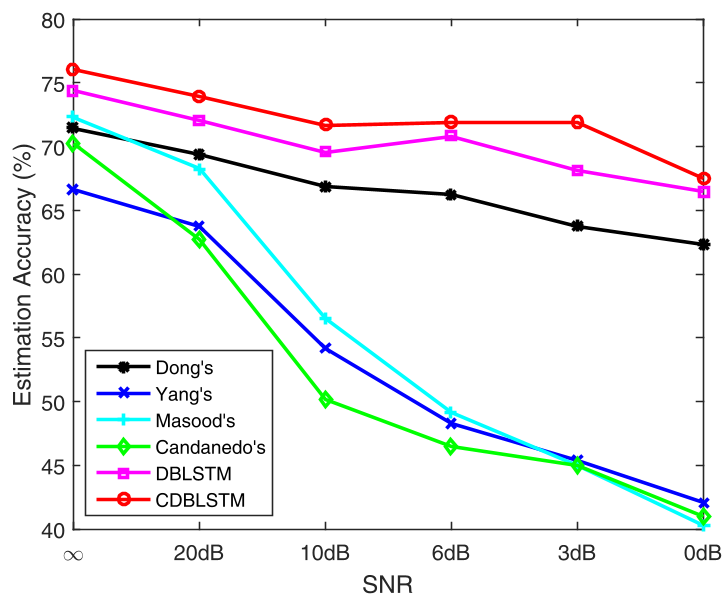 Fig 2. Performance under varying Signal-to-Noise Ratios. Deep sequential models (CDBLSTM, DBLSTM) maintain stability where others fail.
Critical Insight & Conclusion
The Takeaway is clear: the era of manual feature engineering for building sensors is ending. The CDBLSTM proves that by combining local feature extraction (CNN) with long-range dependency modeling (BLSTM), we can achieve high-fidelity occupancy sensing without expensive cameras or privacy-invading wearables.
Limitations: While the testing time is near-instantaneous (0.35s), the training phase requires GPU acceleration and roughly 16 minutes—a trade-off that is highly acceptable for building-scale deployments which only require the model to be trained once.
Future research should focus on optimal sensor placement, as the authors noted that a single occupant moving near a sensor at night still occasionally triggers "False High" estimation.