
The Chemostat: A Mathematical Window into Nonlinear Population Dynamics
3203_Nonlinear population dynamics in the chemostat.
This paper provides a comprehensive analysis of the chemostat as a system for studying nonlinear population dynamics. It establishes the mathematical framework for single-species growth and two-species competition, validating the Principle of Competitive Exclusion through Monod kinetics.
TL;DR
The chemostat is more than just a bioreactor; it is a profound tool for testing the laws of ecology. By modeling bacterial growth as a system of nonlinear differential equations, this study demonstrates that long-term survival is determined by a simple mathematical ratio, , and provides a rigorous foundation for the Principle of Competitive Exclusion.
Background: Stability in Flux
Unlike a closed batch culture where nutrients are finite and waste accumulates, a chemostat (Continuous Stirred Tank Bioreactor) maintains a steady state. Invented by Jacques Monod and Leo Szilard, it allows experimenters to control the growth rate by adjusting the flow of sterile medium. This paper positions the chemostat as a superior model for computational physics and population biology compared to the classical Lotka-Volterra models, due to its experimental controllability.
The Mechanics of Growth: Monod Kinetics
The core of the chemostat's behavior lies in the coupling of biomass density () and substrate concentration (). The specific growth rate is not constant but follows the Monod equation: This introduces a nonlinear saturation effect, analogous to Michaelis-Menten kinetics in biochemistry.
Model Architecture
The system is governed by two coupled equations representing the balance between inflow/outflow and biological consumption/growth:
- Biomass Change:
- Substrate Change:
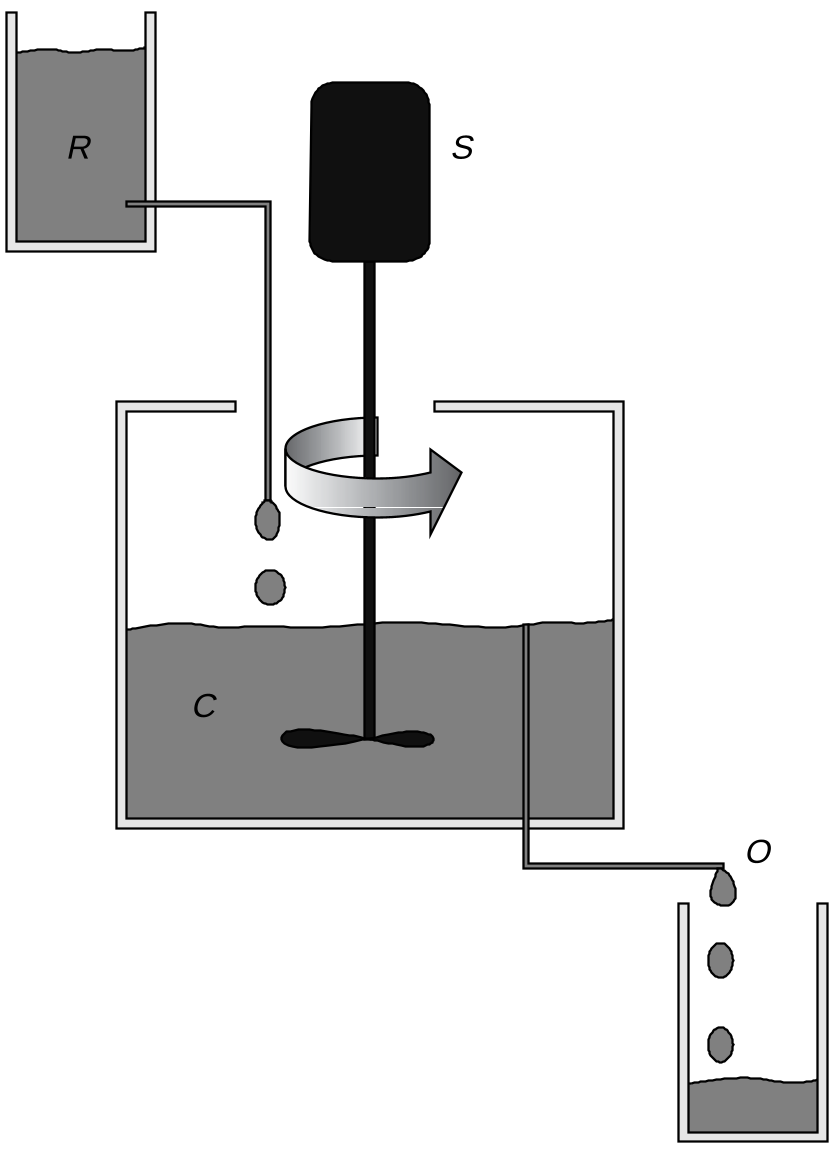 Figure 1: The basic outline of a chemostat where is the reservoir and is the reactor.
Why the System Reaches Equilibrium
By non-dimensionalizing the variables—using dilution rate as the time unit and reservoir concentration as the density unit—the author identifies two fixed points:
- Washout: If the dilution rate is higher than the maximum growth rate , the bacteria are pumped out faster than they can reproduce.
- Stable Steady State: When and is sufficient, the system converges to a stable node.
Stability is proven through the Jacobian Matrix. The analysis shows that any perturbation (e.g., a 20% drop in nutrient supply) results in an exponential return to the steady state, demonstrating the system's robustness.
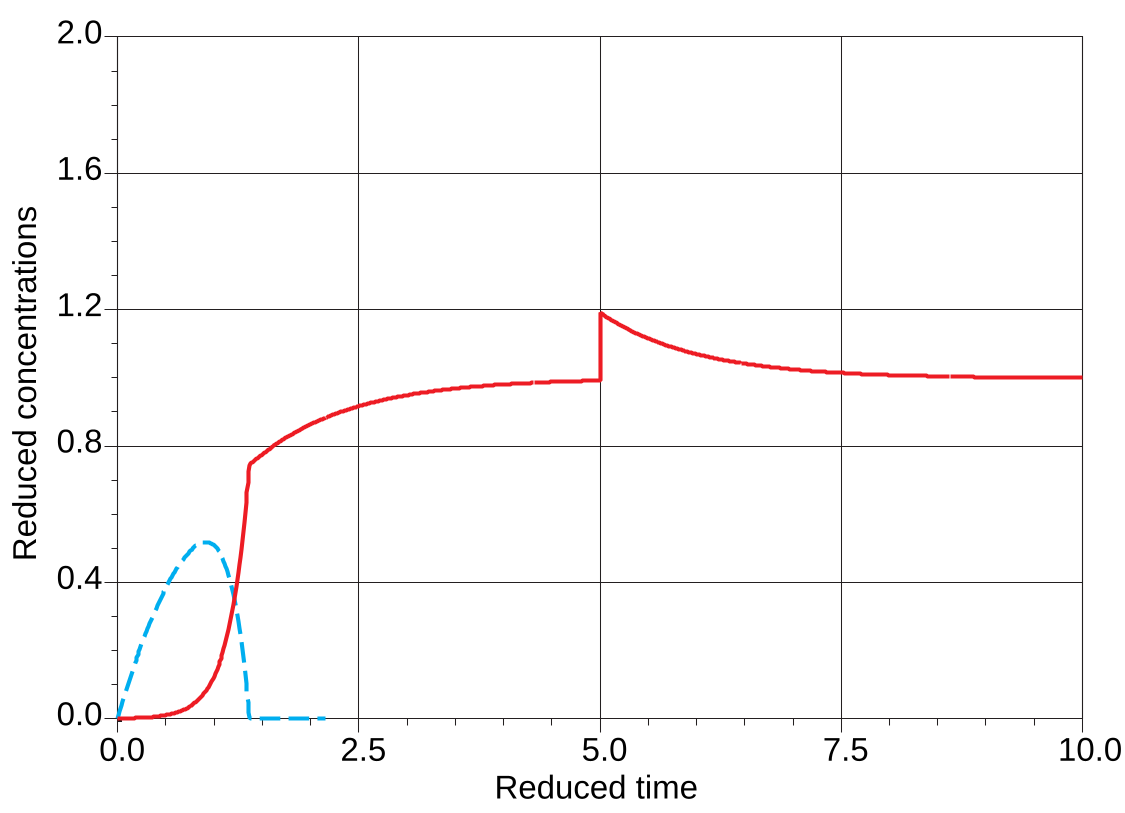 Figure 2: Numerical proof of stability; the system recovers microbial density (full line) after a 20% substrate feed decrease.
Competition and Exclusion: The "Winner Takes All" Rule
The most striking application of chemostat theory is in multi-species competition. When two species compete for a single limiting substrate, the equations for their densities and become:
Mathematical analysis of the three possible steady states reveals that coexistence is impossible. The winner is determined solely by the ratio . The species with the lowest will lower the substrate level to a point where the other species' growth rate is lower than the dilution rate, leading to its eventual washout.
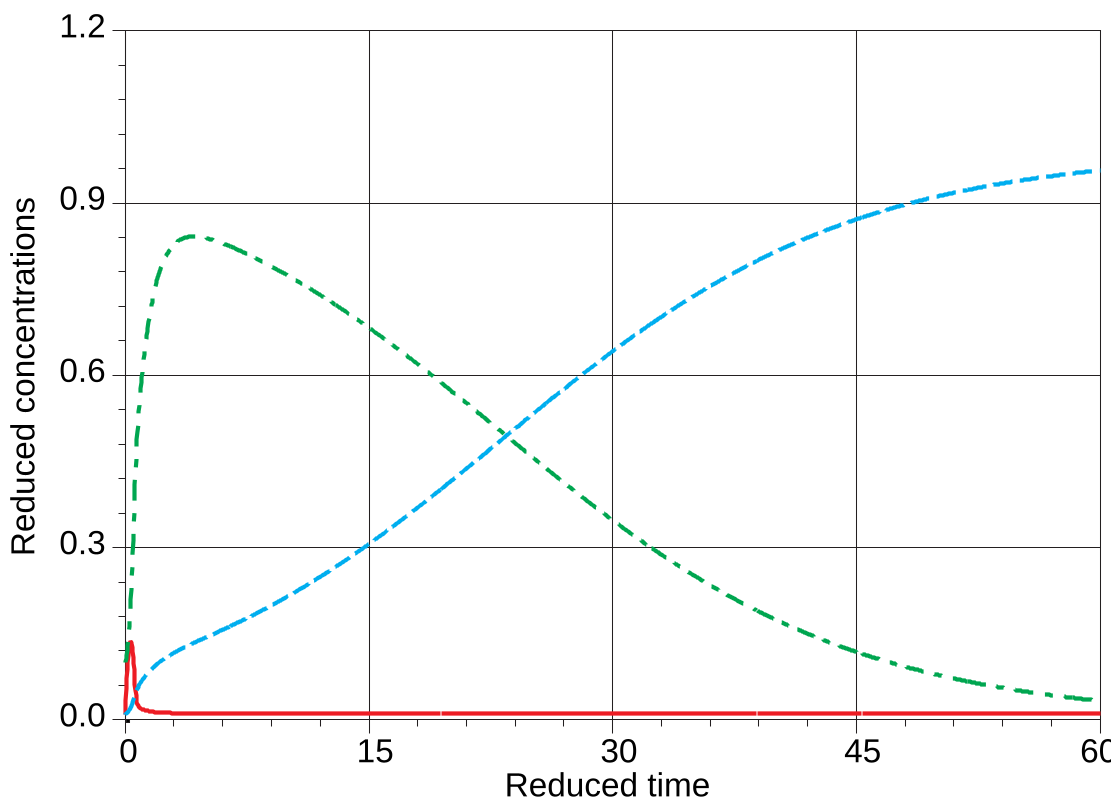 Figure 3: Species 2 (dot-dashed) initially surges but is eventually outcompeted by Species 1 (dashed) as the substrate (solid) stabilizes.
Beyond the Basics: Oscillations and Hysteresis
The author notes that while the basic Monod model predicts a stable node, real-world systems often exhibit oscillations. These can be modeled by:
- Maintenance Energy (): Accounting for energy spent on non-growth activities.
- Variable Yield (): When the yield constant depends on substrate concentration (e.g., ).
Under these conditions, the system can behave like a Van der Pol oscillator, creating limit cycles where populations and nutrients pulse rhythmically.
Critical Insight & Conclusion
This work clarifies that in the microbial world, "fitness" is precisely defined by the ability to survive at the lowest possible nutrient concentration.
Takeaways:
- Predictive Power: The ratio allows for a priori prediction of ecological outcomes.
- Limitations: The model assumes a "well-stirred" environment. In reality, spatial heterogeneity (e.g., biofilms) or multiple limiting nutrients can allow for the coexistence that the simple chemostat model forbids.
- Future Path: Transitioning from "well-mixed" ODEs to spatial PDEs and investigating commensalism (where one species' waste is another's food) represents the next frontier in modelling microbial complexity.