
DDM: Why Scale-Free Networks are a Privacy Nightmare
3325_Social Network De-Anonymization Under Scale-Free User Relations.
This paper investigates social network de-anonymization in scale-free graphs using the Degree-Driven Matching (DDM) algorithm. By leveraging bootstrap percolation theory and a novel graph slicing technique, the authors prove that power-law degree distributions significantly reduce the required seed set for near-perfect network reconciliation.
Executive Summary
TL;DR: This paper reveals that the "scale-free" nature of social networks—where a few hubs have many connections—makes them surprisingly easy to de-anonymize. By introducing the Degree-Driven Matching (DDM) algorithm, the researchers prove that we can identify almost every user in an anonymous network with as few as "seeds" (pre-identified users).
Academic Context: This work moves beyond the simplified Erdös-Rényi models of the past. It provides a rigorous asymptotic analysis using bootstrap percolation theory to demonstrate that the inhomogeneity of real-world networks is not just a feature, but a critical vulnerability for user privacy.
The Motivation: Moving Beyond Random Graphs
Previous research, such as the Percolation Graph Matching (PGM) algorithm, showed that you could "reconcile" two networks (e.g., matching a Twitter graph to an anonymous Facebook graph) if you had enough starting seeds. However, these models assumed an Erdös-Rényi structure where everyone has roughly the same number of friends.
In reality, social networks are Scale-Free. If you treat a celebrity and a casual user with the same matching threshold, you lose the massive information "hubs" provide. The authors realized that by targeting these high-degree nodes first, the de-anonymization process could "percolate" or cascade across the entire network like a digital wildfire.
Methodology: The Power of Graph Slicing
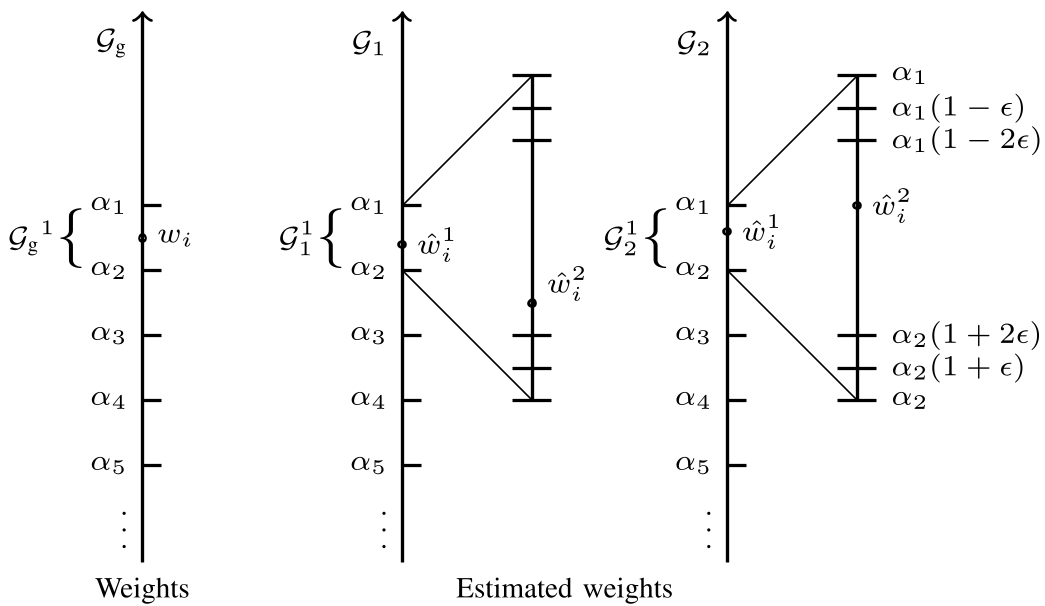
The core innovation is Graph Slicing. Instead of treating the network as a monolithic block, DDM partitions the pairs of nodes into layers based on their degrees.
1. The Cascading Process
The algorithm follows a top-down hierarchy:
- Initial Trigger: It identifies a "sweet spot" slice (nodes with high but not extreme degrees) and uses the initial seeds to trigger percolation here.
- The Waterfall Effect: Once these high-degree nodes are matched, they serve as high-confidence seeds for the next layer (the slice below).
- Refinement: The very highest degree nodes and the very lowest degree nodes are handled in specialized stages to minimize noise and errors.
2. Physical Intuition: Neighbor Thresholds
The algorithm uses a threshold . A pair of anonymous nodes is matched if they share at least already-matched neighbors. In DDM, this threshold is dynamically adjusted based on the "slice," ensuring that errors don't propagate in dense areas and matching doesn't stall in sparse ones.
Experimental Results: Real-World Validation
The authors tested DDM against a real Facebook snapshot (63k nodes).
Key Findings:
- Hub Advantage: When seeds were chosen from high-degree nodes, the number of seeds required to trigger full identification dropped significantly compared to uniform random selection.
- Precision vs. Recall: On synthetic Chung-Lu graphs (which model scale-free behavior), DDM achieved near-perfect matching. However, on the real Facebook data, "clustering" (the fact that your friends are also friends with each other) introduced more errors, though DDM still outperformed standard PGM.
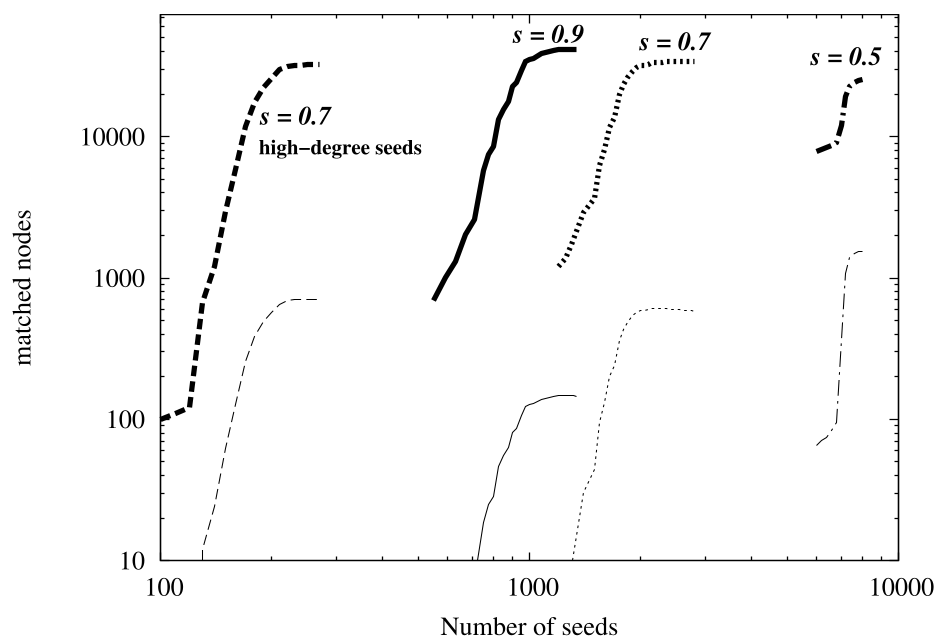
The figure above illustrates that DDM (thick lines) maintains a higher count of correct matches with fewer errors than standard PGM when applied to real-world social data.
Critical Analysis & Future Outlook
The Privacy Takeaway: This research is a warning. If an adversary knows the identities of just a handful of influential "hubs" (seeds), they can mathematically deanonymize a massive portion of the population using only the graph structure—no names or emails required.
Limitations:
- Clustering Sensitivity: The algorithm struggles with "cliques." In real life, your friends know each other, creating redundant edges that can lead to false positives in the matching process.
- Sampling Probability (): The method assumes a certain overlap between the two graphs. As the graphs become more different ( decreases), the "phase transition" for matching becomes much harder to reach.
Future Work: The next frontier is developing algorithms that are robust to clustering and community structures, potentially integrating structural embedding techniques to handle the "local noise" of real social circles.