
ZVZCS Revolution: Achieving 98.2% Efficiency in Bidirectional DC-DC Conversion
3340_A Family of True Zero Voltage Zero Current Switching (ZVZCS) Nonisolated Bidirectional DC-DC Converter With Wide Soft Switching Range.
This paper introduces a novel true Zero Voltage Zero Current Switching (ZVZCS) nonisolated bidirectional DC–DC converter. Utilizing a simplified auxiliary resonant network, the configuration achieves soft commutation for both main and auxiliary switches across a wide operating range, reaching peak efficiencies of 98.2% in boost mode and 97.5% in buck mode.
TL;DR
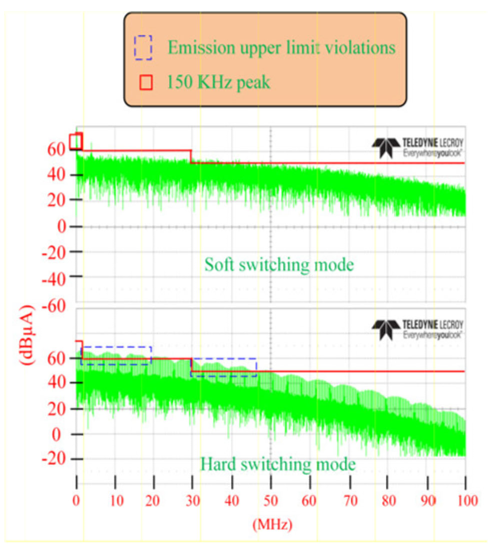
The shift towards high-frequency power conversion necessitates minimizing switching losses. This paper presents a True ZVZCS (Zero Voltage Zero Current Switching) nonisolated bidirectional converter that overcomes the limitations of traditional soft-switching. By using a minimalist auxiliary resonant network, it achieves nearly lossless transitions for all switches, resulting in a staggering 98.2% efficiency and a significantly cleaner EMI profile.
The Problem: The Efficiency-Versatility Trade-off
In power electronics, soft switching is the "holy grail." However, most existing solutions face a triad of challenges:
- Limited Range: ZVS/ZCS conditions often vanish when the load current or input voltage fluctuates.
- Directional Bias: Many high-efficiency ZVZCS topologies only work in one direction (e.g., Boost only), making them useless for battery storage systems.
- Complexity: Adding dozens of auxiliary components often introduces new conduction losses that negate the switching efficiency gains.
The authors solve this by asking: Can we create a unified resonant cell that works for both current directions with minimal parts?
Methodology: The Anatomy of a True ZVZCS Transition
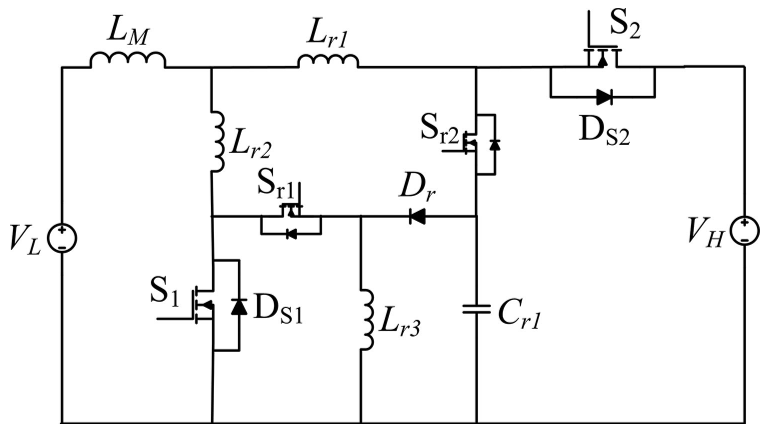
The core innovation is the auxiliary network comprising and . Unlike traditional snubber circuits that merely "soften" the blow, this circuit alters the voltage and current trajectories so they never overlap during switching.
1. The Architecture
The main switches () are supported by two low-power auxiliary switches (). The inductive snubbers () prevent the rapid rise of current (ZCS at Turn-on), while the resonant capacitor handles the voltage transition (ZVS at Turn-off).
2. Eliminating Reverse Recovery
One of the "silent killers" of efficiency is the diode reverse recovery loss. By optimizing to store and then recycle the reverse recovery charge of the high-side diode, the energy is fed back into the system rather than being dissipated as heat.
Experimental Validation & Results
The authors validated their design with a 150W prototype using a TMS320F2812 DSP for closed-loop control.
Key Performance Metrics:
- Max Efficiency (Boost): 98.2%
- Max Efficiency (Buck): 97.5%
- Switching Frequency: 100 kHz - 150 kHz
- EMI Compliance: Successfully met FCC Part 15 Subpart B Class A standards.
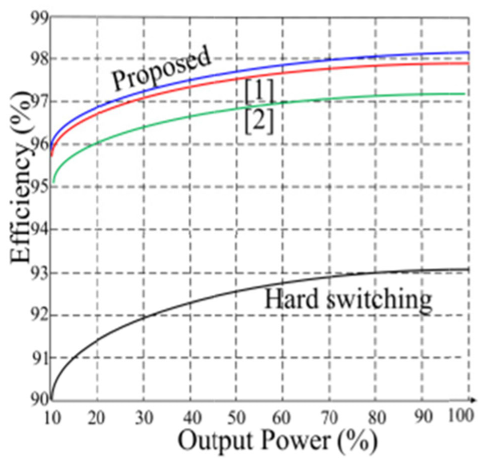
The results (shown above) demonstrate that the proposed converter maintains higher efficiency across the entire load range compared to hard-switched converters and even contemporary soft-switching designs.
Deep Insight: Beyond the Boost Converter
What makes this research particularly valuable is the "Family" concept. The authors demonstrate that this ZVZCS auxiliary cell isn't just for Boost/Buck topologies. It can be seamlessly integrated into Cuk, SEPIC, and Buck-Boost converters without changing the underlying timing logic.
Critical Analysis & Conclusion
Takeaway
This paper effectively bridges the gap between theoretical soft-switching and practical, wide-range bidirectional application. It provides a robust mathematical framework for sizing resonant components () based on switch rise/fall times.
Limitations
- Conduction Losses: At very high power levels, the of the MOSFETs becomes the dominant bottleneck. While switching losses are nearly zero, conduction losses remain.
- Component Precision: While the authors state inductors needn't be "very precise," extreme deviations can still shift resonant peaks out of the PWM dead-band.
Future Outlook
As Wide Bandgap (WBG) materials like GaN and SiC become standard, the timing requirements for auxiliary cells will become tighter (nanosecond scales). Applying this ZVZCS logic to MHz-range GaN converters could potentially push bidirectional efficiency toward the 99% threshold.