
Unified Social Landscapes: Deciphering the Architecture of the Global Super-Graph
3405_A Global Social Graph as a Hybrid Hypergraph.
This paper introduces a large-scale analysis of multi-layered social networks, focusing on the structural properties of integrated "Super-Graphs" composed of numerous individual social platforms. By synthesizing data from over 60 social graphs (including LiveJournal, Twitter, and Flickr), the study investigates how user connectivity and power-law distributions behave when aggregating diverse social ecosystems into a singular hyper-graph structure.
TL;DR
As users distribute their digital lives across dozens of platforms, the "Social Graph" is no longer a localized silo but a fragmented hyper-structure. This study aggregates 60 diverse social networks (including Twitter, Flickr, and LiveJournal) into a Super-Graph to analyze whether universal scaling laws—like the Power Law and Clustering Coefficients—survive the transition from individual platforms to a global aggregate.
Problem & Motivation: The Silo Fallacy
Most network science research treats Facebook or Twitter as an isolated island. However, the reality is a Multiplex Network where users (nodes) are shared across multiple environments. The core challenge is: When we merge these fragmented graphs, does the resulting "Super-Graph" become chaotic noise, or does it maintain the mathematical elegance of a Small-World network?
The authors identified that while individual platforms like pownce.com have high clustering (0.288), others like vox.com are significantly lower (0.069). Understanding the convergence of these statistics is vital for building cross-platform recommendation engines and understanding information virality.
Methodology: Engineering the Super-Graph
The authors define a composite graph . To analyze this, they focused on two primary metrics:
- Clustering Coefficient (): Measuring the probability that a user's friends are also friends with each other.
- Power-Law Distribution (): Determining if the "rich-get-richer" phenomenon (preferential attachment) holds true at a global scale.
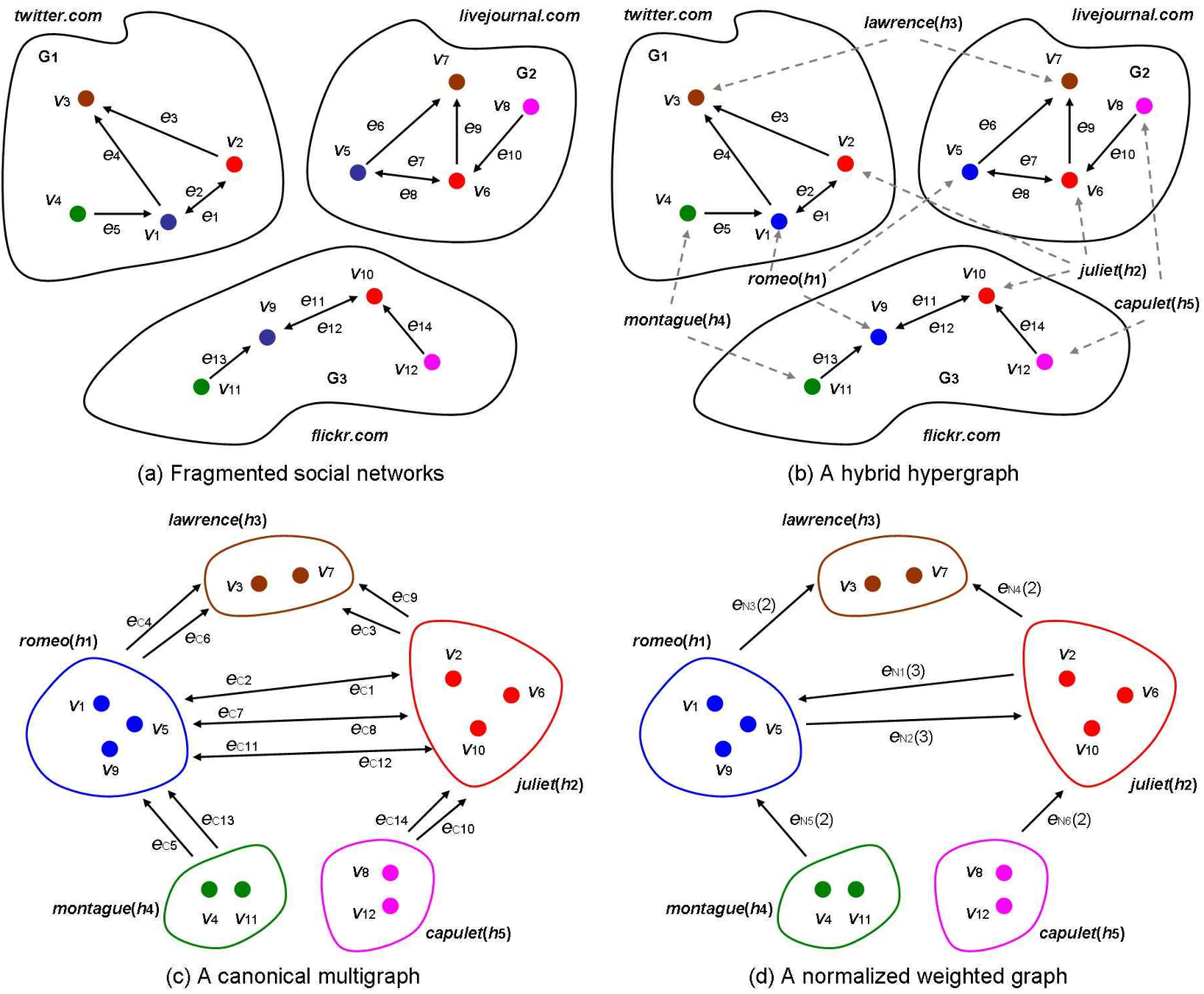 Figure 1: Visual representation of social graph integration.
For the Power-Law estimation, the authors moved beyond simple linear regression on log-log plots, utilizing a more robust Maximum Likelihood Estimation (MLE) approach to calculate the exponent :
Empirical Results: Consistent Scaling in Massive Data
The analysis across 10 primary datasets (G1-G10) and the final integrated graph revealed a surprising stability in network topology:
| Social Graph | Nodes (V) | Edges (E) | Alpha () |
|---|---|---|---|
| LiveJournal | 575,723 | 15,324,304 | 1.38 |
| 78,482 | 2,614,327 | 1.41 | |
| Super-Graph (GN) | 871,393 | 25,695,202 | 1.39 |
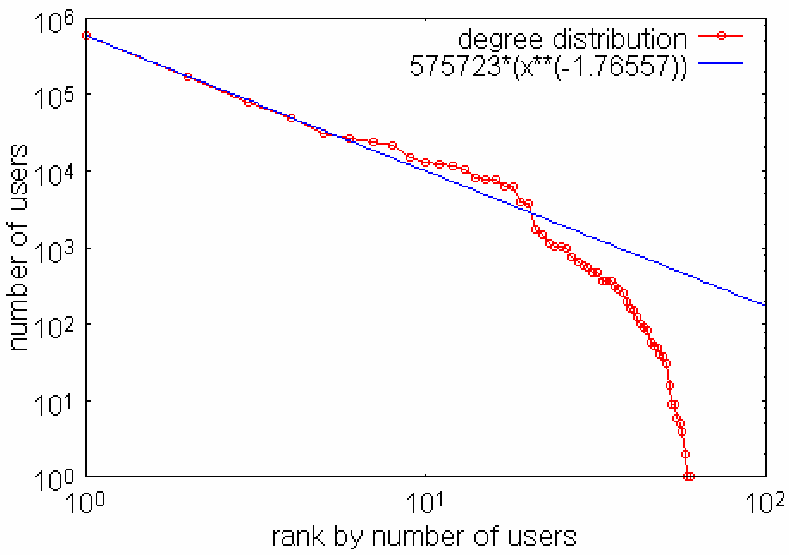 Figure 2: Node degree distribution showing the strict adherence to Power-Law across scales.
The global Clustering Coefficient () for the super-graph remained at 0.0857. While lower than some specific niche platforms, it is significantly higher than a random graph of equivalent size, confirming that the Small-World effect is an emergent property of the global social fabric, not just a platform-specific quirk.
Critical Insight & Future Outlook
The primary takeaway is the structural invariance of social behavior. Whether users are sharing photos on Flickr or micro-blogging on Twitter, the underlying "social physics" results in a Power-Law exponent near 1.4 and a consistent clustering density.
Limitations: The dataset, while massive, is a snapshot in time. Social networks are dynamic; the transition from Web 2.0 to Web 3.0 (where identities are portable) may further condense these clustering coefficients.
Future Work: This research lays the groundwork for Interoperable Social Graphs. If we know the global graph's mathematical properties, we can design "bridge" algorithms that help users rebuild their social capital more efficiently when moving between decentralized platforms.