
Scaling Gender Classification: Deep Learning on 5 Million Weakly Labelled Images
3530_Gender Classification by Deep Learning on Millions
The paper presents a high-performance gender classification system trained on 5 million weakly labelled images using Deep Convolutional Neural Networks (CNNs). By scaling both the dataset size and network depth (based on the VGG-16 architecture), the authors achieve state-of-the-art results on the Labeled Faces in the Wild (LFW) and GROUPS datasets.
Executive Summary
TL;DR: This research demonstrates that the "unreasonable effectiveness of data" applies directly to gender recognition. By training deep VGG-based networks on over 5 million images scraped from the web, the authors achieved a record-breaking 98.90% accuracy on LFW, proving that volume and depth can overcome the noise inherent in weak labeling.
Positioning: This work moves away from carefully curated, small-scale datasets toward a "Big Data" paradigm, establishing new SOTA benchmarks for cross-database generalization in unconstrained environments.
Problem & Motivation: The Real-World Gap
While gender recognition might seem solved in controlled laboratory settings, "In-the-Wild" images (unaligned, poor lighting, diverse poses) remain a significant challenge. Most prior works used hand-labeled datasets which are inherently limited in scale. When these models are tested on data from different sources (Cross-database testing), their accuracy typically plummets.
The authors' intuition was twofold:
- More Data beats Better Labels: Weak labels (derived from text queries) allow for a massive increase in training volume that compensates for occasional labeling errors.
- Context Matters: A face isn't just a collection of landmarks; surrounding pixels (hair, shoulders, clothing) provide vital gender cues that "tight crops" discard.
Methodology: Depth and Context
The team developed three network architectures, G6, G10, and G16, progressively adding convolutional layers based on the VGG-16 framework.
1. The Power of Depth
They found a direct correlation between model depth and the ability to digest noisy data. Deep networks (G16) were far more capable of extracting abstract features from the 5-million-image corpus than shallow networks (G6) or traditional SVMs with Local Binary Patterns (LBP).
2. The Contextual Insight
In Experiment 2, the researchers expanded the facial bounding box by 1.5x. This simple change allowed the CNN to "see" hairstyle and clothing, which boosted accuracy by 0.65%—a significant margin when approaching the near-perfect 99% ceiling.
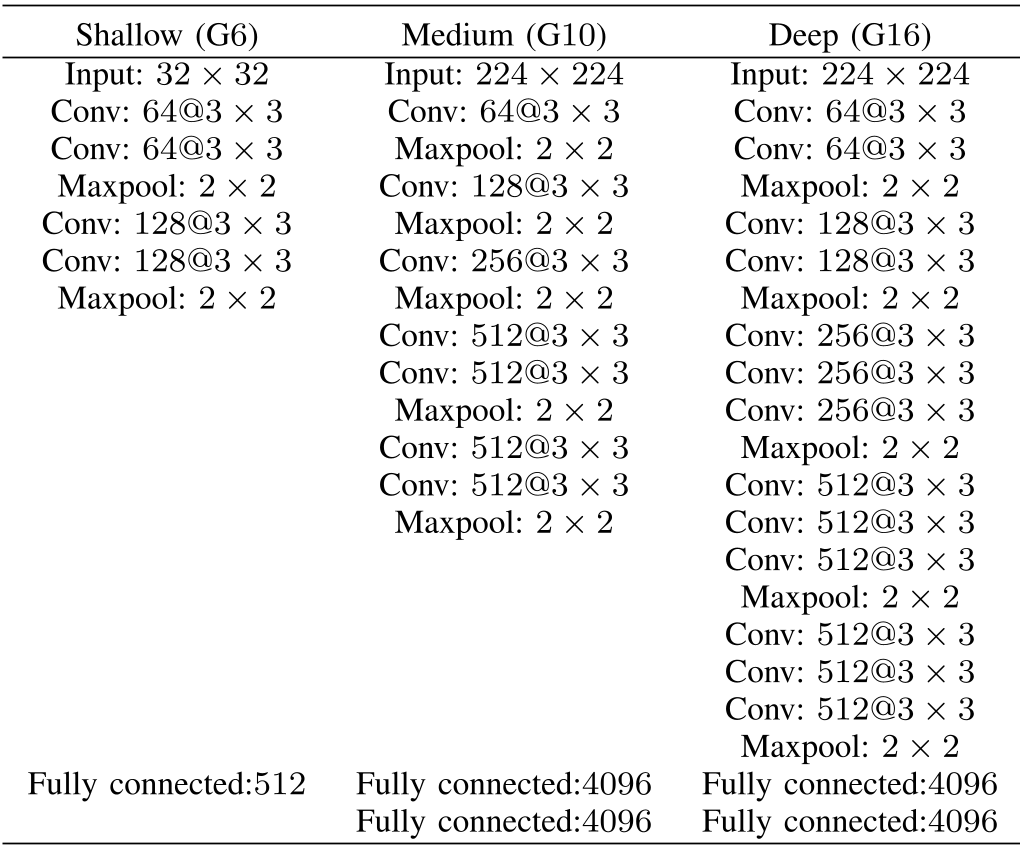 Table: Comparison of the Shallow (G6), Medium (G10), and Deep (G16) architectures used.
Experiments & Results
The G16 model dominated across all benchmarks. Most impressively, the model showed remarkable Generalization. Even when trained on one dataset and tested on another (Cross-database), the performance remained stable.
| Dataset | Previous SOTA | This Work (G16) |
|---|---|---|
| LFW (Aligned) | 97.31% | 98.90% |
| GROUPS (Full) | 90.14% | 91.34% |
| GROUPS (Adults) | 80.53% | 96.10% |
 Table: The impact of network depth and bounding box size on accuracy.
Critical Analysis & Conclusion
Takeaway
The primary contribution is the validation of Large-Scale Weak Supervision. By using millions of images, the network learns an internal representation of gender that is robust to the variety of real-world photography.
Limitations
- Weak Labels: While the volume helps, the paper doesn't deeply explore the "noise ceiling"—at what point does more noisy data stop helping?
- Bias: The use of IMDB names for queries likely introduces a Western-centric demographic bias, which is a common limitation in 2017-era facial datasets.
Future Outlook
This work paved the way for modern "Foundation Models" in facial analysis. Future research can extend this by using self-supervised learning to eliminate the need for gender-specific text queries entirely, or by exploring the ethical implications of such high-accuracy surveillance-adjacent technologies.