
Beyond Keywords: Discovering Environmental Data through Heatmap Recognition
3575_Discovery of Environmental Web Resources Based on the Combination of Multimedia Evidence.
This paper proposes a multimedia-driven framework for discovering environmental Web resources, specifically those providing air quality measurements and forecasts. It combines textual and visual evidence—specifically targeting "heatmaps"—through domain-specific search engine querying and post-retrieval filtering using SIFT/SURF descriptors with VLAD encoding.
TL;DR
Researchers have developed a new framework to find elusive air quality data on the Web by treating search as a multimedia problem. By specifically looking for heatmaps—the visual currency of environmental forecasts—and combining traditional text search with advanced image descriptors (SIFT/SURF + VLAD), they have significantly boosted the precision and recall of environmental resource discovery.
The "Data in Images" Bottleneck
When you search for "air quality forecasts," most search engines find articles about pollution. However, the actual raw data and sensors are often tucked away in portals that present information through interactive or static maps. These heatmaps (as seen in Figure 1) are high-signal indicators of a "highly relevant" resource, yet most domain-specific crawlers ignore them, leading to noisy results.
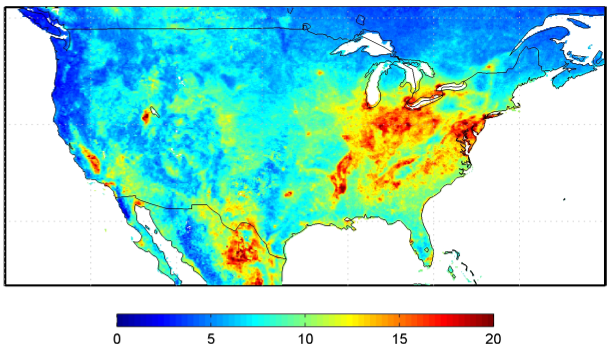 Figure 1: A typical air quality heatmap representing PM2.5 concentrations.
Methodology: The Multimedia Discovery Pipeline
The authors argue that a resource's "relevance" is a sum of its parts. Their framework operates in two distinct phases:
1. The Multi-Channel Query Phase
Instead of just using Google or Yahoo Web search, the system generates "Keyword Spices"—complex Boolean logic derived from machine learning (C4.5 decision trees) to find terms that distinguish data portals from generic news sites. These queries are then submitted to both Web and Image Search APIs. This is a crucial pivot: searching for the images first leads the crawler back to the high-value pages hosting them.
2. Post-Retrieval Multimedia Fusion
Once a page is found, the system doesn't just trust the text. It analyzes the embedded images specifically looking for heatmaps.
- The Surprise in the Tech Stack: Interestingly, the study found that "shallow" descriptors like SIFT and SURF combined with VLAD encoding outperformed Convolutional Neural Networks (CNNs).
- Why? Because standard CNNs (like those trained on ImageNet) are designed to see "dogs and cats," not the abstract geometric and color patterns specific to atmospheric heatmaps.
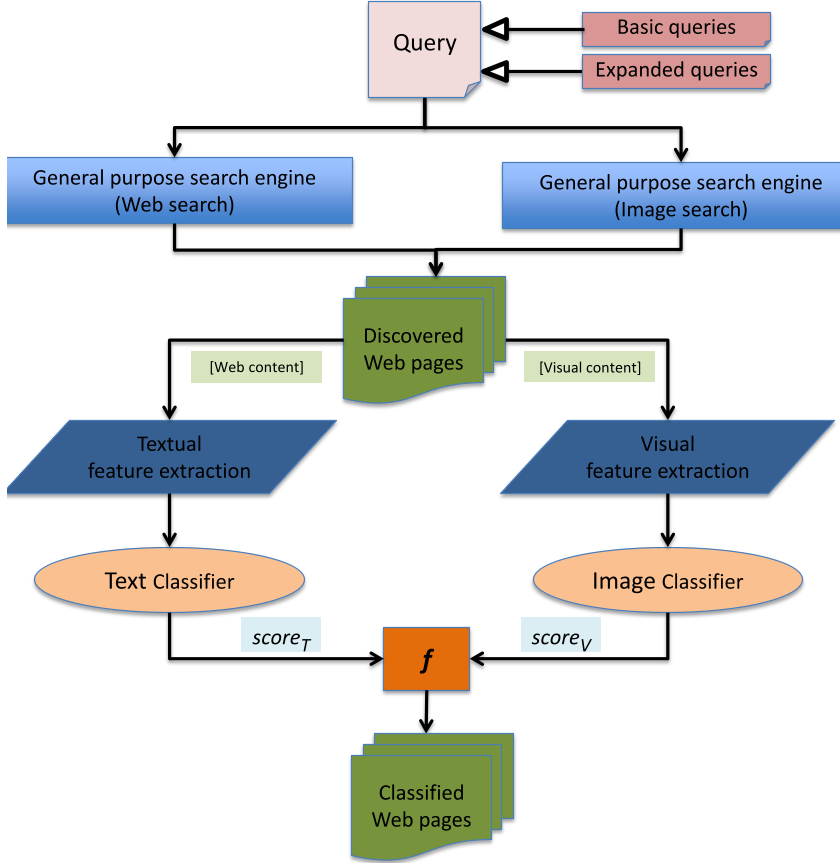 Figure 2: Overview of the discovery framework combining textual and visual classification.
Benchmarking Performance
The experimental results confirm that "Keyword Spices" (Q4) combined with visual evidence provide the most effective results.
| Descriptor Type | Precision | Recall | F-measure |
|---|---|---|---|
| SSV (SIFT/SURF + VLAD) | 99.83 | 97.95 | 98.88 |
| CNN-M (Medium Architecture) | 97.52 | 67.18 | 79.55 |
| CNN-S (Slow Architecture) | 99.51 | 52.22 | 68.50 |
As shown in the data, the SSV approach is the clear winner for heatmap recognition. In the final stage of resource discovery, using combination methods like CombMNZ (which factors in both the number of positive signals and their confidence) yielded the best balance, achieving a recall of 0.93 for finding air quality nodes.
Critical Insight & Future Outlook
This paper serves as a vital reminder that in the era of Deep Learning, "old school" feature descriptors like SIFT/SURF still hold significant value for specialized, fine-grained visual tasks where large-scale labeled datasets (like those needed to fine-tune a CNN for heatmaps) are scarce.
Takeaway for Practitioners: If you are building a domain-specific search engine for scientific, medical, or technical fields, do not ignore the visual "fingerprints" of your data. Combining image-based discovery with text-based filtering is no longer optional—it is a requirement for SOTA performance.
Limitations
The current model relies on pre-defined "keyword spices" which may become stale as Web terminology evolves. Additionally, while the SIFT/SURF approach is highly accurate, it is computationally regular; future iterations could explore using Vision Transformers (ViTs) or specialized Self-Supervised Learning to eliminate the need for manual feature engineering while maintaining the high accuracy seen here.