
NVIE: Bridging the Gap Between Artificial and Natural Affective Computing
3595_A Natural Visible and Infrared Facial Expression Database for Expression Recognition and Emotion Inference.
The paper introduces the Natural Visible and Infrared Facial Expression (NVIE) database, a comprehensive multimodal dataset containing both spontaneous and posed expressions from over 100 subjects. It is the first database of its kind to provide simultaneous visible-light and infrared thermal imagery under various illumination conditions and with/without glasses to support robust facial expression recognition (FER) and emotion inference.
TL;DR
Researchers from USTC have released the Natural Visible and Infrared Facial Expression (NVIE) database, the first large-scale dataset to capture both spontaneous and posed emotions across two spectrums. By providing synchronized thermal and visible data, the study demonstrates that while visible light remains king for "Happiness," infrared thermal data offers unique, illumination-independent clues for deep emotional inference through temperature variance in the forehead and cheeks.
Background & Motivation: The "Posed" Problem
Most computer vision models for emotion recognition are trained on "Actors"—people told to "look angry" or "look surprised." These are posed expressions, which tend to be exaggerated and morphologically distinct from the subtle, fleeting expressions we make in real life.
Furthermore, the visible spectrum is a fickle friend; a slight change in room lighting can render a model useless. Infrared Thermal Imaging offers a solution by recording the heat distribution of facial veins, which is immune to external lighting. However, until this work, there was no comprehensive database combining spontaneous triggers with dual-spectrum recording.
Methodology: The NVIE Architecture
The authors constructed a dedicated photographic room equipped with a visible camera (704x480) and an infrared camera (320x240, 8–14 μm band).
1. Data Collection Strategy
- Spontaneous Elicitation: To get "real" reactions, subjects watched 3-4 minute emotional clips (Happy, Sad, Angry, Fearful, etc.).
- Posed Collection: After the videos, subjects were asked to mimic the six basic emotions under various conditions.
- Variations: The set includes front, left, and right lighting, as well as images with and without glasses.
2. The Verification Pipeline
The authors didn't just release data; they established baselines using:
- Visible Spectrum: PCA, LDA, and AAM (Active Appearance Models) to capture shape and texture.
- Infrared Spectrum: Analyzing absolute temperature and temperature variance (VAR).
 Fig 1: Examples of Posed vs. Spontaneous expressions in the NVIE database.
Key Insights from Experiments
Visible Recognition: Happiness is Universal
The baseline results (Tables III & IV) show that Happiness is the easiest to recognize (often >80% accuracy). Why? Because most people smile in a similar way (lifting mouth corners). Conversely, Disgust and Fear are frequently confused because individual "natural" reactions to fear vary wildly—some open their mouths, some close them, some squeeze their eyes shut, others widen them.
Thermal Recognition: The Temperature of Emotion
The paper’s most intriguing contribution is the ANOVA analysis of facial temperature.
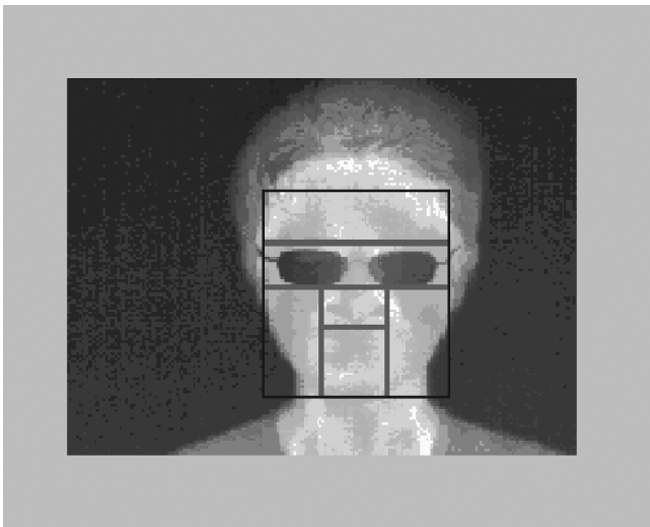 Fig 2: Manual segmentation of the face into 5 regions for thermal analysis.
- Key Finding: The Forehead and Cheeks are the most statistically significant regions (using the VAR parameter) for detecting emotional shifts.
- The "Nose" Exception: Unlike visible features where the mouth is critical, the nose region in thermal imaging is often inconsistent, likely due to changes in breathing patterns during arousal.
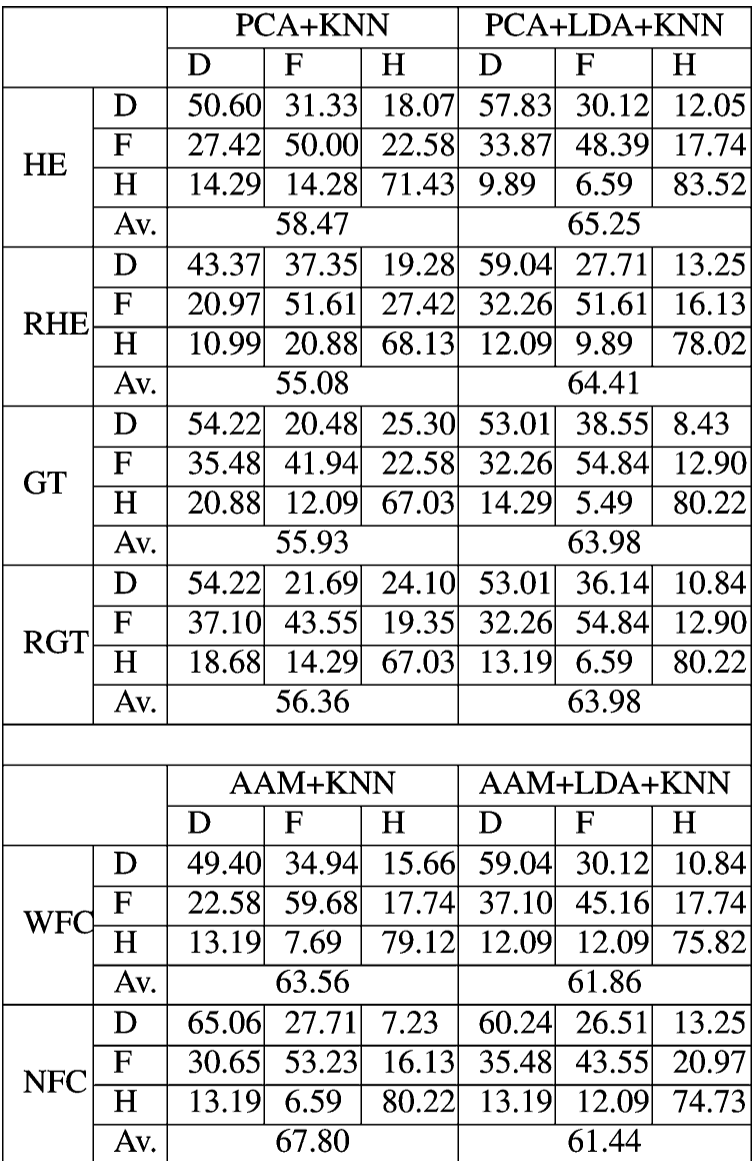 Table 1: Performance of various baseline algorithms (PCA, LDA, AAM) on the NVIE dataset.
Critical Analysis & Conclusion
While the NVIE database is a landmark for the field, the baseline results show that Natural Expression Recognition is still significantly harder than recognizing posed emotions. The recognition rates for spontaneous infrared expressions (approx. 41%) highlight a massive "accuracy gap" that modern deep learning models need to fill.
Takeaway for Researchers:
- Foreheads Matter: If you are using thermal cameras for emotion AI, focus your feature extraction on the forehead and cheek temperature variances.
- Multimodal is Mandatory: Combining visible and infrared data is the only reliable way to handle the high variability and low intensity of natural, spontaneous emotions.
Future Outlook: The NVIE database paves the way for "in-the-wild" affective computing, where systems can understand how we feel even in low light or when we are trying to mask our expressions.