
Hypergraph Learning: Mastering Visual-Textual Synergy in Social Image Search
3686_Visual-Textual Joint Relevance Learning for Tag-Based Social Image Search.
The paper introduces a Visual-Textual Joint Relevance Learning approach for tag-based social image search using hypergraph learning. By constructing a hypergraph where vertices represent images and hyperedges encapsulate both bag-of-visual-words and bag-of-textual-words, the method achieves SOTA ranking performance on a dataset of 370K+ images.
TL;DR
Researchers have developed a Visual-Textual Joint Relevance Learning framework that treats social image search as a hypergraph problem. Unlike traditional methods that look at tags and pixels separately, this approach connects images through "hyperedges" representing shared visual or textual concepts. By automatically learning which tags are "junk" and which are "gold," the system achieves a massive boost in search relevance (NDCG@20 from 0.57 to 0.88).
Problem & Motivation: The Noise of the Social Web
Social platforms like Flickr are goldmines for data, but they are incredibly messy. Two primary issues plague tag-based search:
- Tag Noise: Only about 50% of user-provided tags are actually relevant to the image content.
- Sequential Bias: Previous systems usually filtered by tags then refined by visual features (or vice versa). This "sequential" logic loses the bridge between a semantic concept (the word "Apple") and its visual manifestation (the fruit vs. the tech logo).
The authors' insight was simple yet powerful: high-order relationships. An image isn't just a point; it’s a vertex in a complex web where a single hyperedge can link dozens of images sharing a specific nuance, whether it's a visual texture or a specific tag.
Methodology: The Weighted Hypergraph
The core of the paper is the construction of a Social Image Hypergraph.
1. Unified Representation
The system extracts Bag-of-Visual-Words (BoVW) using SIFT descriptors and Bag-of-Textual-Words from tags. Each unique visual word or tag becomes a hyperedge. If five images contain the "gear" visual word, they are all linked by one hyperedge.
2. Architecture & Weight Learning
Traditional hypergraphs use fixed weights for edges. This is a mistake in social media because "noise" tags would carry as much weight as "signal" tags. The authors introduced HG-WE (Hypergraph with Weight Estimation).
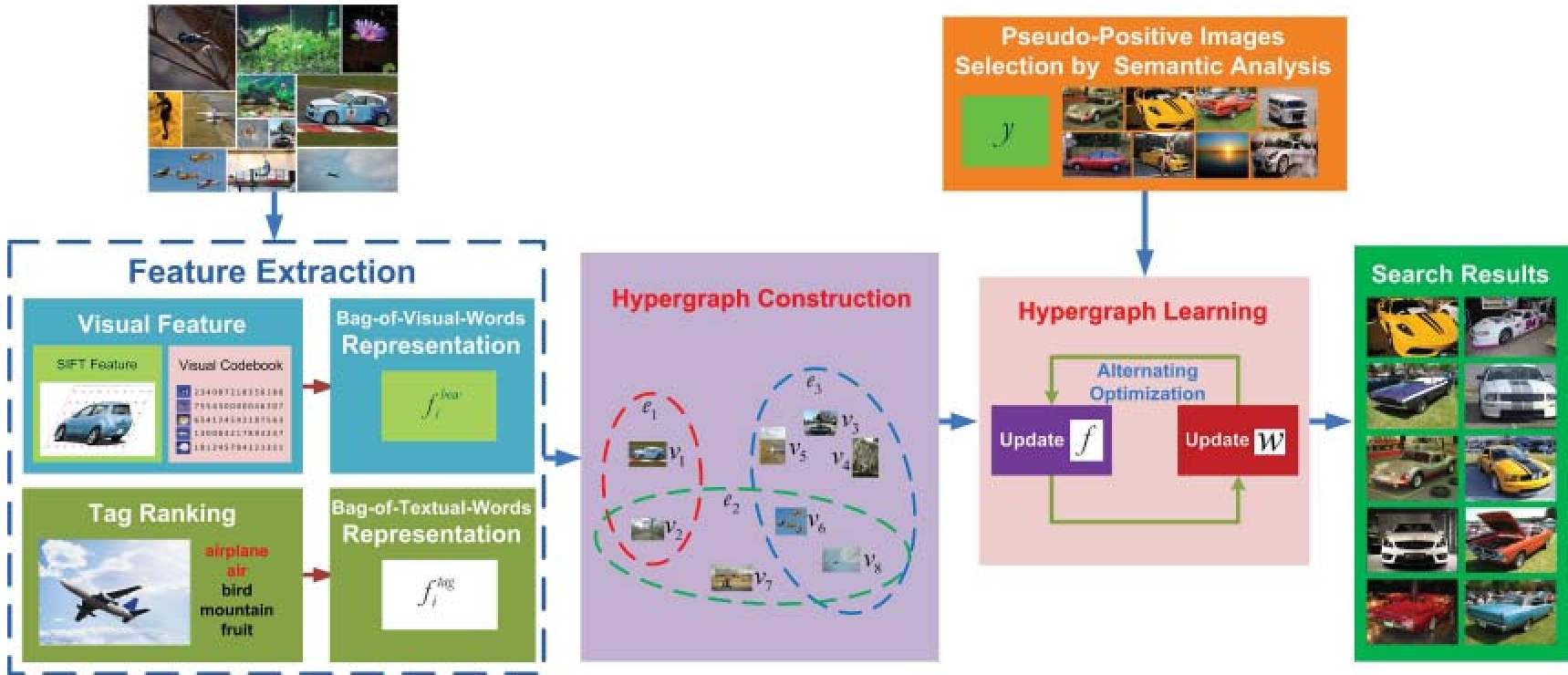
The algorithm uses an alternating optimization strategy:
- Step A: Fix the weights and solve for the image relevance scores ().
- Step B: Fix the relevance scores and update the hyperedge weights ().
This iterative process effectively "mutes" noisy tags and highlights visual features that consistently appear in relevant samples.
Experiments & Results: Seeing the Difference
The team tested their method against several baselines, including standard Graph-based learning and sequential reranking.

Quantitative Edge
As shown in the table above, the HG-WE (Hypergraph with Weight Estimation) method achieved a mean NDCG@20 of 0.8814, dwarfing the "Sequential" method's 0.5778.
Qualitative Intuition
For the query "Apple," the system successfully retrieved both the fruit and the tech brand products. By using Flickr Distance to select pseudo-positive samples, the model learned a broader manifold of "appleness" than simple tag matching could ever achieve.
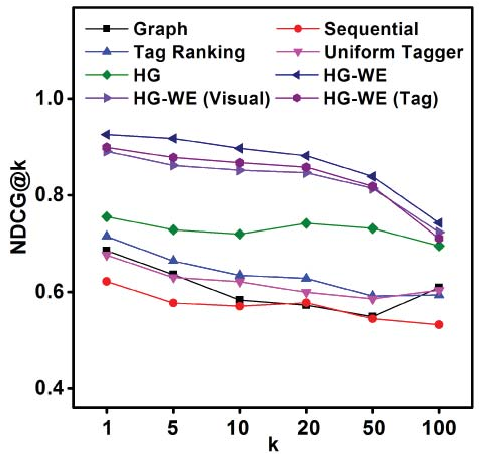
In the figure above, note how HG-WE maintains diversity while ensuring every result is strictly relevant to at least one facet of the query.
Critical Analysis & Conclusion
The true value of this paper lies in its probabilistic explanation of hypergraph learning. By assuming hyperedge weights follow a Gaussian distribution, the authors transformed a heuristic weighting problem into a formal Bayesian inference task.
Limitations:
- Computational Cost: As the authors admit, the iterative optimization is slower than simple graph methods.
- Feature Aging: The use of SIFT and BoVW is somewhat dated compared to modern Vision Transformers (ViT) or CLIP-based embeddings.
Future Outlook: Integrating this hypergraph weighting mechanism with Deep Embeddings could likely lead to even more significant breakthroughs in cross-modal retrieval. This paper remains a cornerstone for anyone looking to model higher-order correlations in multi-modal data.