
Controlling the Uncontrollable: How Randomness Can Break Social Polarization
3844_Use of Random Topics as Practical Control Signals in a Social Network Model.
This paper introduces a practical control framework for knowledge diffusion in synthetic social networks by injecting random topics into strategic "driver nodes." By leveraging serendipity—the unsought encounter of information—the authors demonstrate a method to perturb network evolution using the "Rewiring Effect" to mitigate polarization and filter bubbles.
TL;DR
Social networks naturally drift toward "filter bubbles" and extreme polarization. This paper demonstrates that instead of using heavy-handed persuasion, we can "reset" network dynamics by injecting random topics into key nodes. This "serendipity injection" reduces network rigidity, increases clustering, and makes the system far more controllable and healthy.
Background: The Problem with Pure Controllability
In technical systems, "controllability" means the ability to move a system from any state A to state B. In social networks, however, we don't have "knobs" to turn or "hooks" to pull. We cannot force people to change their minds without provoking "reactance"—a psychological backlash.
The authors identify a critical gap: Prior work focuses on the math of control but ignores the ethics and practicality of social influence. They argue that the goal shouldn't be to hit a specific "target state," but to nudge the system away from "negative outcomes" like extreme homophily or information enclaves.
Methodology: The Power of Serendipity
The core of this research is a synthetic model of knowledge diffusion. Unlike static models, this one evolves: agents "ask questions" to those who know more about specific topics (experts). This naturally leads to Hubs (super-experts) and Polarization (specialists who ignore the broader info spectrum).
The "Rewiring" Mechanism
The authors introduce a control signal: Random Topic Injection.
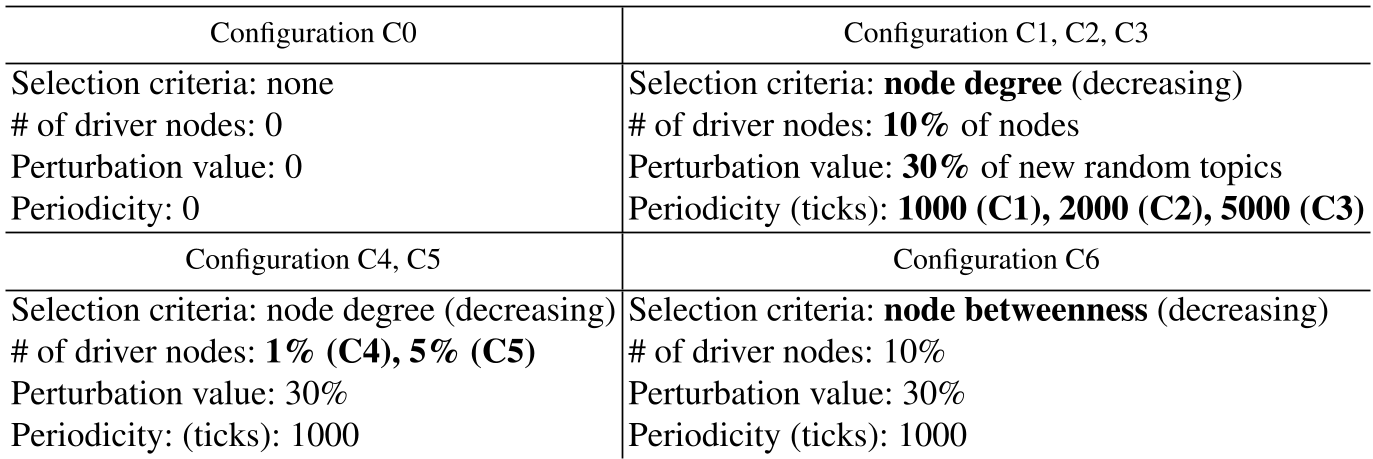
- Driver Node Selection: They identify nodes based on Degree (connections) or Betweenness (bridge-like quality).
- Stochastic Perturbation: At fixed intervals, these nodes are given random topics they didn't previously care about.
- The Result: These nodes suddenly look for new interaction partners outside their "bubble," effectively rewiring the network's topology.
Experiments and Scale Effects
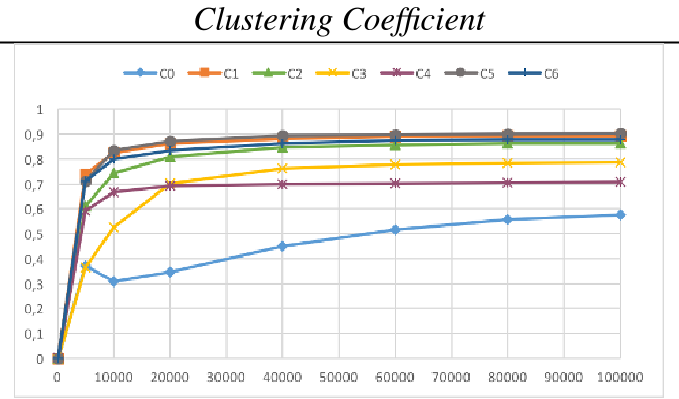
The researchers tested configurations (C1-C6) across network sizes from 100 to 1,000 nodes. They measured Average Node Degree (density) and Clustering Coefficient (local connectivity).
Key Findings:
- Efficiency of Hubs: Injecting random topics into just 1% of nodes (the main hubs) can drastically reduce the average degree across the whole network.
- Small-World Transformation: As random info enters the system, the clustering coefficient increases while the average degree drops. This suggests the network is moving toward a "Small-World" architecture, which is theoretically easier to control.
- Scale Sensitivity: In smaller networks (N=200), control is easy. In larger networks (N=1000), the formation of a "Giant Component" (the main body of the network) slows down, requiring more frequent perturbations.
Deep Insight: Why Randomness is Effective
The brilliance of this approach lies in its Inductive Bias. Most control strategies try to find the "perfect" path to influence. This paper argues that in social systems, diversity is the control. By increasing information heterogeneity, you naturally break the gravitational pull of "attractors" (polarized states).
The "Rewiring Effect" works because it bypasses the system's preference for similarity (Homophily). It acts like a digital version of a "chance encounter" at a library or a coffee shop, forcing the network to maintain links that would otherwise wither away.
Critical Analysis & Conclusion
Takeaway
This work provides a strategic blueprint for social media platforms and educational tools. If a community is becoming too insular, the solution isn't to censor or direct-message users; it is to subtly increase the serendipity of their information feed.
Limitations
- Synthetic Constraints: The model assumes agents always accept new knowledge if the source is an expert. In reality, trust and ideological barriers are much higher.
- Dynamic Scaling: The study notes that as networks grow, the ratio of information to agents decreases, potentially leading to communication congestion that wasn't fully explored for massive (N > 10,000) scales.
Future Work
The next frontier is applying these random control signals to live social networks or recommendation algorithms to observe if "artificial serendipity" can truly dismantle real-world political polarization.