
Safebook: Weaponizing Real-Life Trust to Topple Centralized Social Media Giants
3990_Safebook A privacy-preserving online social network leveraging on real-life trust.
Safebook is a decentralized, privacy-preserving Online Social Network (OSN) that replaces centralized providers with a peer-to-peer (P2P) architecture. It leverages a unique "Matryoshka" structure built on real-life trust relationships to achieve SOTA-level data privacy and protection against identity-based attacks.
TL;DR
Safebook is a revolutionary peer-to-peer (P2P) social network architecture that eliminates the need for a central service provider like Facebook. By organizing users into Matryoshkas—concentric shells of trusted friends—it ensures that personal data remains encrypted and metadata is obscured, effectively neutralizing "Big Brother" surveillance while maintaining social functionality.
Background: The Price of "Free" Social Networks
In the modern digital landscape, the "service provider" is often the greatest threat to user privacy. Centralized OSNs hold a monopoly on user interactions, enabling mass profiling, image harvesting, and unauthorized data mining. Even if a user manages their privacy settings perfectly, the provider still owns the raw database. Safebook shifts the paradigm from "trusting a corporation" to "leveraging existing real-life trust."
The Problem: The P2P Trust Gap
Previous attempts at decentralized social networks (like early P2P systems) suffered from two major flaws:
- Lack of A Priori Trust: How do you know a peer in the network isn't a malicious bot?
- Performance vs. Anonymity: Systems like Tor or Freenet offer high anonymity but suffer from prohibitive delays for social interaction.
Methodology: The Matryoshka Architecture
Safebook’s core innovation is the Matryoshka system. Instead of storing your data on a central server, your data is replicated across a shell of "Mirrors"—your actual, trusted friends.
1. Multi-Layered Security
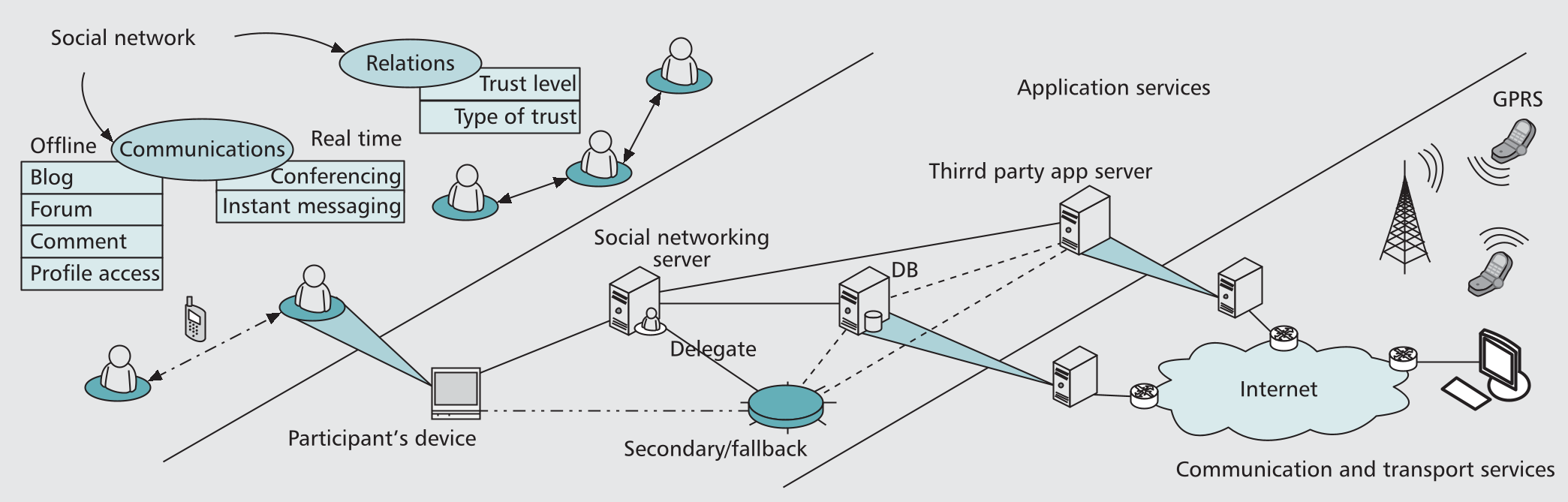
The system operates on three distinct levels:
- Social Network (SN) Level: The digital representation of your real-life friends.
- Application Service (AS) Level: A P2P substrate (Kademlia-based) for looking up contacts.
- Communication & Transport (CT) Level: The underlying Internet infrastructure.
2. The Matryoshka Mechanism
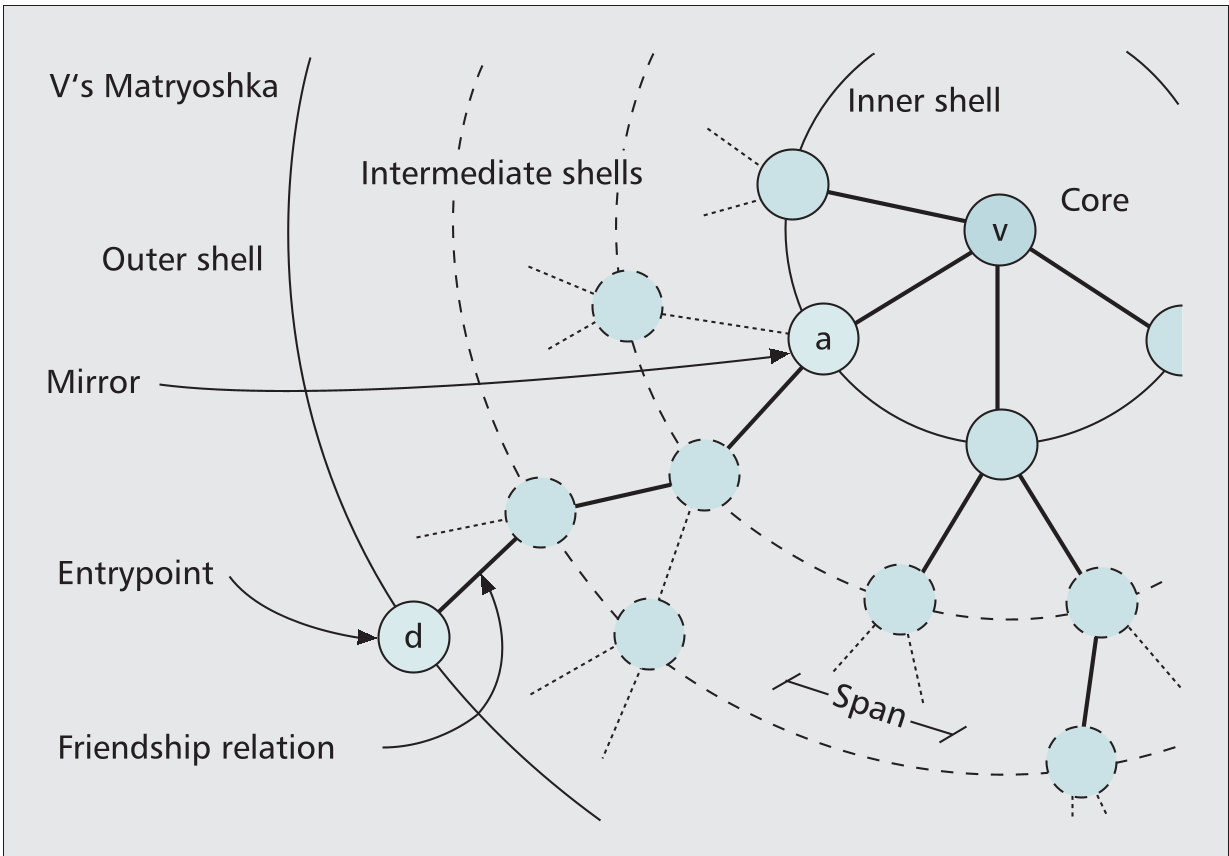
Each user is a "core" surrounded by rings.
- Mirrors (Inner Shell): Direct friends who store your encrypted profile data.
- Entrypoints (Outer Shell): Nodes that act as gateways for search requests.
- Radial Paths: Communication travels through these shells. Because every "hop" in a shell is a trust-based link, an attacker cannot easily infiltrate the path to discover your identity (Node ID) or your physical IP address.
3. Identity and Encryption
Safebook uses a Trusted Identification Service (TIS) to prevent Sybil Attacks (where an attacker creates thousands of fake profiles). Users must prove their real-world identity (e.g., via a passport or face-to-face verification) to receive a unique Node ID and Pseudonym.
Experiments: Performance vs. Privacy
The authors conducted a feasibility study to address the "elephant in the room": does this multi-hop routing make the network too slow?
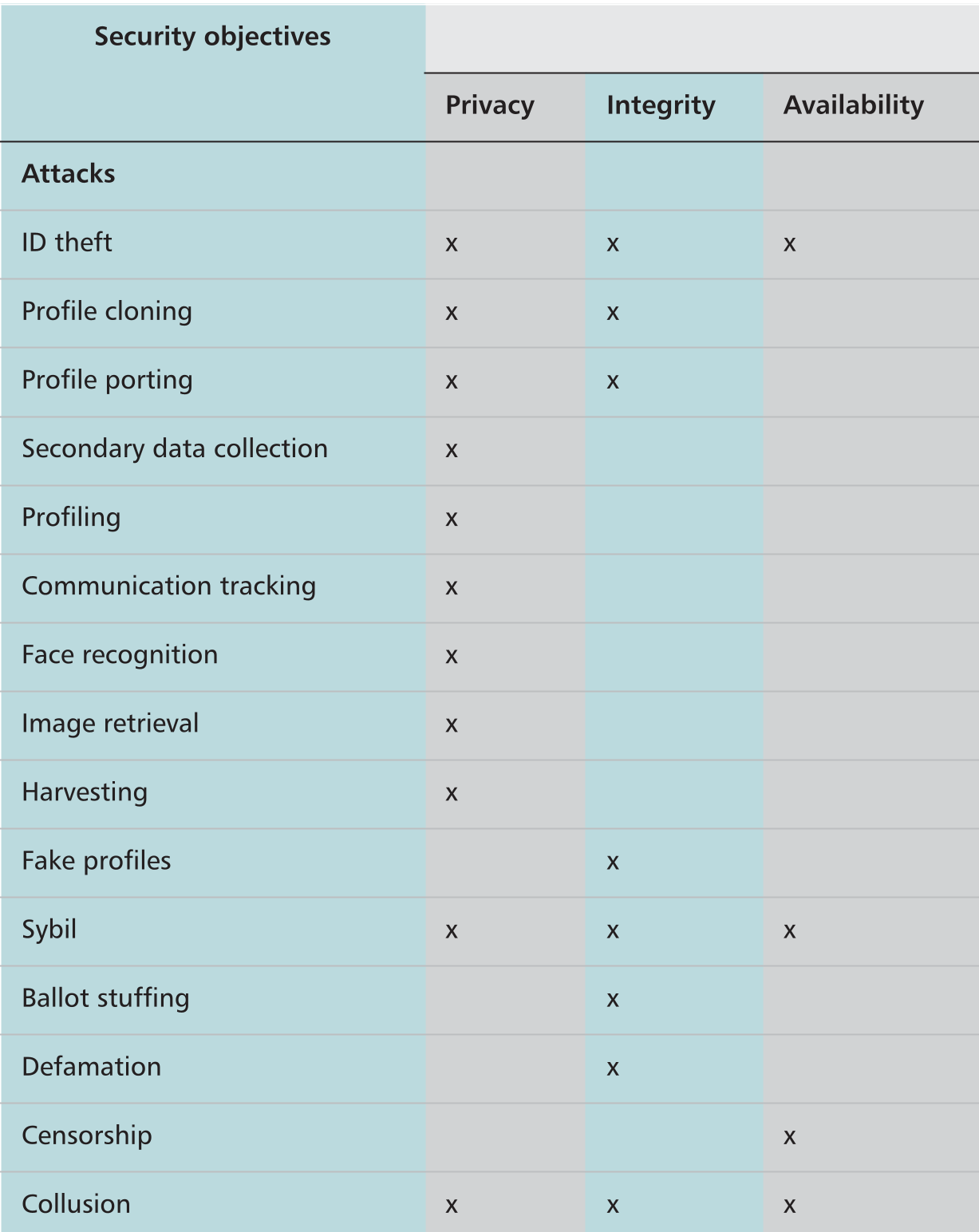
Key findings include:
- Integrity: The TIS successfully mitigates ID theft and profile cloning—common plagues in centralized networks.
- Availability: By replicating data across mirrors, the system remains resilient even if the "core" user goes offline.
- Latencies: While slower than a direct server request, the lookup times are "feasible" for asynchronous social interactions (like wall posts and profile browsing).
Deep Insight: Why This Matters
Safebook is more than just a P2P app; it’s a study in Inductive Bias. It assumes that if you trust someone in real life, you can trust their computer to hold a piece of your encrypted digital life. This "Socially-Informed Routing" is a powerful tool against the profiling capabilities of current tech giants.
Conclusion & Future Work
Safebook demonstrates that we don't need a "Big Brother" to stay connected. By utilizing the trust we already have in our friends, we can build a resilient, private, and decentralized digital society. Future research will likely focus on reducing the latency of Matryoshka lookups and optimizing the "obfuscation layers" to protect against global traffic analysis.
Senior Editor's Note: This 2009 work was prophetic. As we move into the era of Web3 and decentralized identity, the principles of Safebook—trust-based replication and multi-shell anonymity—are more relevant than ever.