
Bridging the Emotional Gap: A Dynamic 3-D Virtual Talking Head for Natural HCI
Abstract-To investigate how emotions are identified from the avatar character in the natural scene during human-computer interaction. In current paper, a novel 3-D virtual talking head system with dynamic emotional facial expression for applying to human-robot communication was developed. Furthermore, eye tracking experiment and subjective evaluation experiment were utilized to explore the emotional perception of the 3-D virtual talking head. The results showed that there was no significant difference of observation mode between audio-visual animation of 3-D virtual talking head videos (AV3D) and audio-visual human face videos (AVHF). Besides, the recognition accuracy of HF was higher than 3D and almost all the accuracy of emotions had been improved when adding audio to videos. Finally, the results demonstrated that happiness was identified the best whether watching 3-D virtual talking head videos (3D) or human face videos (HF). These results implied that the 3-D talking head has potentially been as a suitable natural communication form in human-computer interaction
The paper presents a realistic 3-D virtual talking head system designed for human-computer interaction (HCI), utilizing a Dirichlet Free-Form Deformation (DFFD) algorithm for dynamic facial synthesis. The study evaluates the system's effectiveness through eye-tracking and subjective experiments, establishing that it achieves near-human performance in emotion perception, particularly when audio-visual cues are combined.
TL;DR
Researchers have developed a high-fidelity 3-D virtual talking head system that uses motion-capture data and the DFFD algorithm to synchronize speech with dynamic facial expressions. By conducting comprehensive eye-tracking and subjective studies, the paper proves that while humans still outperform avatars in purely visual emotion recognition, the gap nearly vanishes when audio is introduced, making 3D avatars a powerful tool for next-gen human-robot interaction.
Background & Motivation
Effective Human-Computer Interaction (HCI) requires more than just processing text; it requires affective computing. While much research has focused on how we perceive human faces, the transition to robotic agents often feels "stiff" or "unnatural." Existing methods often struggle with real-time responsiveness or fail to capture the nuances of dynamic movement—how a smile forms or how eyes widen during a surprise.
The authors argue that the key to acceptance is not just static accuracy, but dynamic synchronicity—the way facial muscles move in tandem with speech.
Methodology: The DFFD Advantage
The system's architecture (Fig. 1) is built on a high-precision pipeline:
- Data Collection: Using the OptiTrack system with 6 infrared cameras to capture 41 marker points at 100fps.
- Texture Mapping: Applying cylindrical projection to ensure the 3-D model looks "human-like" and approachable.
- DFFD Algorithm: Unlike simple linear interpolation, the Dirichlet Free-Form Deformation (DFFD) algorithm uses a Sibson local coordinate system. This means that a change in a control point (like a lip corner) naturally and smoothly deforms the surrounding "skin" area, mimicking biological tissue movement.
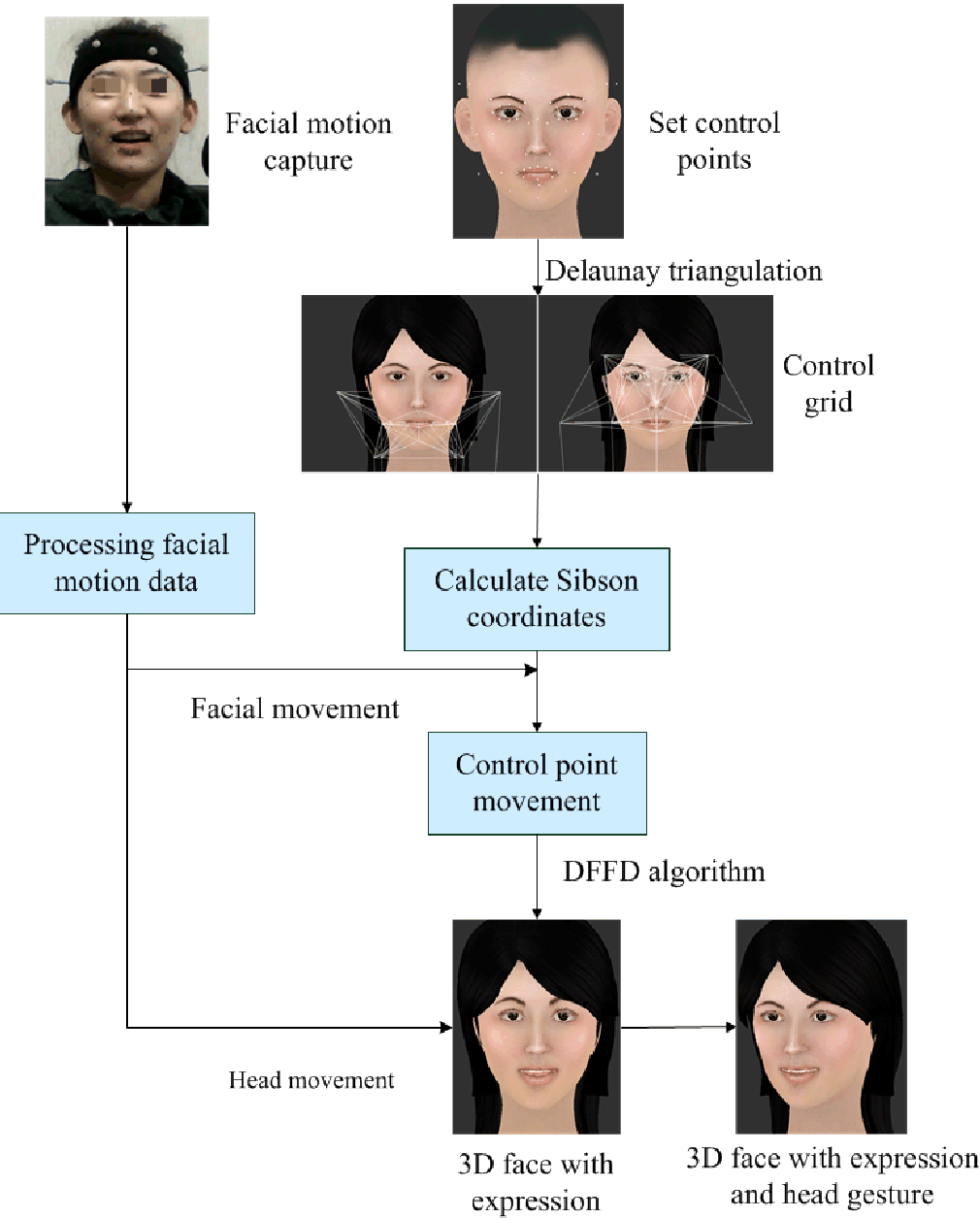 Fig 1: The structure of the 3-D dynamic facial expression synthesis system.
The researchers specifically increased control points in sensitive areas (increasing eye points to 24 and lip points to 16) to ensure the deformation was realistic enough for human perception.
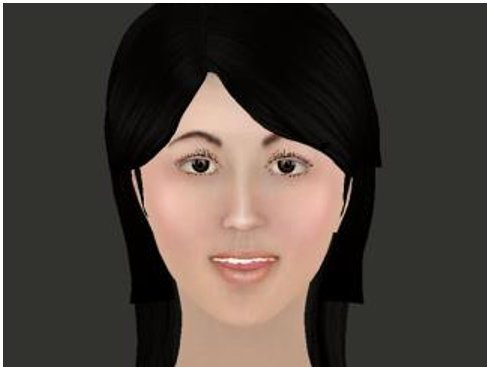 Fig 2: Synthesized dynamic expressions: (a) Happiness, (b) Surprise, (c) Anger, (d) Sadness.
Experiments: Do We Look at Avatars Differently?
One of the most profound aspects of this study is the use of Eye Tracking. The researchers wanted to know: Do we focus on different features when talking to an AI vs. a real human?
Key Findings:
- The "Happiness" Standard: Happiness was the most easily identified emotion across both 3-D models and real human faces.
- Audio-Visual Synergy: In cases like "Anger" and "Surprise," the recognition accuracy of the 3-D avatar jumped significantly when voice was added. This suggests that audio serves as a critical "disambiguator" for synthetic faces.
- Gaze Patterns: Interestingly, participants spent more time fixating on the eye and mouth regions of the 3-D talking head compared to the human face. This suggests that while we find the avatars natural, we might be subconsciously "searching" for more information to confirm the emotion.
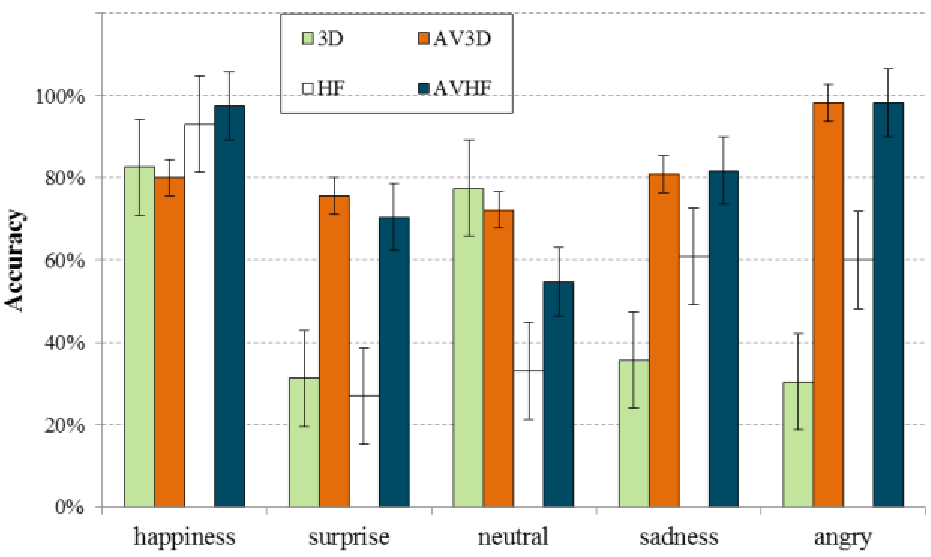 Fig 3: Gaze fixation duration percentages for the mouth region across different conditions.
Critical Insight & Results
The subjective evaluation results (Table 1) were impressive:
- Naturalness: 3.92 / 5
- Fluency: 4.28 / 5
This indicates that the DFFD algorithm successfully avoided the "jitter" often associated with real-time 3-D rendering. The high fluency score is particularly vital for robotic communication, where lag can break the user's immersion.
Conclusion & Future Work
The study concludes that 3-D virtual talking heads are potentially "one step away" from being indistinguishable from human interaction in functional scenarios. The authors' future work will involve building more extensive databases that map every phoneme to its corresponding facial displacement, aiming for a "Universal Speaker Head."
Limitations: The study currently relies on 41 markers and high-end infrared cameras for data collection, which might be overkill for consumer-grade applications. Moving toward a purely vision-based (camera-only) tracking system would be the next logical step for commercial AI avatars.
Takeaway for Practitioners: When designing virtual agents, don't just focus on the "look." The "movement" (DFFD) and the "sound" (AV synchronization) are what truly drive emotional perception and trust in HCI.