
[Deep Dive] The Latent Space: Unlocking the Machine-Native Substrate of Intelligence
4
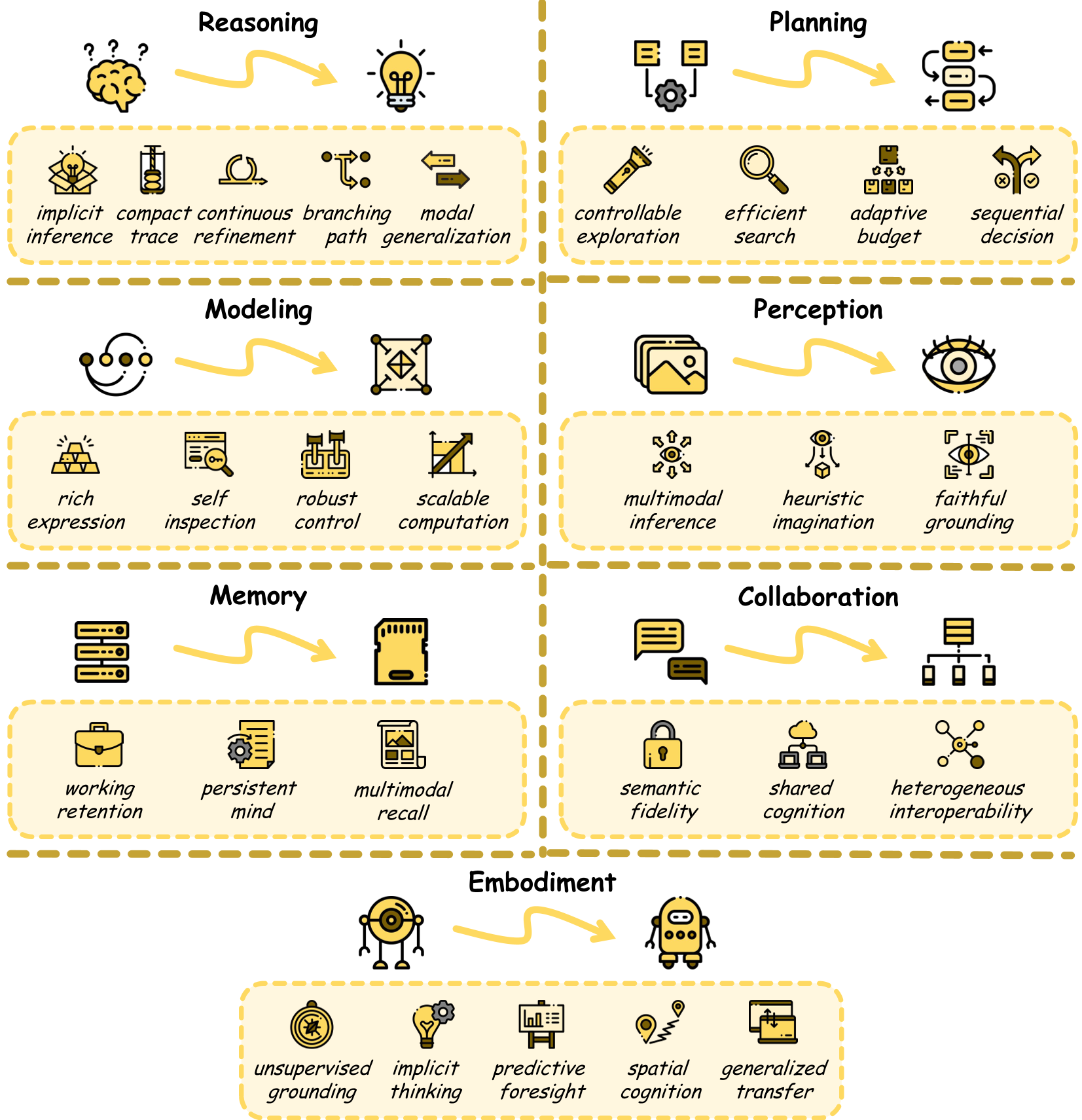
This paper provides a first-of-its-kind comprehensive survey on Latent Space in language-based models (LLMs, VLMs, VLAs), framing it as a machine-native computational substrate that transcends explicit token generation. It introduces a unified two-dimensional taxonomy across Mechanisms (Architecture, Representation, Computation, Optimization) and Abilities (Reasoning, Planning, Perception, Memory, etc.), tracking the field's evolution from early "latent reasoning" to a broad systems-level paradigm.
TL;DR
For years, we've viewed AI through the lens of tokens—the human-readable symbols models spit out. But a revolutionary shift is happening: researchers are moving "thought" from the explicit verbal space into the continuous latent space. This survey (Yu et al., 2026) is the definitive map of this transition, arguing that the future of AI isn't in better talking, but in more efficient internal "thinking" within machine-native manifolds.
Problem & Motivation: The Token Bottleneck
Current LLMs and VLMs are trapped in the Explicit Space. When a model uses Chain-of-Thought (CoT), it must generate thousands of tokens to "reason." This approach is:
- Redundant: Much of natural language is filler (grammatical glue) that serves humans, not logic.
- Discrete & Lossy: Forcing 3D spatial data or complex motor actions into discrete words causes a "quantization bottleneck," where fine-grained nuances are lost.
- Sequentially Inefficient: Every token requires a full model forward pass.
The Insight? Hidden states (activations) are Machine-Native. They are continuous, flexible, and capable of "superposition"—representing multiple potential reasoning paths simultaneously.
Methodology: The Four Pillars of Latent Mechanism
The authors categorize the "How" of latent space into four dimensions. This is the heart of why this paradigm works.
1. Architecture: Beyond the Feed-Forward Stack
Instead of a fixed sequence of layers, new architectures like Huginn or Ouro use "Recurrent Depth."
- Looped Backbones: Reusing the same transformer blocks iteratively to "ponder" without increasing parameter counts.
- Auxiliary Models: Using a specialized vision model to "inject" features directly into the latent space of a language model.
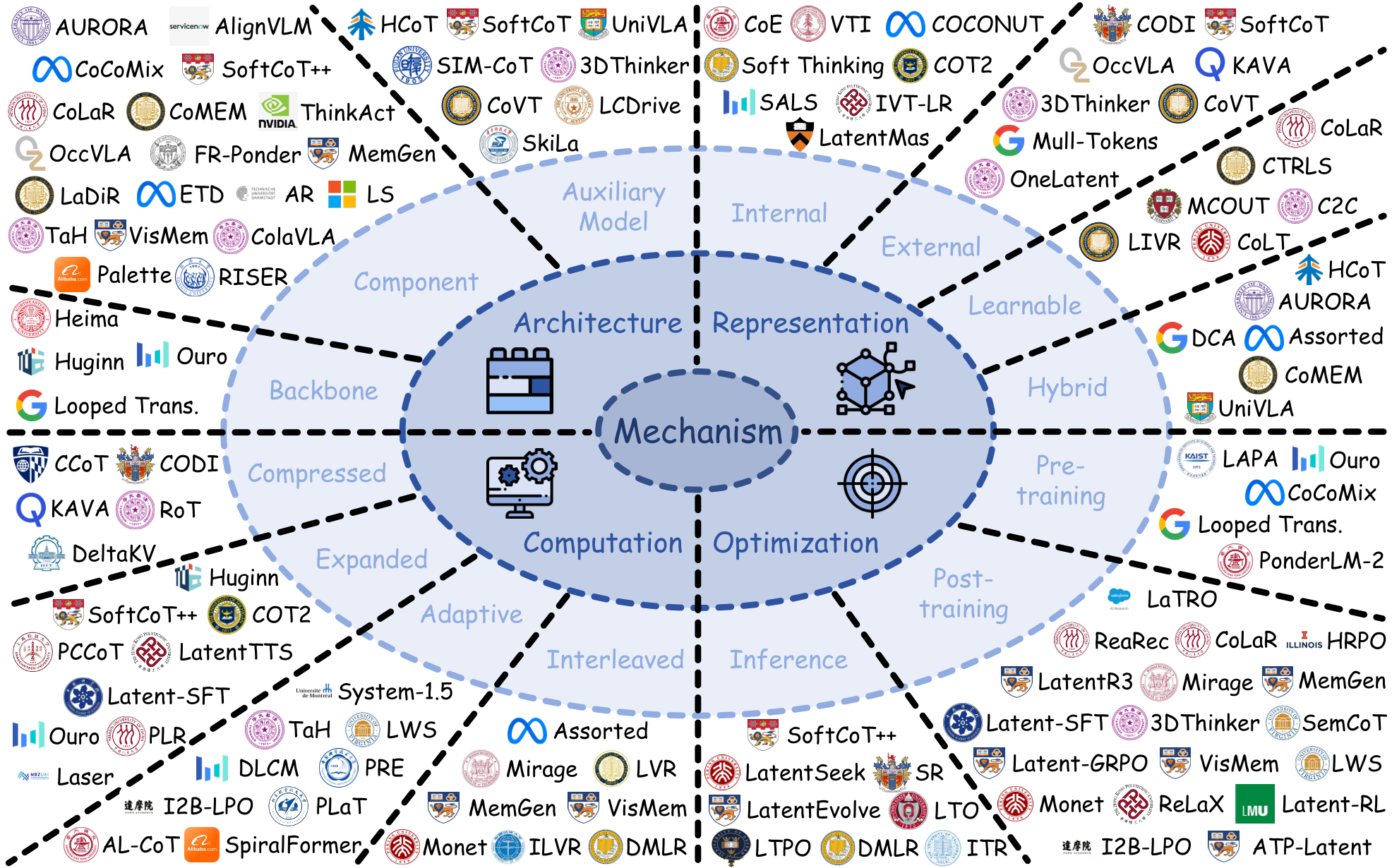
2. Computation: Folding and Expanding
How does the model actually do math in this space?
- Compressed: Turning long CoT chains into a single "thought vector" (HCoT).
- Adaptive: Knowing when a problem is "easy" (halting early) or "hard" (allocating more latent iterations).
The "Ability" Spectrum: What Can Machines Do in the Dark?
By moving beyond tokens, models gain capabilities that were previously "hallucinated" or clumsy:
- Reasoning by Superposition: In latent space, a model can track multiple search frontiers at once. Unlike a human who reads one word at a time, the latent manifold allows the model to explore a "breadth-first search" internally before committing to an answer.
- Visual Imagination: Models like 3DThinker and Latent Sketchpad don't just describe images; they manipulate internal visual latents to "visualize" 3D geometry from 2D views.
- Embodied Action: For robots, latent spaces serve as a "body-agnostic" layer. An AI can learn to move a robotic arm by watching human videos (Unsupervised Grounding) because the latent action semantics transfer across different hardware shapes.
Critical Analysis: The Price of Efficiency
While the gains in speed and power are undeniable, the survey candidly points out the Inscrutability Problem.
- Evaluability: If a model "thinks" in latents, how do we verify if its reasoning is correct before it gives the final answer?
- Interpretability: Latent dimensions are "entangled." We can't easily parse what a specific activation signifies.
Future Outlook: The End of the Token Era?
The paper predicts a "Unified Latent Workspace." In this future:
- Explicit Language is just the API for humans.
- Latent Space is the OS where all the work (perception, memory, planning) happens.
We are witnessing a shift from probabilistic word completion to deliberate latent simulation. The "hidden states" are no longer just an implementation detail—they are the new native substrate of intelligence.
Takeaway for Researchers
If you are building LLMs, stop optimizing just for the next-token loss. Start looking at test-time compute scaling via recurrent latent depth and latent memory consolidation. The most powerful models of 2026 won't be the ones that talk the most; they'll be the ones that think the most before they speak.
Final Note: For a full collection of resources, check out the Awesome Latent Space Repo.