
RNNs Reborn: Pretraining Recurrent Networks without Recurrence
4
The paper introduces Supervised Memory Training (SMT), a novel framework for pretraining nonlinear Recurrent Neural Networks (RNNs) without using Backpropagation Through Time (BPTT). SMT achieves state-of-the-art results on pixel-sequence modeling and langauge tasks by reducing RNN training to time-parallel supervised learning on memory transition labels provided by a Transformer-based teacher.
TL;DR
For decades, Recurrent Neural Networks (RNNs) have been held back by Backpropagation Through Time (BPTT)—a training method that is notoriously slow, non-parallelizable, and prone to gradient instability. Supervised Memory Training (SMT) breaks this curse. By using a Transformer to "teach" an RNN what an ideal memory looks like, SMT enables time-parallel training with a stable gradient path, allowing nonlinear RNNs to finally conquer long-range dependency tasks that were previously the sole domain of Transformers.
The Problem: The O(T) Bottleneck
In the classic BPTT paradigm, if you want your model to remember something from 1,000 steps ago, the gradient must "travel" back through 1,000 sequential matrix multiplications. This path length causes two fatal issues:
- Vanishing/Exploding Gradients: The signal either disappears or blows up, leading to "recency bias."
- Sequential Computation: You cannot compute step 1,000 until steps 1 through 999 are finished, wasting the massive parallel power of modern GPUs.
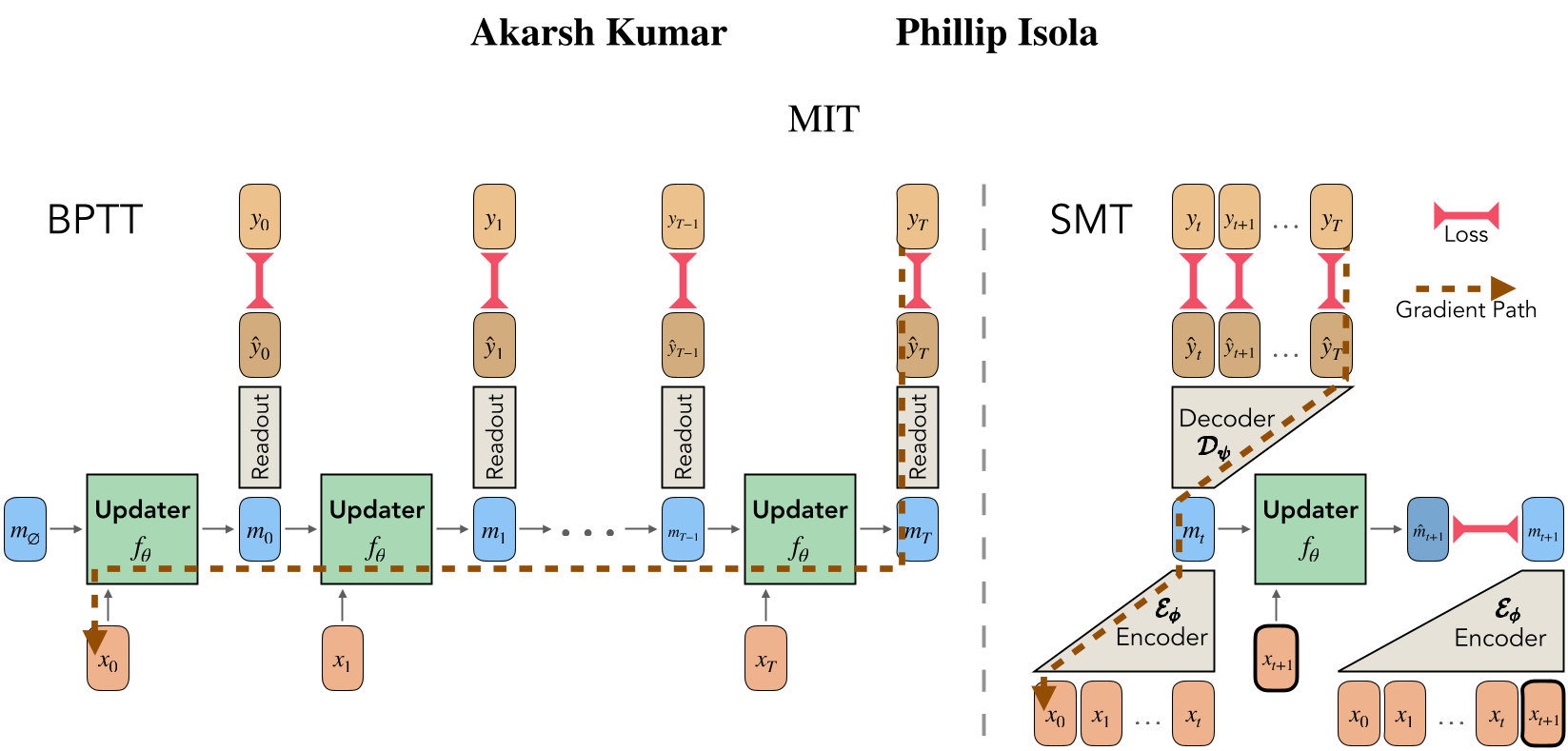 Figure 1: While BPTT unrolls the updater across time (left), SMT supervises the internal transition using a parallel teacher (right).
The Insight: Decoupling Representation from Dynamics
The authors observe that "memory" is simply a sufficient statistic of the past needed to predict the future—a Predictive State.
Instead of making the RNN "figure out" what to remember via trial and error across time, SMT uses a Transformer Encoder-Decoder pair as a teacher.
- The Encoder looks at the whole past and says: "This is the optimal memory state ."
- The RNN then only has to solve a simple supervised task: "Given current memory and new input , can I predict the next optimal memory ?"
Because the teacher Transformer is bidirectional and time-parallel, the "optimal" memories for every timestep can be generated simultaneously. The RNN's training is reduced to a series of independent, one-step supervised learning problems.
Methodology: The SMT Framework
The training objective consists of three parts:
- Decoding Loss (): Ensures the memory tokens contain enough information to reconstruct the future.
- Dynamics Loss (): Forces the RNN to match the memory transitions generated by the encoder.
- Uniformity Loss (): Prevents the memory space from collapsing into a single point.
Architecture
The system utilizes multiple Transformer backbones for the encoder, decoder, and the RNN body itself. The choice of a nonlinear transition function in the RNN ensures it remains more expressive than "linear" alternatives like Mamba or RWKV for certain logic-heavy tasks.
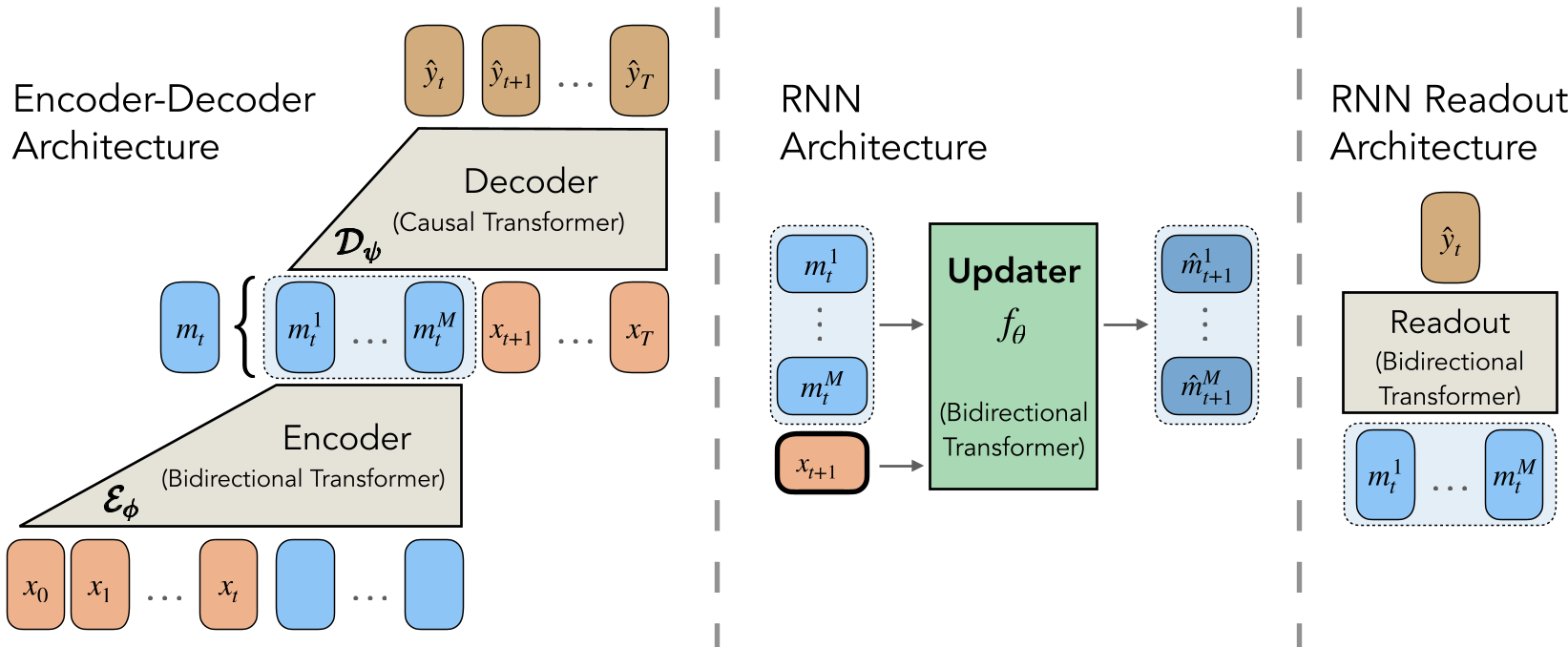 Figure 2: The SMT pipeline utilizes an encoder to compress context into a memory "bottleneck" (Registers), which the RNN is then trained to emulate.
Experiments: Conquering the "Attneave's Cat"
One of the most impressive results comes from Pixel Sequence Modeling. Imagine reading an image pixel by pixel (raster scan). To know that a single white pixel belongs to a "cat's ear," you must remember a pixel seen hundreds of rows ago.
While BPTT-trained RNNs fail and produce "static noise," SMT-trained RNNs successfully capture the global stroke structure.
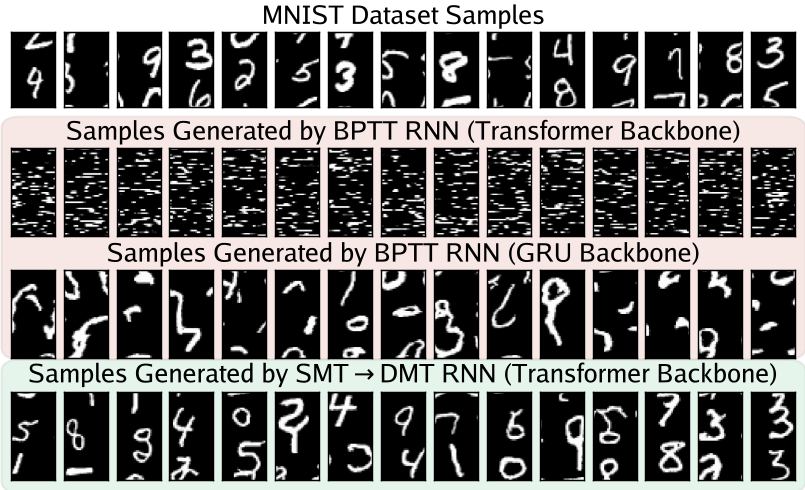 Figure 3: BPTT vs SMT on MNIST. Note how SMT preserves global digital structure where BPTT fails.
Key Breakthroughs:
- Gradient Stability: As shown in Figure 11 (in the paper), SMT's gradient magnitude remains constant regardless of sequence length, whereas BPTT's gradients vanish almost immediately.
- Compression as Scaling: The authors found that with more compute, SMT can achieve the same performance using smaller memory states, suggesting a new path for ultra-efficient inference.
- DAgger Memory Training (DMT): To solve the "drift" that happens when an RNN runs on its own predicted memories during inference, the authors add a lightweight fine-tuning phase using imitation learning.
Critical Analysis & Conclusion
Why does this matter? Transformers are great but their memory grows with (or they have a sliding window that "forgets"). RNNs have fixed memory , but we couldn't train them well. SMT offers a "Best of Both Worlds" scenario:
- Transformer-speed Training: 100% time-parallel.
- RNN-speed Inference: Constant time and memory per token.
Limitations: The RNN is theoretically limited by the teacher. Since Transformers have finite "depth" (circuit complexity), an SMT-trained RNN might need additional BPTT-style fine-tuning to solve tasks requiring "infinite" sequential reasoning logic.
Final Takeaway: SMT proves that we can "bootstrap" the efficiency of RNNs using the representational power of Transformers. For researchers working on long-context agents or "lifetime" learning, this provides a scalable alternative to the quadratic cost of Attention.