
Qwen-Music: Bridging Compositional Logic and 48kHz Acoustic Reality
4
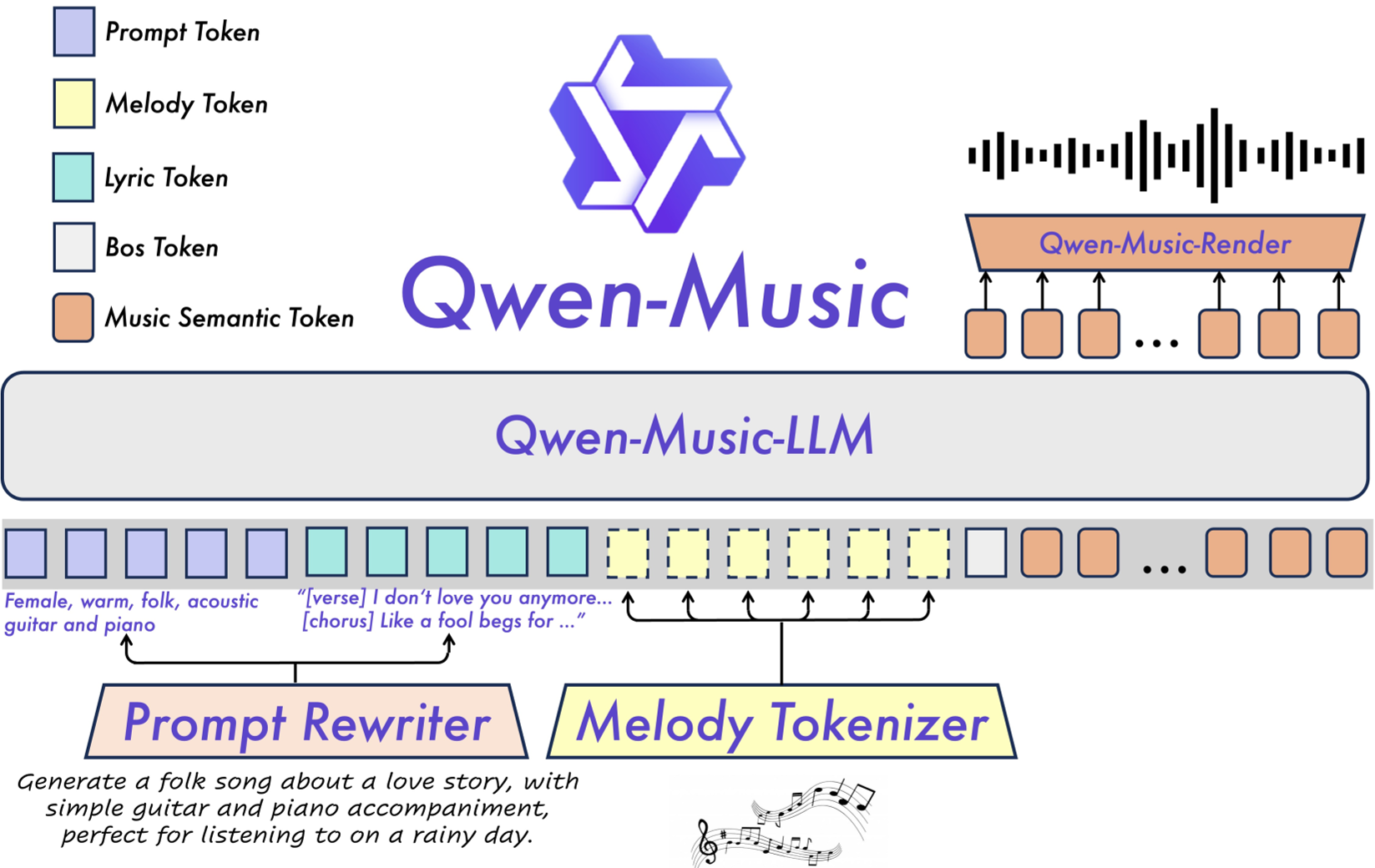
Qwen-Music is a large-scale music generation system that produces high-fidelity songs with full vocals, supporting both Text-to-Music and Cover Song generation. It features a three-part architecture: Qwen-Music-Tokenizer (25Hz semantic tokens), Qwen-Music-LLM (using a Melody-CoT mechanism), and Qwen-Music-Render (diffusion-based 48kHz stereo synthesis), achieving SOTA performance across 13 of 16 evaluation metrics.
Executive Summary
TL;DR: Qwen-Music is the latest technical breakthrough from the Qwen Team, offering a unified framework for high-fidelity song generation. By separating the "brain" (semantic composition via LLM) from the "throat" (acoustic rendering via DiT), and introducing a Melody-CoT mechanism for explicit planning, it bridges the gap between creative intent and professional-grade 48kHz stereo output.
Positioning: This work is a SOTA Heavyweight. It moves away from "end-to-end" black-box generation toward a structured, hierarchical approach that masters both long-form musicality and fine-grained acoustic textures, rivaling (and often surpassing) top-tier proprietary models like Suno V5.5 and MiniMax.
Problem & Motivation: The "Semantic-Acoustic Bridge"
Generating a song isn't just about sound; it's about structure. Existing models often face a two-fold failure:
- Semantic Drift: In long sequences, models lose the melody or fail to follow the lyric structure (the "composition" problem).
- Acoustic Muddying: Highly compressed discrete tokens lose the "shine"—the stereo width, phase alignment, and high-frequency details that define high-fidelity audio.
The Qwen team realized that asking an LLM to predict "arrangement" and "waveform" at the same time is too much. Their insight? Give the model a Melody Plan (Melody-CoT) first.
Methodology: The Core Architecture
Qwen-Music’s pipeline is a masterclass in hierarchical modeling.
1. The Tokenizer: 25Hz Semantic Anchor
Instead of raw waveforms, the model works with Music Semantic Tokens. At 25Hz, the bitrate is a lean 375 bit/s. This compact space allows the LLM to "see" the entire structure of a 5-minute song without running out of context.
2. Qwen-Music-LLM & Melody-CoT
This is the "Composer." The novelty lies in Melody-CoT (Chain-of-Thought).
- Text-to-Music: The LLM first writes the melody contour (relative MIDI) and then "fills in" the orchestration.
- Cover Songs: It takes melody tokens from a reference audio as a prefix, forcing the model to stay on-key while changing the style or singer.
3. Qwen-Music-Render: The Virtual Studio
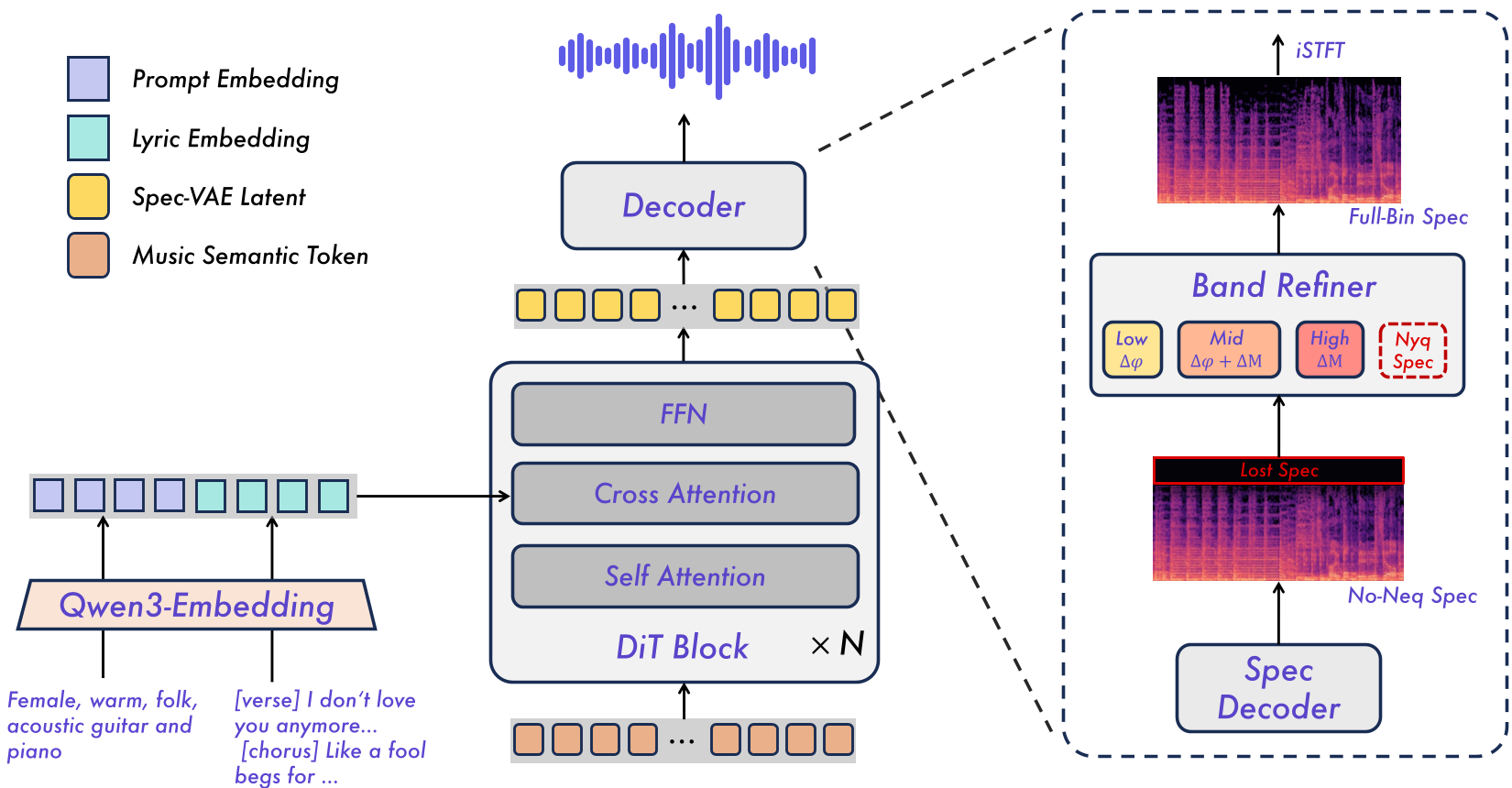
The renderer uses a Diffusion Transformer (DiT) conditioned on semantic tokens. To reach 48kHz, they introduced Spec-SnakeBeta activations—a frequency-aware extension of SnakeBeta that understands that high-frequency bins need different nonlinear handling than bass.
Experiments & Results: Dominating the Charts
Qwen-Music underwent rigorous testing against market leaders.
Subjective Preference
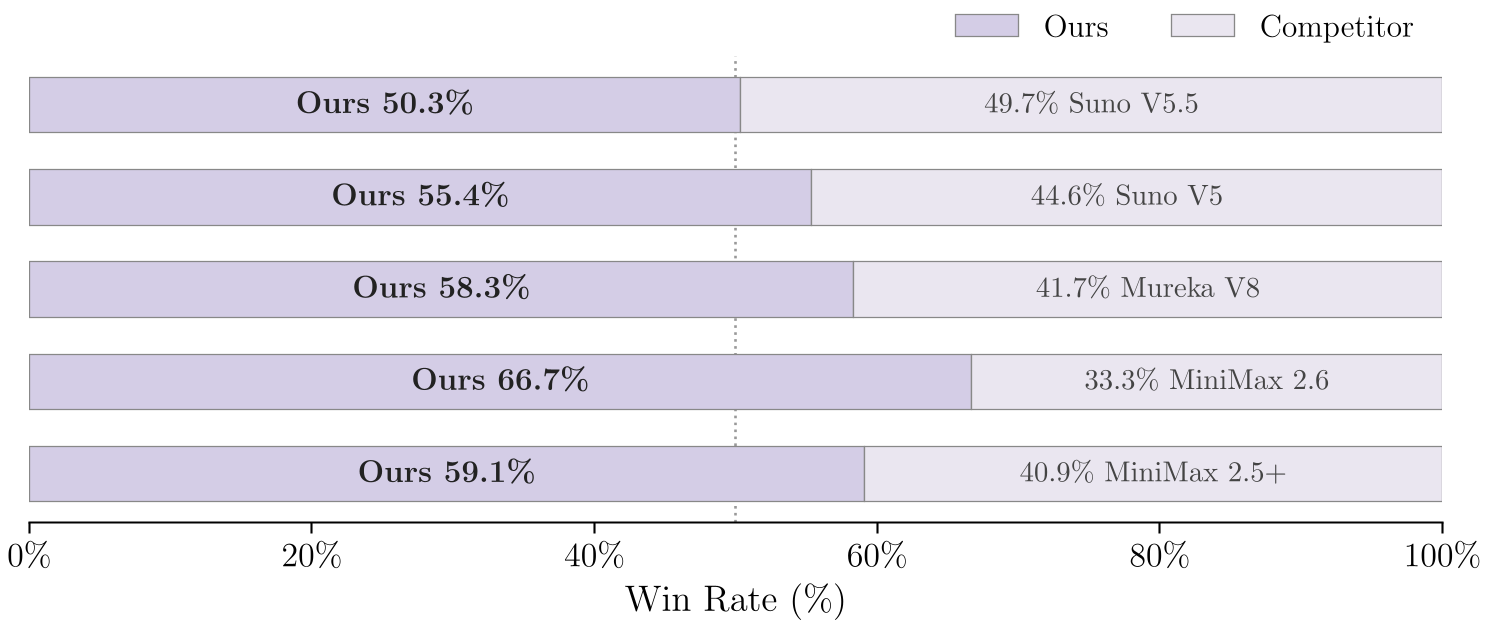
In blind A/B tests with professional raters, Qwen-Music achieved a 50.3% win rate vs. Suno V5.5 and crushed MiniMax Music 2.6 with a 66.7% preference score. It is particularly dominant in genres like EDM, Rock, and Jazz.
Objective Benchmarks
- SongBench: Best-in-class across Melody, Arrangement, and Mixing.
- Melody Preservation: In Cover Song tasks, it maintained a 1.44 Melody MAE, proving it doesn't "hallucinate" new melodies when the user wants a strict cover.
Critical Analysis & Conclusion
Takeaway
Qwen-Music proves that explicit planning (Melody-CoT) is the secret sauce for controllable music AI. By turning melody into a first-class citizen in the token space, they've solved the "unpredictability" problem of previous generative audio models.
Limitations & Future Work
While the 48kHz rendering is impressive, the Band-Mode Refiner adds a third stage to prediction, which may impact real-time latency. Future revisions will likely look into distilling the DiT + Refiner into a single-step consistency model for lightning-fast inference without sacrificing that 48kHz "sparkle."
Final Thought: If Suno was the "ChatGPT moment" for music, Qwen-Music is its "GPT-4" evolution—more precise, higher resolution, and significantly more professional.