
Integrating Personal Digital Traces: From Static Objects to Episodic Scripts
4101_Integration and Exploration of Connected Personal Digital Traces.
The paper introduces a script-based architectural model for Personal Information Management (PIM) that integrates fragmented "Personal Digital Traces" (PDTs) into episodic narratives. By leveraging stereotypical action sequences (scripts), the system unifies heterogeneous data from emails, calendars, financial records, and location services into coherent life events.
TL;DR
Our digital lives are scattered across disparate platforms—a receipt in our email, a check-in on social media, and a transaction in our bank app. This paper proposes a transition from traditional, static Personal Information Management (PIM) to a dynamic, episodic model. By using "scripts"—AI plan skeletons—the authors demonstrate how to reconstruct coherent narratives from fragmented digital traces, achieving significantly higher retrieval accuracy than single-source methods.
Problem: The Fragmentation of Digital Memories
Most existing PIM tools (like Haystack or Semex) treat personal data as a collection of objects (files, emails) and static relationships (sender, date). However, human memory is episodic; we remember events, not just files. The authors argue that current systems fail because:
- Heterogeneity: Data spans diverse formats (APIs, web forms, notifications).
- Fragmentation: A single event (e.g., a dinner out) leaves footprints in five different apps.
- Static Bias: Systems ignore the "flow" of human activities.
Methodology: The Script-Based Approach
The core innovation is the application of Scripts—a concept from 1970s AI (Schank & Abelson) reimagined for the modern cloud era. A script is a stereotypical sequence of actions (e.g., "The Eating Out Script" involves: deciding to eat -> making a reservation -> traveling -> eating -> paying).
The w5h Framework
To organize these traces, the authors use the w5h model:
- Who: Social agents involved.
- What: The nature of the activity.
- When & Where: Spatio-temporal anchors.
- Why & How: The motivation and execution (often the hardest to extract).
Heuristic Connection Algorithm
The system doesn't just look for exact matches. It uses:
- Trigger Expansion: Expanding keywords using WordNet and ConceptNet to find "clues" in raw data.
- Evidence Merging: If an email mentions a restaurant at 7 PM and a credit card shows a charge at the same place at 9 PM, the system merges them into one "Episode."
Experimental Results: The Power of Multi-Source Fusion
The researchers conducted a case study with three users (Alice, Bob, and Charlie) over six months. The results were revealing:
- Individuality: One user might rely on messaging for plans, while another only uses their calendar.
- The "Golden Set": Users manually identified "Eating Out" events to act as a ground truth.
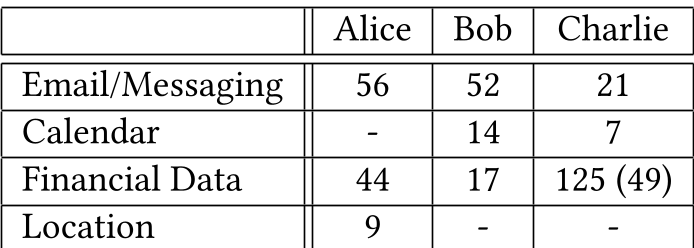
- Superior Recall: As shown in the data tables, no single source was sufficient. For "Charlie," messaging only caught 6% of events, but financial data caught 89%. Combining all sources brought Recall to 100% for all users.
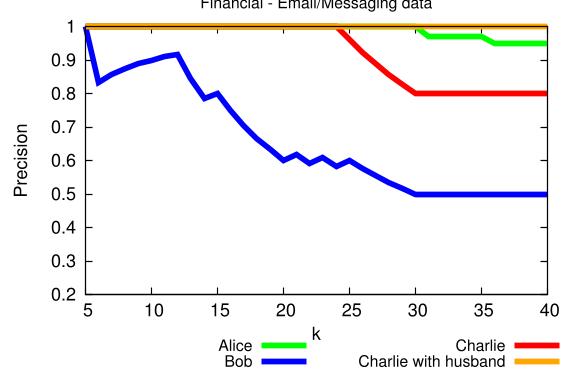 Figure: Precision@k across different source combinations shows that "All Sources Combined" (Bottom-Right) provides the most stable and high-quality results for event reconstruction.
Critical Insight & Future Outlook
This work highlights that digital traces are social. A significant portion of our data is shared (e.g., Charlie's shared credit card). Identifying "Who" is not just about email headers but understanding shared physical and digital spaces.
Limitations
- NLP Sensitivity: Without advanced Natural Language Processing, the system can struggle with "noise" (e.g., an advertisement for a restaurant vs. a real reservation).
- Entity Resolution: Distinguishing between "Eating at a restaurant" and "Buying groceries at a restaurant's retail shop" remains a challenge for automated metadata.
Conclusion
By moving beyond the "file" metaphor and embracing "episodes," we can build PIM systems that actually mirror how the human mind organizes life. This script-based approach proves that the sum of our digital traces is much greater than the parts, provided we have the right narrative framework to bind them together.