
NodeRanking: Mining Reputation from the Fabric of Social Networks
4106_Extracting reputation in multi agent systems by means of social network topology.
The paper introduces NodeRanking, a decentralized algorithm for extracting the reputation of agents in Multi-Agent Systems (MAS) by analyzing social network topology. It demonstrates that an agent's importance (reputation) can be inferred from its position in a "small-world" social graph, achieving high correlation with real-world scientific citation indices.
TL;DR
In the early 2000s, while the web was transitioning to link-based ranking, researchers Josep M. Pujol et al. realized that reputation isn't just what people say about you; it's where you stand. They developed NodeRanking, a decentralized algorithm that calculates agent reputation by analyzing the topology of a social network. By moving away from intrusive user feedback and focusing on "small-world" graph properties, they achieved a high correlation with real-world expertise markers (like citation counts) using only local information.
Context: The Collapse of Feedback-Based Trust
In multi-agent systems (MAS) and electronic communities, trust is the currency. For years, we relied on explicit feedback—think eBay ratings. However, this model has a "fatigue" problem: users stop rating, and the system's accuracy plummets.
The authors pose a compelling question: Can we extract reputation automatically from the structure of the community itself? If an expert is well-regarded, they will naturally be "central" in the social network (connected to other experts).
Methodology: The NodeRanking Logic
The core of the paper is the NodeRanking algorithm. While inspired by PageRank, it is designed for a decentralized world.
1. Building the Social Network
The authors didn't just look at "friends." They used a weighted heuristic to build edges based on:
- Email Traffic: Direct communication.
- Link Depth: References to resources in personal web pages.
- Name Occurrences: How often an agent is mentioned by others.
2. Decentralized Authority Propagation
Unlike PageRank, which requires the entire adjacency matrix of a graph, NodeRanking is built for autonomous agents.
- Local Exploration: A random walker moves from agent to agent.
- Adaptive Jumping: The probability of "jumping" to a new random node is calculated locally (). This allows the algorithm to adapt to the specific topology of the local neighborhood.
- The Convergence Factor (): Because the algorithm is asynchronous, it uses a factor to maintain authority within a finite range, preventing values from drifting to infinity as agents share their "reputation" scores.
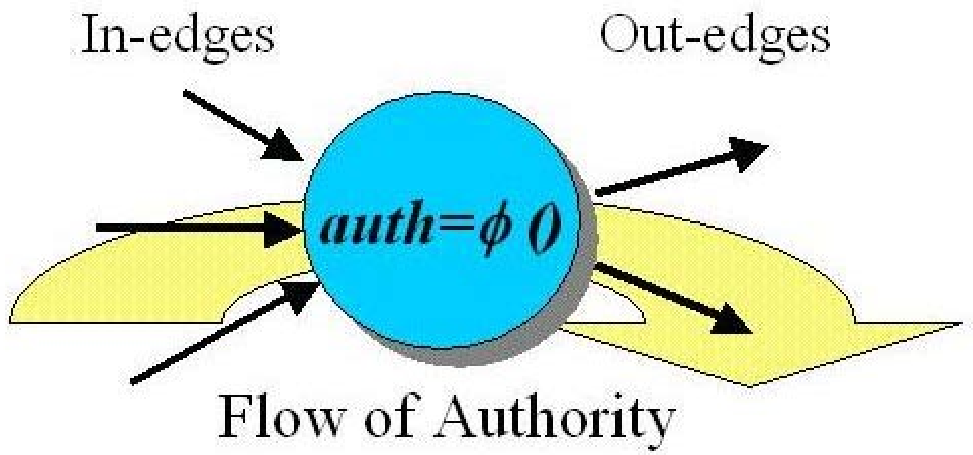 Figure: The flow of authority in NodeRanking, where a node passes its importance to its neighbors.
Experiments: Validating Against Reality
To prove this wasn't just mathematical theory, the authors tested it against the Software Department at the Technical University of Catalonia (UPC). They compared the algorithmic "Reputation" against CiteSeer citation indices—the gold standard for academic reputation.
Performance Comparison
The results were striking. NodeRanking significantly outperformed the global-calculation standards of the time:
| Algorithm | Correlation with Citations |
|---|---|
| NodeRanking | 0.687 |
| PageRank (Weighted) | 0.535 |
| HITS Authority | 0.412 |
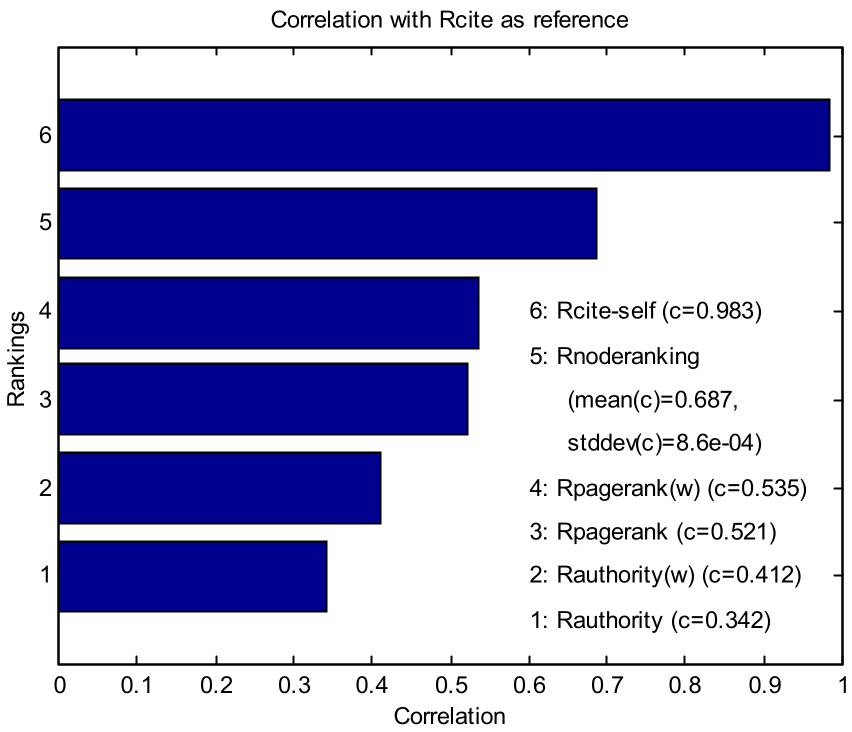 Figure: Comparison of various ranking algorithms against real Citation Indices.
Why NodeRanking Wins
The secret sauce is Topological Adaptation. Typical "small-world" networks have an exponential distribution of connections (most people have few links; a few "hubs" have many). PageRank uses a fixed jumping probability (usually 0.15), which can lead to "rank sinks" in social graphs. NodeRanking’s ability to adjust its behavior based on local connectivity makes it far more robust for social structures.
Critical Insight & Future Outlook
This paper was a pioneer in Web Intelligence. It proved that social network topology is a high-fidelity proxy for human trust.
Limitations: The success of the algorithm is entirely dependent on the quality of the social network construction. If the input data (emails, links) doesn't reflect actual expertise, the output remains a "hallucination" of structural importance.
Future Impact: Today, as we build Decentralized Identifiers (DIDs) and Reputation systems for Web3 and AI-driven communities, the "Topology-as-Reputation" insight remains the cornerstone of non-intrusive trust management.
Summary Takeaway
Stop asking for stars; start looking at the map. By analyzing how agents are woven into the social fabric, we can identify experts more accurately than by asking tired users for ratings.