
Flickr Circles: Unveiling Aesthetic DNA via Multi-View Regularized Topic Modeling
4131_Flickr Circles Aesthetic Tendency Discovery by Multi-View Regularized Topic Modeling.
The paper introduces "Flickr Circles," an unsupervised framework for categorizing social media users into groups based on shared aesthetic interests. It utilizes a Multi-view Regularized Topic Model that fuzes color, texture, and semantic features to quantify user tendencies in a latent space, achieving state-of-the-art performance in community discovery on a million-scale dataset.
TL;DR
Aesthetic preference is highly subjective and hard to quantify. This paper presents a sophisticated framework to automatically discover "Flickr Circles"—communities of users who share specific aesthetic tastes (e.g., minimalist architecture vs. vibrant landscapes). By combining multi-view feature fusion with a manifold-regularized Gaussian Mixture Model (GMM), the authors successfully cluster users even when their historical data is extremely sparse.
The Challenge: Aesthetic Data Imbalance
In the world of social media analytics, professional artists and casual snappers coexist. On Flickr, some power users upload tens of thousands of photos, while others barely reach double digits. This creates two massive hurdles for researchers:
- Extensible Representation: Portrait aesthetics depend on different visual cues than landscape aesthetics. A model must be flexible enough to weigh different features (color, texture, semantics) differently.
- The Sparsity Problem: Standard probabilistic models fail when a user has only 10 photos—they overfit to those specific images rather than capturing a general "style."
Methodology: High-Level Intuition
The authors break down the problem into three distinct technical components.
1. Multi-View Feature Fusion
Instead of simply concatenating color moments, HOG textures, and semantic tags, the team uses a Multi-view learning framework. This allows the system to automatically adjust feature weights. If a specific "circle" is defined by color (like the "Orange and Blue" group), the color channel receives higher priority automatically.
2. Manifold-Guided Regularization
This is the "special sauce" of the paper. Standard GMMs treat data points in Euclidean space. The authors argue that Flickr photos actually reside on a manifold—a lower-dimensional structure within the high-dimensional feature space. By introducing a Laplace-Beltrami operator as a regularizer, they force the model to stay "smooth." If two photos are close on the manifold, their aesthetic classification should be similar. This prevents the model from overfitting to the limited data of "small-scale" users.
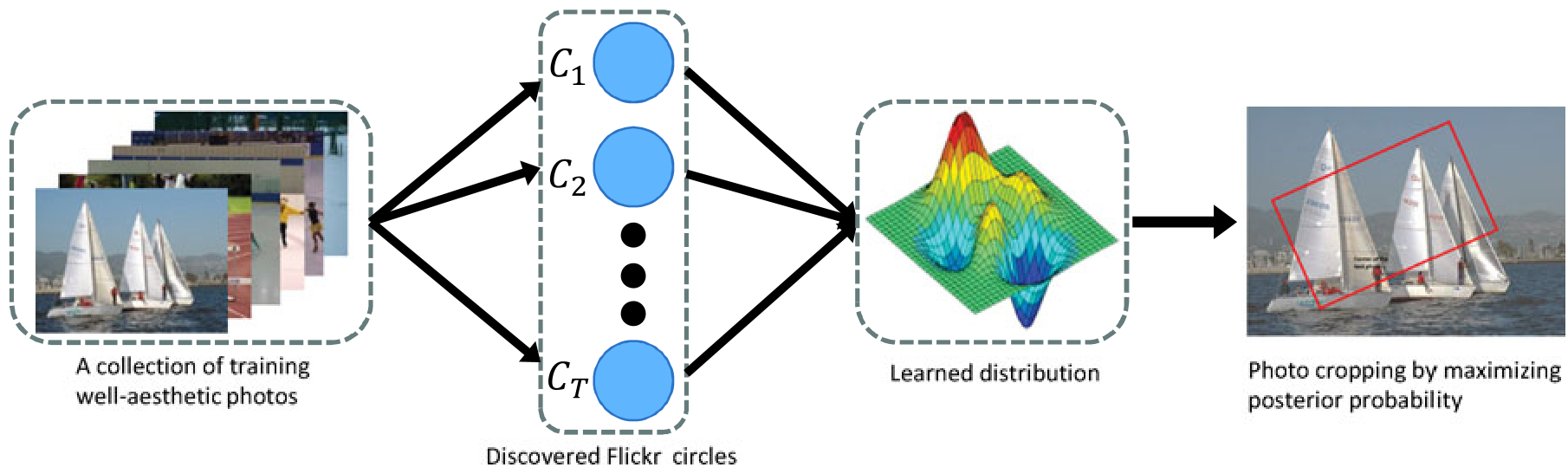 Figure: The pipeline of discovered Flickr circles being used to enhance transferal-based photo cropping.
3. Dense Subgraph Mining (Graph-Shift)
To find the actual circles, the system builds an affinity graph of users using KL-divergence. Instead of traditional K-means (which forces every user into a group), they use Graph-Shift. This algorithm seeks "modes" or dense clusters and leaves outliers (users with very weird/unique tastes) ungrouped, preserving the purity of the discovered circles.
Experimental Results: SOTA Performance
The model was tested against 35 ground-truth Flickr groups. The results were clear: the proposed method dominated across almost all categories.
- Versus Baselines: Specifically in groups like "Graphic Designers" or "Night Lights" (where users have fewer photos), the regularized model showed massive gains over K-means and Link Clustering.
- Abstract vs. Concrete: The model performs exceptionally well on concrete concepts (Architecture, Window Seats) but faces challenges with abstract concepts (Jump Projects), where visual consistency is naturally lower.
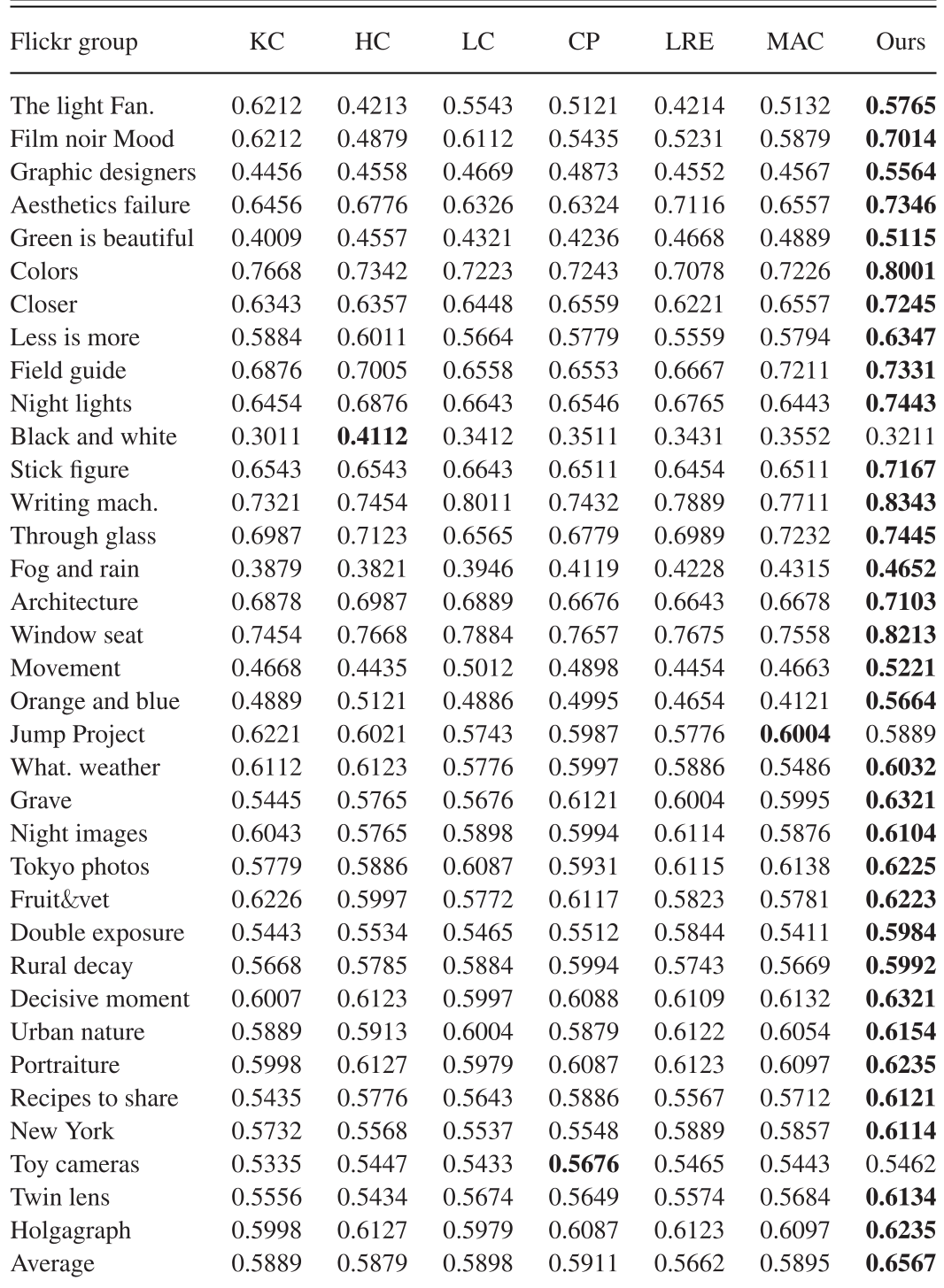 Table: Comparison of Balanced Error Rate (BER) across diverse Flickr groups. Our approach (rightmost) maintains the highest accuracy.
Application: Smarter Photo Cropping
The real-world value of "Flickr Circles" is demonstrated through transferal-based photo cropping. By knowing which "aesthetic circle" a user belongs to, the system can look at how "pros" in that same circle crop their photos and transfer those rules to the user's poorly framed shots. A user study with 30 PhD/Master students confirmed that this circle-aware cropping is significantly more "pleasing" than standard saliency-based methods.
Critical Insight & Conclusion
The genius of this paper lies in its recognition that aesthetics are a distribution, not a single point. By using a GMM regularized by manifold geometry, the authors bridge the gap between low-level pixels and high-level human taste.
Limitations: As the authors admit, "abstract" aesthetics still elude pure visual descriptors. Future work integrating exposure, contrast, and perhaps modern Vision Transformers (ViT) could further refine our understanding of what makes a photo "beautiful."
Takeaway for Researchers
When dealing with noisy, imbalanced social media data, don't just throw more data at a standard model. Look for the underlying manifold structure. Regularization isn't just a math trick; it’s a way to encode the physical reality of the data's distribution.