
TRODA: Taming Dynamic Node-Selfishness in Wireless Relay Networks
4146_Cross-Layer Resource Optimization for Wireless Relay Networks Under Dynamic Node Selfishness.
This paper investigates cross-layer resource optimization in wireless relay networks (WRNs) where relay nodes (RNs) exhibit dynamic selfishness based on energy levels and incentives. It proposes the Two-Timescale Resource-Optimization Dynamical Algorithm (TRODA) to jointly control transmit power and flow rates, achieving stable performance in stochastic environments.
TL;DR
In modern decentralized networks, Relay Nodes (RNs) aren't always "good citizens"—they exhibit selfishness to save their own battery life. This paper introduces a novel two-timescale framework that models energy depletion and incentive mechanisms as dynamic variables. By using the Two-Timescale Resource-Optimization Dynamical Algorithm (TRODA), the authors prove that we can maintain network stability and optimal data flow even when nodes try to "cheat" the system.
The Problem: The Myth of the Altruistic Relay
Most wireless relay research assumes nodes will forward packets purely out of duty. In reality, nodes are constrained by:
- Intrinsic Factors: Drastic energy depletion leading to conservative power allocation (DeIS).
- Extrinsic Factors: Insufficient incentives provided by the end-user (DeES).
Current SOTA methods often fail because they treat these factors as static. However, energy changes over hours (long timescale), while incentives and channel states change over seconds (short timescale). Failing to account for this temporal mismatch leads to packet drops and inefficient resource waste.
Methodology: The Two-Timescale Approach
The authors propose a comprehensive model that separates the "selfishness" into two distinct dynamics:
1. The Selfishness Model
- DeIS (Intrinsic): Modeled as a function of residual energy . As energy drops, selfishness rises.
- DeES (Extrinsic): Modeled via a Wiener process to account for stochastic errors in incentive information received from the network.
- DeNS (Total Selfishness): A composite function .
2. TRODA Architecture
TRODA operates on a dual-loop mechanism:
- Short-Timescale Index (): Manages Physical Layer transmit power control.
- Long-Timescale Index (): Manages Transport Layer flow rate control.
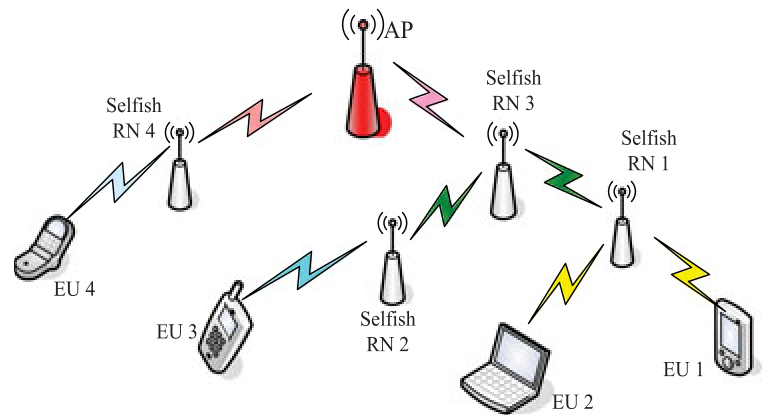 Fig 1: Wireless Relay Network (WRN) Topology featuring altruistic EUs and selfish RNs.
Lyapunov Stability and Tracking
A significant contribution of this work is the mathematical rigor. The authors didn't just simulate; they used Lyapunov Theory to derive a sufficient condition for stability. They quantified the "Tracking Error"—the gap between the theoretical optimum and the practical algorithm performance—and proved it remains bounded even under high mobility (up to 28 m/s).
Experimental Validation
The simulations tested various mobility profiles, from stationary nodes to vehicular speeds.
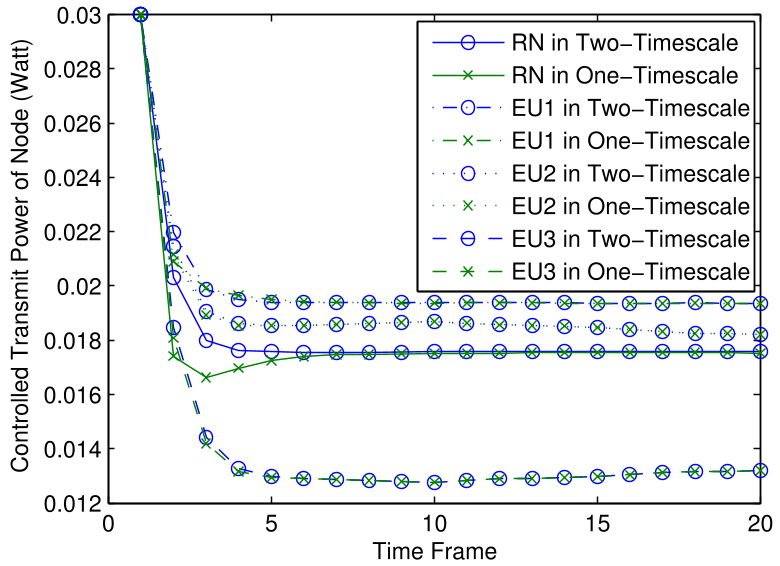 Fig 9: Convergence of controlled transmit powers for all nodes. Note how the Two-Timescale approach tracks the One-Timescale central optimum almost perfectly.
Key findings from the experiments:
- Mobility Impact: Higher movement speeds increase tracking errors for flow rates, primarily due to rapid channel gain fluctuations (as seen in Figs 12 & 14).
- Fairness: Despite node selfishness, TRODA successfully balances the load between EUs directly communicating with the Access Point and those relying on the relay.
Critical Insight & Conclusion
This paper is a masterclass in combining Stochastic Control Theory with Network Economics. By recognizing that selfishness is not a binary state but a dynamic process driven by physics (energy) and logic (incentives), the authors provide a pathway for more robust 5G/6G ad-hoc networks.
Takeaway: To build resilient autonomous networks, we must stop assuming cooperation and start engineering for calculated selfishness. TRODA provides the mathematical "carrot and stick" needed to keep packets moving.
Limitations: The current model considers slow-fading channels. Future expansions integrating fast-fading channel dynamics into a three-timescale model would be the next logical step for high-dynamic environments.