
The Silent Reservoir: Decoding the Environmental Drivers of Antibiotic Resistance
41579_2021_Article_649
This review article, published in Nature Reviews Microbiology, comprehensively examines the environment's role as a reservoir for antibiotic resistance genes (ARGs) and a conduit for their transmission. It highlights how anthropogenic activities—particularly antibiotic pollution and faecal contamination—accelerate the evolution of "superbugs" and proposes environmental surveillance, such as sewage monitoring, as a vital tool for global health management.
TL;DR
Antibiotic resistance is not just a hospital problem; it is an environmental crisis. This seminal review by Larsson and Flach reveals that while the clinic is where we see the consequences of resistance, the environment is the engine where new resistance factors are born and circulated. By shifting our focus to "Sewage Epidemiology" and tightening industrial pollution controls, we can move from reactive treatment to proactive global surveillance.
Problem & Motivation: Beyond the Clinic
For decades, the battle against antibiotic resistance was fought in the ICU. However, the "One Health" perspective suggests that humans, animals, and the environment are inextricably linked. The core frustration for researchers has been the "black box" of environmental evolution: How do genes move from harmless soil bacteria into deadly human pathogens?
Prior work often conflated "presence" with "risk." The authors argue that we must distinguish between:
- Recurrent Transmission: Resistant strains moving through water and food (High frequency, predictable).
- De Novo Evolution: The rare mobilization of a new gene from the environmental resistome into a pathogen (Low frequency, catastrophic impact).
Methodology: The Architecture of Resistance
The authors detail a four-step evolutionary ladder that transitions an immobile, harmless gene to a mobile, pathogenic threat:
- Intracellular Mobility: Association with insertion sequences (IS).
- Intercellular Mobility: Relocation to plasmids or integrons.
- Horizontal Transfer: Movement from environmental hosts to human-associated bacteria.
- Ecological Connectivity: Physical transfer to the human microbiota.
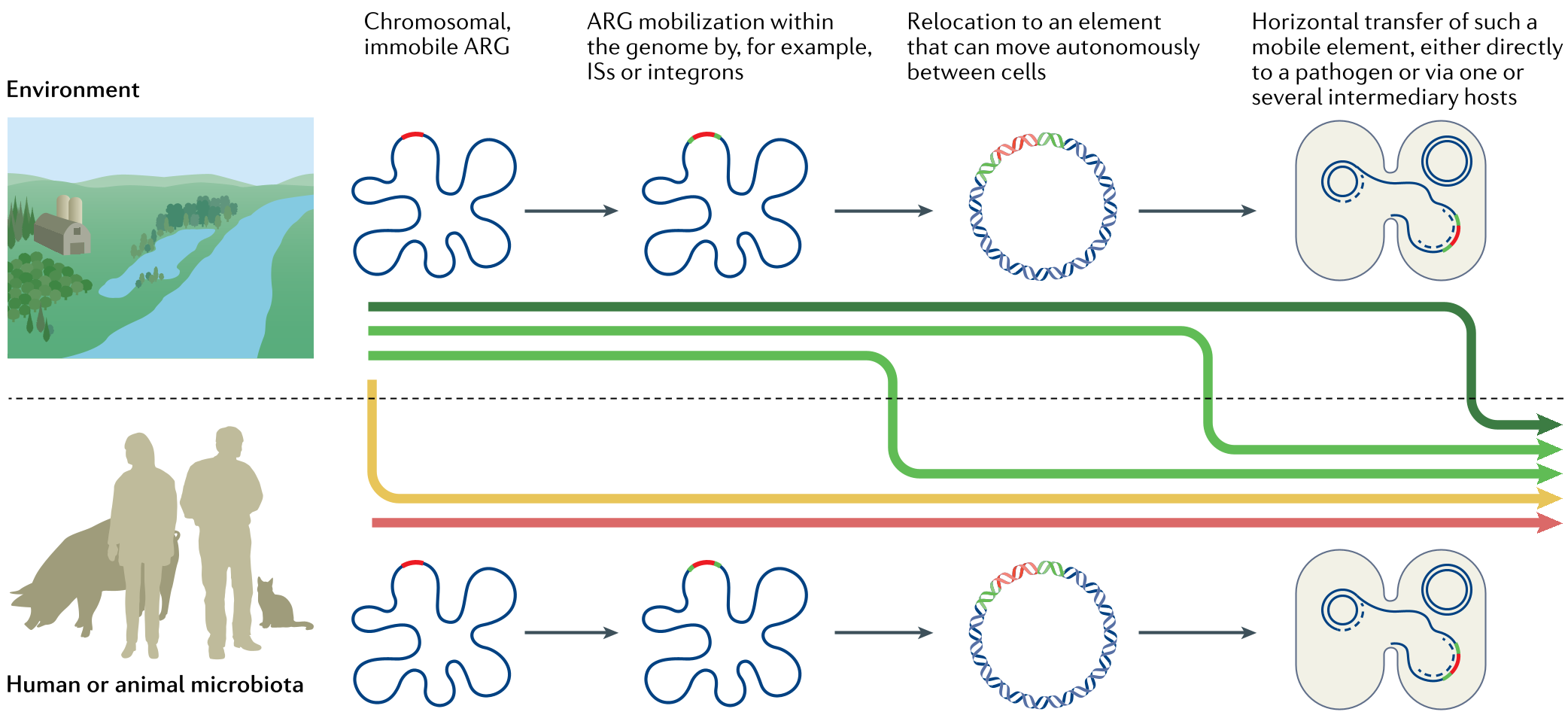 Figure 1: Conceptual illustration showing how evolution can occur entirely in the environment, entirely in humans, or (most commonly) across boundaries.
The Selection Pressure Gradient
A critical contribution of this paper is the analysis of antibiotic concentrations in aquatic environments. While "excreted" antibiotics (from human use) often fall below the Minimal Inhibitory Concentration (MIC), they often exceed the Minimal Selective Concentration (MSC)—the point where a resistant strain gains a competitive advantage over a sensitive one.
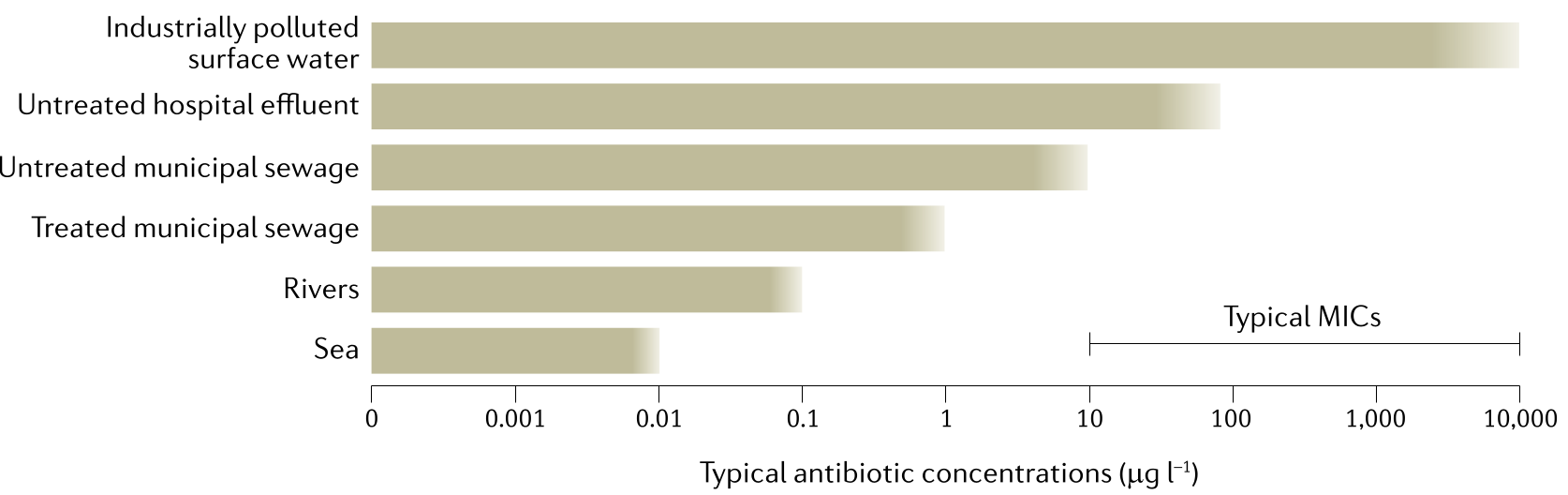 Figure 2: Comparing typical environmental concentrations vs. clinical MICs. Note that selective pressure occurs long before a drug reaches the concentrations used in a hospital.
Experiments & Results: Sewage as a Mirror
One of the most promising technological frontiers discussed is Sewage Surveillance. By analyzing the "pooled" faecal matter of a city, we can:
- Predict Clinical Trends: Metagenomic data from sewage mirrors the resistance patterns found in local hospitals (correlation confirmed in 100+ countries).
- Early Warning: Detect rare resistance genes before they cause widespread outbreaks.
The authors provide a masterclass in comparing gene-based (metagenomics) vs. isolate-based (culture) surveillance. Metagenomics is simple and fast, but isolate-based analysis is still the "Gold Standard" for linking a specific resistance gene to a specific pathogenic host.
Critical Analysis & Future Outlook
Takeaway
The environment acts as a massive "Genetic Library." When we pollute it with antibiotics—specifically from pharmaceutical manufacturing—we are essentially funding the "research and development" of new ways for bacteria to kill us.
Limitations
A major bottleneck remains Bioavailability. Finding 1mg/kg of ciprofloxacin in soil doesn't mean it's active; much of it binds to organic matter. We need better "biosensor" strains to measure how much of the drug the bacteria actually feel.
The Road Ahead: Prevention via Infrastructure
The most effective way to curb the resistance crisis in low-to-middle-income countries (LMICs) isn't necessarily more expensive antibiotics; it is basic sanitation. If we stop the flow of faecal bacteria into surface water, we break the cycle of both transmission and evolution.
In summary: We must treat environmental antibiotic pollution with the same regulatory urgency as toxic chemical spills. The cost of inaction is a post-antibiotic era where simple infections once again become lethal.