
Beyond Binary Friendships: Higher Accuracy through Quantified Social Tie Strength
4242_Social recommendation using quantified social tie strength.
The paper introduces a social recommendation approach based on Quantified Social Tie Strength. It utilizes an unsupervised latent variable model to estimate continuous tie strength from user similarities and social interactions, moving beyond binary "strong/weak" classifications.
TL;DR
Social recommendation systems often oversimplify human connections into "strong" or "weak" ties. This paper challenges that status quo by introducing a method to quantify social ties on a continuous spectrum. By integrating user similarity (Homophily) and interaction frequency into an unsupervised latent variable model, the authors achieve superior performance in predicting user preferences on platforms like Douban.
The Problem: The "Coarse-Grained" Social Gap
Social recommendation leverages Online Social Networks (OSNs) to solve the chronic "sparsity problem" of collaborative filtering. However, most existing SOTA methods treat friendship as a binary variable.
The authors argue that this is fundamentally flawed. Is a colleague you occasionally reply to on a forum the same "strength" as a close friend you interact with daily? By failing to distinguish the degree of these relationships, previous models introduce noise that degrades recommendation quality.
Methodology: Quantifying the Latent Tie
The core of this work is an unsupervised model that treats "Tie Strength" as a latent variable . Its design is rooted in two sociological intuitions:
- Homophily: "Birds of a feather flock together"—users with similar attributes or interests naturally share stronger ties.
- Interaction Frequency: The frequency of comments, replies, and likes is both a result of and an incentive for tie strength.
The Mathematical Intuition
The authors use a Gaussian distribution to model the probability of tie strength based on similarity, and a logistic function to link that strength to the probability of visible interactions (like comments or shares).
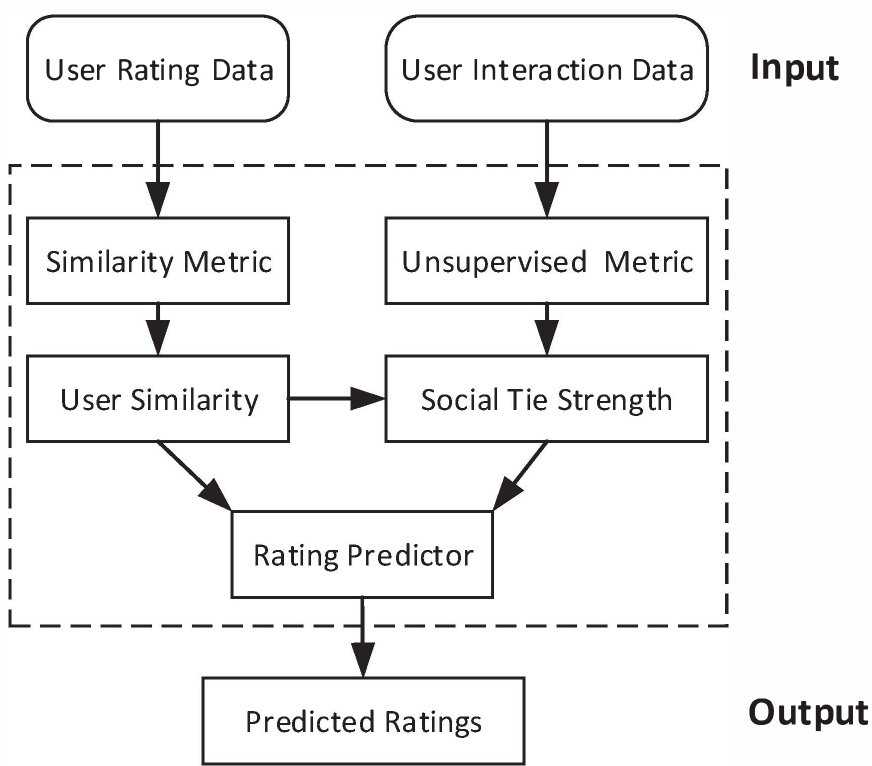 Fig 1: The schematic flow from user similarities/interactions to quantified tie strength and final recommendation.
The optimization uses Coordinate Ascent and Newton’s Method to iteratively refine the latent variables without requiring labeled training data—a massive advantage for real-world OSN applications where "tie strength" labels are impossible to harvest.
Experiments & Performance
The model was tested on the Douban dataset, a gold standard for multi-domain (movies, books, music) social interactions in China.
Key Breakthroughs:
- Accuracy Over Scale: The system shows a clear trend: as the number of users increases, the error (MAE/RMSE) decreases. This suggests the model is highly effective at "learning" from the density of social signals.
- Quantifiable Gains: At 9,000 users, the MAE reaches a low of ~0.8.
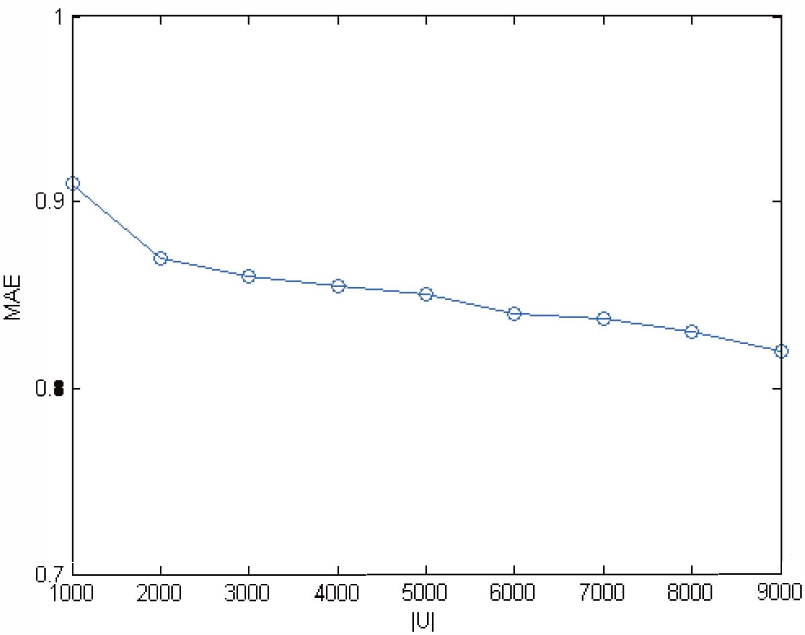 Fig 2: Mean Absolute Error (MAE) trends showing improved precision as user data scales.
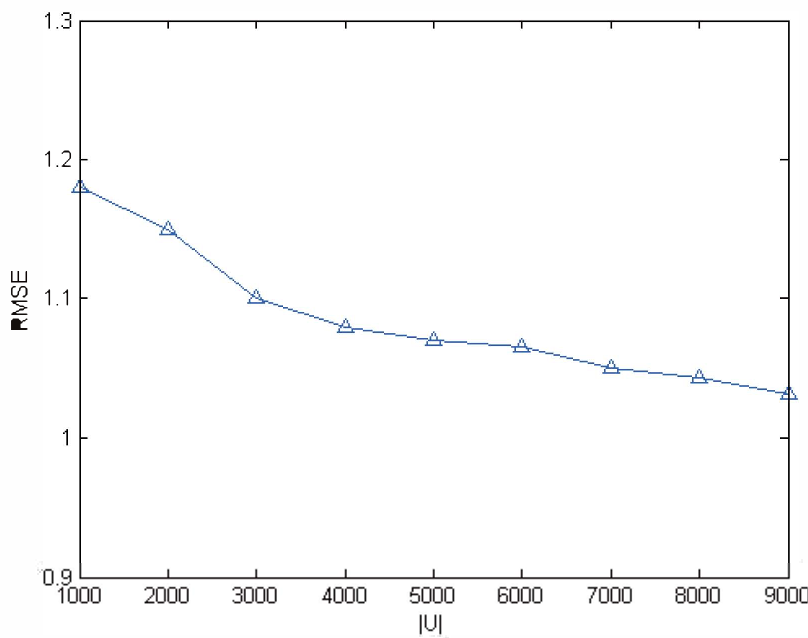 Fig 3: Root Mean Square Error (RMSE) results, confirming stability across different user counts.
Critical Insight: Why This Matters
The value of this paper lies in its Inductive Bias. By assuming that social ties are continuous and tied to measurable interactions, it transforms "social noise" into "social signal."
However, as the authors acknowledge, ties are not static. A "strong tie" last year might be a "weak tie" today. The next frontier for this research is the temporal dimension—integrating the decay of social relationships over time.
Conclusion
This work represents a vital shift from qualitative to quantitative social recommendation. By proving that "how much" matters as much as "who," the researchers have provided a framework that significantly enhances the reliability of recommendations in increasingly complex online social ecosystems.