
iGSLR: Personalizing the "Where" in Geo-Social Recommendations via KDE
43_iGSLR personalized geo-social location recommendation a kernel density estimation approach.
The paper introduces iGSLR, a personalized geo-social location recommendation framework that leverages Kernel Density Estimation (KDE) to model individual geographical check-in behaviors. Unlike prior universal models, iGSLR achieves state-of-the-art performance by integrating personalized spatial distributions with social influence and user preferences.
TL;DR
Conventional location-based social network (LBSN) recommenders assume we all travel the same way. iGSLR shatters this "one-size-fits-all" approach by using Kernel Density Estimation (KDE) to model the unique geographical pulse of every individual user. By fusing personal spatial habits with social circles, it delivers superior accuracy even when data is sparse.
The Motivation: Not All Travelers are Equal
Most existing systems (at the time of this research) relied on universal laws. For instance, they assumed everyone follows a Power-Law Distribution (staying close most of the time, occasionally venturing far). However, real-world data from Foursquare and Gowalla tells a different story.
As shown in the authors' analysis, one user might be a global jet-setter, another a domestic traveler, and a third a local homebody. A universal model treats these three differently-behaved people as the same statistical average. iGSLR was born from the insight that geographical influence must be personalized.
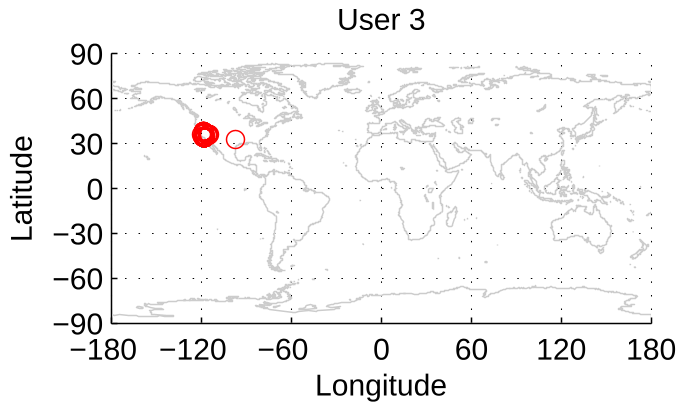 Figure: Evidence of diverse user mobility patterns that universal models fail to capture.
Methodology: The Power of KDE
The core innovation is moving away from parametric assumptions. Instead of forcing a Gaussian or Power-Law shape on the data, iGSLR uses Kernel Density Estimation (KDE).
1. Modeling Personal Space
For every user, the system collects the distances between every pair of locations they've visited. It then applies a normal kernel to estimate a continuous probability density function: This allows the model to "learn" if a user is likely to visit a POI 5km away vs. 500km away based only on their own history.
2. A Two-Step Fusion Framework
The "How" of iGSLR involves two distinct fusion points:
- Input-Fusion: It adjusts the similarity between friends using the distance between their residences. If you and your friend live in the same city, your social influence on each other is weighted higher.
- Output-Fusion: The final recommendation score is a product of the Collaborative Filtering rating (preference) and the KDE-derived probability (spatial likelihood).
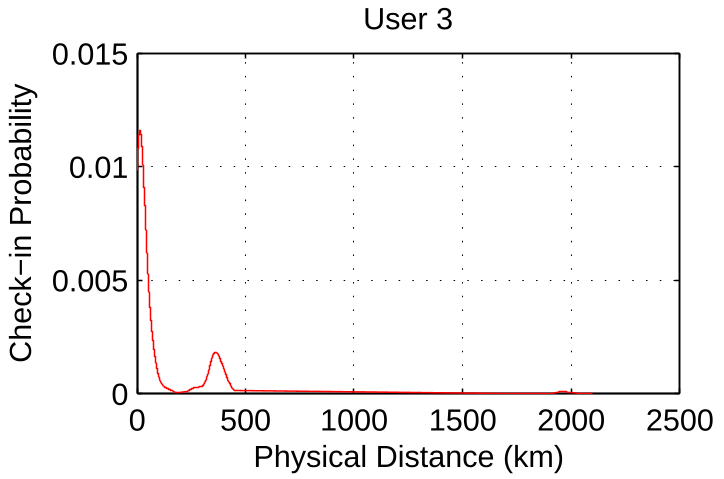 Figure: Distinct KDE-fitted distributions for three different types of users.
Experiments & SOTA Results
The authors tested iGSLR against industry-standard baselines (User-CF, Social-CF, PD, and MGM).
- Accuracy Boost: iGSLR demonstrated the highest precision and recall across both Foursquare and Gowalla. In Foursquare, at , precision was nearly 34%, meaning one in three recommendations was a "hit."
- The Sparsity Test: Even when 50% of the check-in data was removed, iGSLR's lead over universal models (like PD) actually increased. This proves that personalized spatial anchors are more reliable than global averages when data is thin.
- Cold-Start Performance: While KDE usually needs data, the authors cleverly used residence-to-check-in distance for new users, allowing iGSLR to outperform others even when a user only has 2-3 visits.
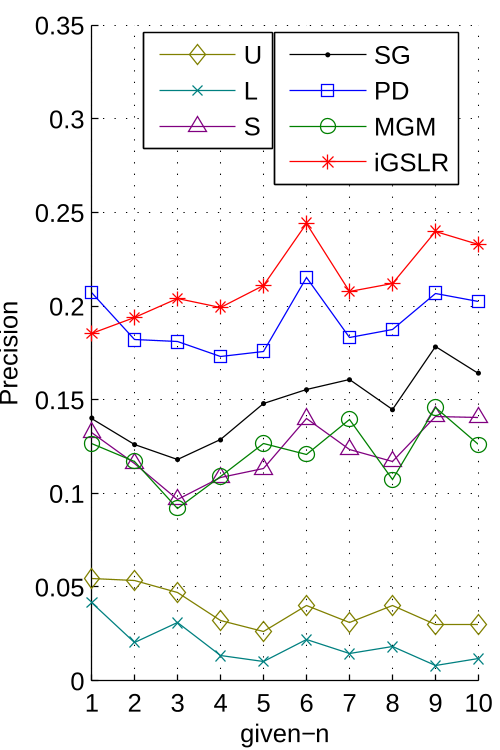 Figure: Comparison showing iGSLR (red line) consistently outperforming other geo-social methods.
Critical Insights & Future Outlook
The "Why" behind iGSLR's success is rooted in the Inductive Bias it introduces: that a user's past spatial behavior is the best predictor of their future spatial range.
Limitations: Since it relies on KDE, it is computationally more intensive than a simple Power-Law lookup. Additionally, for users with zero check-ins, it still falls back on residence data, which might not be available or accurate.
Future Path: The integration of POI categories (e.g., does this user travel far for hiking but stay local for coffee?) and temporal patterns (weekday vs. weekend) are the logical next steps for this personalized framework.
Conclusion
iGSLR marks a significant shift from "Global Models" to "Personal Models" in spatial computing. By treating every user as a unique geographical entity, it provides a blueprint for more relevant, human-centric location services.