
Beyond the Wall: Analyzing why Local Governments Still "Push" instead of "Partner" in the Web 2.0 Era
4629_An exploration of the reasons and governance models for web 2.0 in providing public services.
This study explores the perceptions of policymakers in Spanish local governments regarding the integration of Web 2.0 technologies for public service delivery. It identifies a strong preference for the "Bureaucratic" and "Government as a Platform" models, achieving SOTA-level insights into how institutional experience (the learning curve) shifts governance preferences from control to collaboration.
TL;DR
Social media promised a revolution in participatory democracy, but for most local governments, it remains a fancy digital noticeboard. This paper analyzes why Spanish policymakers are hesitant to let citizens "co-produce" services, finding that while they value the efficiency of Web 2.0, they are terrified of losing hierarchical control. The secret to breaking this deadlock? Time and the "Learning Curve."
The Human Bottleneck in Digital Transformation
While the technical infrastructure for Web 2.0 (Facebook, Twitter, RSS) is ubiquitously available, the institutional mindset remains firmly rooted in the 20th century. The authors identify a core tension: citizens expect a "private sector" experience—interactive, fast, and participative—but policymakers view these platforms through the lens of risk management.
The problem isn't the technology; it’s the Hierarchical Control Bias. Most municipalities use social media as a "unidirectional tool," simply broadcasting news rather then engaging in dialogue.
Methodology: Mapping the Governance Spectrum
The study categorizes local government behavior into four distinct governance models, ranging from top-down to bottom-up:
- Bureaucratic (G2G): High control, government as the sole executor.
- Citizen Sourcing (G2C): Government leads, but seeks citizen feedback.
- Government as a Platform (C2G): Government provides the data/tools; citizens help design the solution.
- Do-It-Yourself (C2C): Citizens govern themselves with minimal government interference.
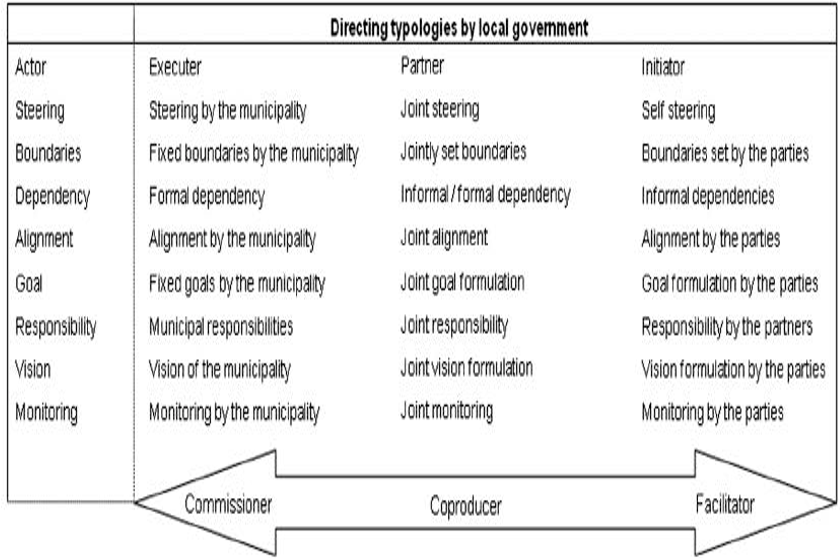 The table above illustrates the shift from 'Executor' to 'Initiator' roles, highlighting the redistribution of responsibility.
The Experience Dividend: What the Data Shows
The researchers found that a policymaker's perception of Web 2.0 is dictated by their municipality's Learning Curve.
- Early Adopters (The 2009 Cohort): These veterans have moved past the fear stage. They view Web 2.0 as a tool for Legitimacy. They are more likely to support "Government as a Platform" and "Citizen Sourcing."
- Late Adopters (2012+): These newcomers are primarily focused on Information Access and Promotion. They perceive higher risks, such as "inappropriate use of networks" and "lack of regulatory frameworks," leading them to retreat into the "Bureaucratic Model."
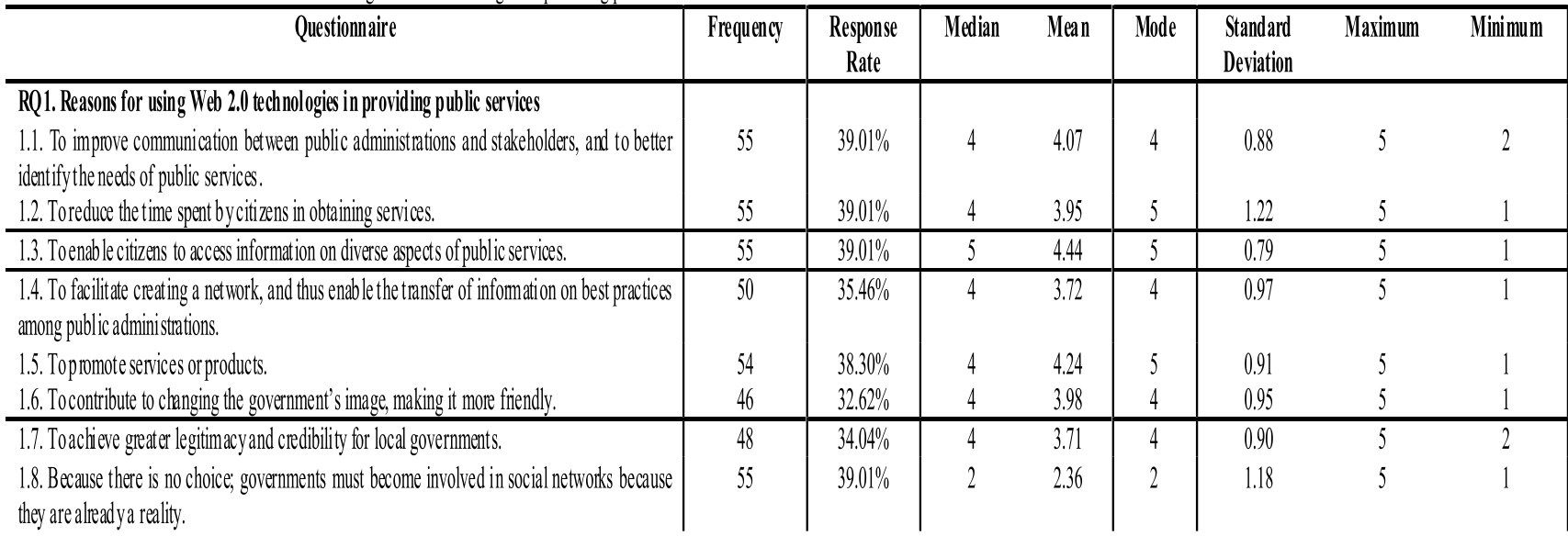 Quantitative results showing that while "Information Access" (1.3) is highly valued, the pressure to adopt (1.8) is surprisingly low, suggesting adoption remains a choice rather than a necessity.
Critical Insight: The Risk-Innovation Paradox
Policymakers are caught in a trap. They recognize that Web 2.0 can improve service delivery (Median 4), yet they are highly concerned about "unauthorized postings" and the "lack of staff training."
To mitigate this, the study shows that governments prefer to:
- Appoint a Senior Official to oversee all social media coordination.
- Retain all management internally rather than hiring external experts.
- Implement rigid security controls.
This "Safe Environment" strategy effectively smothers the very thing that makes Web 2.0 valuable: spontaneous, organic citizen participation.
Conclusion: From Public Service to Public Partnership
The study concludes that local government is currently in a state of Government 1.5. We have the tools of 2.0, but the operating model of 1.0.
The Takeaway: For future public services to be truly "citizen-centric," we must move beyond transparency. The "Learning Curve" suggests that as governments spend more time on these platforms, their fear of "losing control" diminishes. The future of e-governance isn't just about better apps; it's about shorter learning curves and a radical shift in administrative culture.
Limitations: The study is localized to Spain and focuses on larger municipalities. Future research should investigate if the "AI surge" will accelerate this transition or lead to a new form of digital bureaucracy.