
Decoding Educational Data Mining: The Architecture of Learning Intelligence
4662_Educational Data Mining A Review of the State of the Art.
This seminal review paper provides a comprehensive taxonomy and state-of-the-art survey of Educational Data Mining (EDM), covering research from 1995 to 2009. It establishes a multi-dimensional classification framework for EDM tasks ranging from student performance prediction to social network analysis, solidifying EDM as a distinct interdisciplinary field.
TL;DR
This landmark survey by Romero and Ventura serves as the "foundational map" for Educational Data Mining (EDM). It transitions the field from a collection of isolated experiments into a rigorous discipline by categorizing research into 11 distinct tasks—such as performance prediction and student modeling—and identifying the specific algorithms that drive them.
The "Gold Mine" in the Classroom
The surge in digital education through the 2000s created what the authors describe as a "gold mine" of data. However, mining this data isn't just about applying commercial logic to students. Unlike e-commerce, where the goal is a sale, EDM deals with intrinsic semantic information and pedagogical hierarchies.
The problem this paper addresses is a lack of cohesive framework: Prior work was fragmented across Intelligent Tutoring Systems (ITS), E-learning platforms, and traditional psychological experiments.
Methodology: The 11 Pillars of EDM
The core of this work is the classification of EDM into 11 functional tasks. Here is a breakout of the most significant categories:
- Student Modeling: Building cognitive maps of a learner's skills and declarative knowledge.
- Performance Prediction: The most mature area, predicting final grades or dropout risks using Bayesian Networks and Neural Networks.
- Relationship Mining: Specifically Association Rule Mining to find "hidden" patterns, like which learning materials correlate with success.
- Social Network Analysis (SNA): Measuring group cohesion through forum interactions.
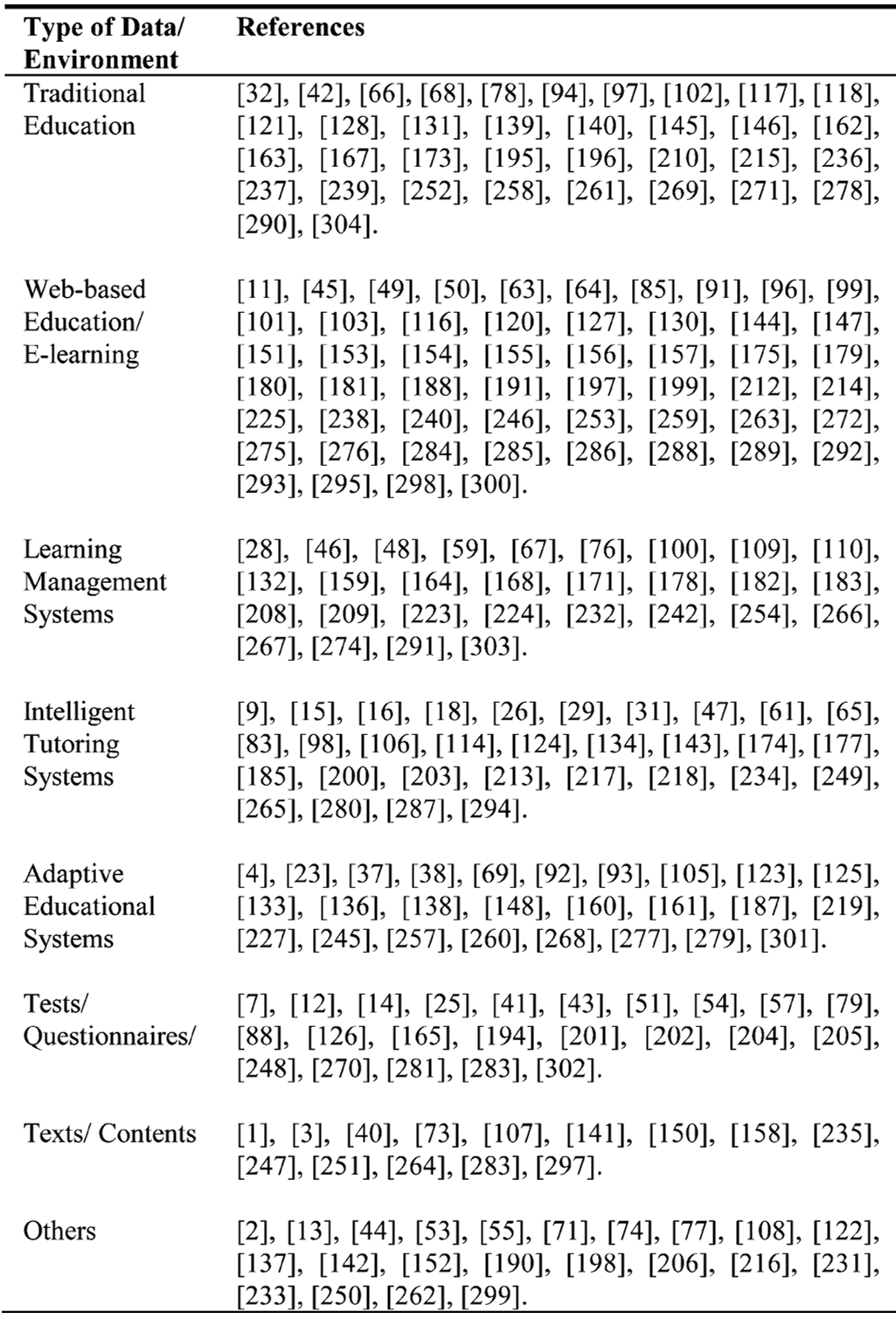 Above: A look at the mapping of EDM references to specific educational environments, highlighting the diversity from traditional classrooms to specialized Intelligent Tutoring Systems.
Why Conventional DM Isn't Enough
Romero and Ventura argue that EDM requires a specialized toolkit.
- Objective Complexity: Pure research (understanding learning) vs. applied goals (improving grades).
- Multilevel Hierarchy: Courses consists of chapters, lessons, and specific concepts, requiring algorithms that understand these relationships (like Q-matrices).
- Human Elements: Factors like "motivation" and "cheating" are high-dimensional and non-linear.
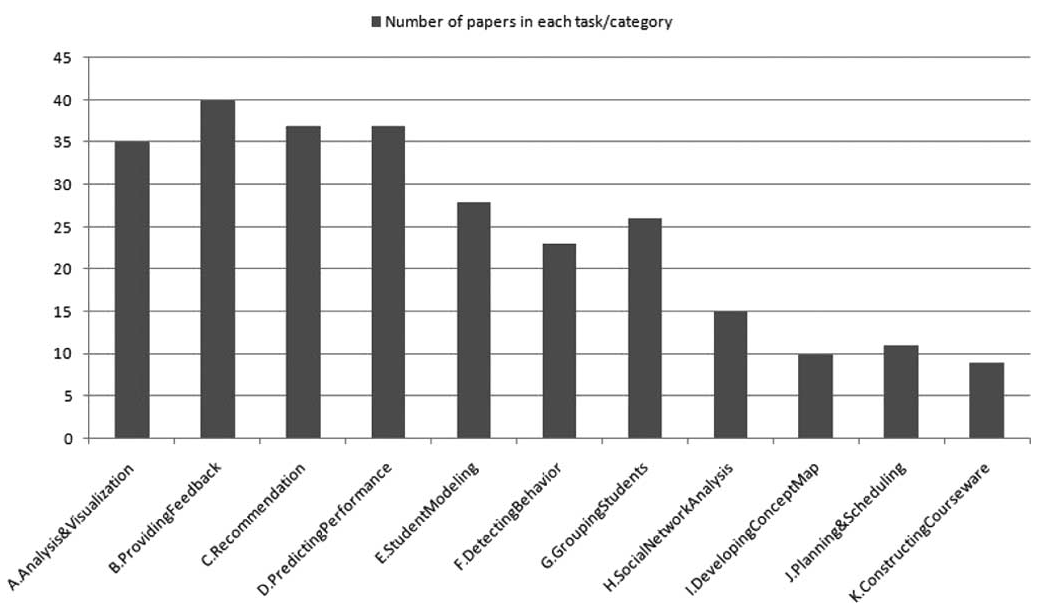 The exponential growth of the field, marking its transition from "discovery phase" to a structured academic discipline.
Future Outlook: The Path to Maturity
The authors conclude that EDM is in its "adolescence." To reach maturity, the field must overcome:
- The "Expert Gap": Current tools are too complex for teachers. We need "wizard-style" interfaces that automate preprocessing.
- Standarization: The field lacks a common data format (though XML and PMML are proposed).
- Integration: DM features should not be external plugins but native parts of the Learning Management System (LMS).
Critical Insight
While this paper is a review, its true value lies in the Inductive Bias it provides for future researchers. By grouping disparate techniques (from Markov Decisions to Genetic Programming) under educational goal-oriented categories, it allows researchers to choose methods based on the educational problem rather than the algorithm's popularity.
If you are building an AI-native educational tool today, this paper provides the blueprint for what metrics actually matter beyond simple engagement scores.