
Dynamic Harmony: Bridging Social Circles and Global Peers for Smarter Recommendations
4782_Neighbourhood Aging Factors for Limited Information Social Network Collaborative Filtering.
This paper introduces a hybrid Social-Collaborative Filtering recommendation framework that dynamically integrates social network data with traditional collaborative filtering. It utilizes a novel Adaptive Weighting (AF) mechanism to balance signals from peer ratings and social connections, achieving superior rating prediction accuracy on real-world datasets like Ciao and Dianping.
TL;DR
This research tackles the inherent sparsity of recommendation systems by merging two worlds: who you are similar to (Collaborative Filtering) and who you know (Social Networks). The breakthrough lies in an Adaptive Weighting mechanism that decides in real-time whether to trust your friends or your "statistical twins" more for any given item.
Background: The Social Dilemma in Recommender Systems
Most modern Recommender Systems (RS) rely on Collaborative Filtering (CF). However, CF hits a wall when data is sparse—a new user with only two ratings is a "Cold Start" mystery. Social Recommendation attempts to fix this by using your social graph. But here is the catch: your friends don't always share your taste in every niche. Static fusion (treating social and CF data with equal importance) often leads to suboptimal results.
The Core Innovation: Adaptive Signal Fusion
The authors propose a dual-path prediction model. For a target user and item , the system calculates:
- CF Path: Finds neighbors based on rating similarity (Pearson Correlation).
- SN Path: Finds neighbors within the explicit social graph (trust/friendship).
Instead of simply averaging them, the paper introduces the Adaptive Factor (AF):

The intuition is brilliant: if your social neighbors have a very consistent and high-confidence rating for an item compared to the global average, the "Social Weight" increases. If the social circle is divided or lacks data, the system leans back on global user trends (CF).
Methodology: From Formulas to Intuition
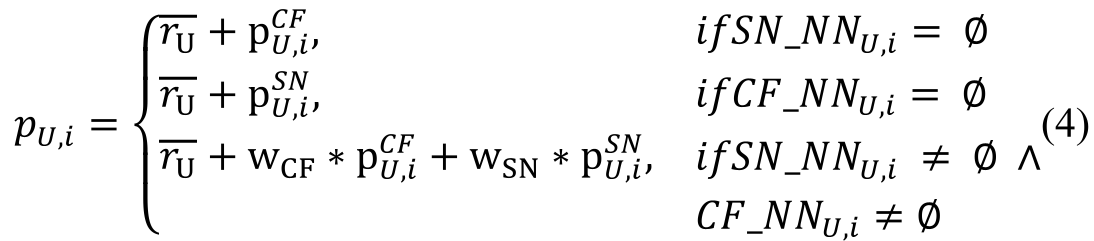
The final prediction is a weighted sum:
The weights and are not hyperparameters tuned during training; they are dynamically computed for every single request based on the neighborhood's rating distribution. This allows the model to be "Social-heavy" for lifestyle products (where friends influence us) and "CF-heavy" for technical or niche products (where experts/similar strangers matter more).
Performance Benchmarks
The model was validated on two massive datasets:
- Ciao: A movie rating dataset with explicit "Trust" relations.
- Dianping: A massive restaurant review dataset from China with "Friendship" relations.
| Dataset | #Users | #Social Relations | #Ratings |
|---|---|---|---|
| Ciao | 30,000 | 40,000 | 1,600,000 |
| Dianping | 148,000 | 2,500,000 | 2,100,000 |
The results (visualized in the paper's charts) confirm that the Adaptive Hybrid approach consistently yields lower error rates (MAE/RMSE) than using either social data or CF in isolation.
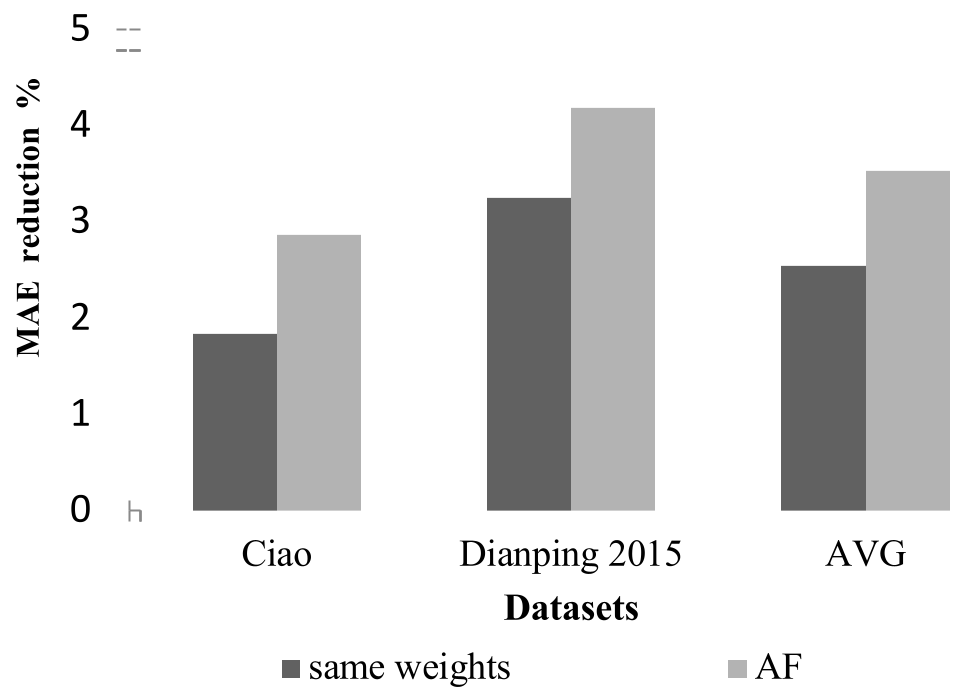 (Note: Visualization of the error reduction across different sparsity levels)
Critical Insight & Future Outlook
The beauty of this work is its interpretability. Unlike black-box Deep Learning models, we can see exactly why a recommendation was made: "We trusted your friends more for this restaurant because their consensus was high."
Limitations: The model relies on explicit social graphs, which are becoming harder to access due to privacy regulations (GDPR/CCPA). Future work should look into Implicit Social Graphs—inferring "friendship" from shared behavior rather than explicit follow buttons.
Conclusion: By moving from static fusion to adaptive integration, this paper provides a robust blueprint for the next generation of trustworthy, context-aware recommender systems.