
DeaiExplorer: Bridging Physical Proximity and Academic Genealogy with RFID
48 PER VASI V E computing
The paper introduces DeaiExplorer, a pervasive computing system that uses passive RFID technology and the DBLP publication database to visualize social networks among colocated conference participants. By mapping physical proximity to professional genealogies, it facilitates interpersonal discovery and networking in academic environments.
TL;DR
DeaiExplorer is an innovative pervasive computing system that transforms academic conferences into interactive social hubs. By combining passive RFID tags on badges with the DBLP publication database, the system detects when researchers are standing near each other and instantly visualizes their professional "degrees of separation"—including shared coauthors, citations, and common research interests—on public displays.
The Motivation: Moving Beyond "Hello, My Name Is..."
Physical conferences offer unique opportunities for informal knowledge sharing and networking that digital media cannot replicate. However, the "ice-breaking" phase between strangers is often awkward or limited to surface-level information (name, affiliation).
The authors identified that while platforms like Orkut or LinkedIn exist, they are often cluttered with social noise. The real "social currency" of academics lies in their publication history. The challenge was: How do we bring this invisible web of citations and coauthorships into the physical hallway where people actually meet?
Methodology: From ID to Interaction
The researchers built a system architecture consisting of multiple stations (PCs with RFID readers and plasma displays) and a central database server.
- Hardware: They utilized Hitachi -Chips (passive RFID), which are tiny (0.4mm) and cost-effective. These tags have a read range of ~30cm, intentionally requiring a "semi-conscious" gesture to trigger the system.
- Data Extraction: The system queries the DBLP database (over 600,000 records) to identify connections. It doesn't just look for direct coauthors; it calculates up to four-step connections.
- Research Flow: To go beyond simple cocitation (which can be noisy), they used a conditional probability technique called "research flow" to identify meaningful thematic links between authors who might not even know each other.
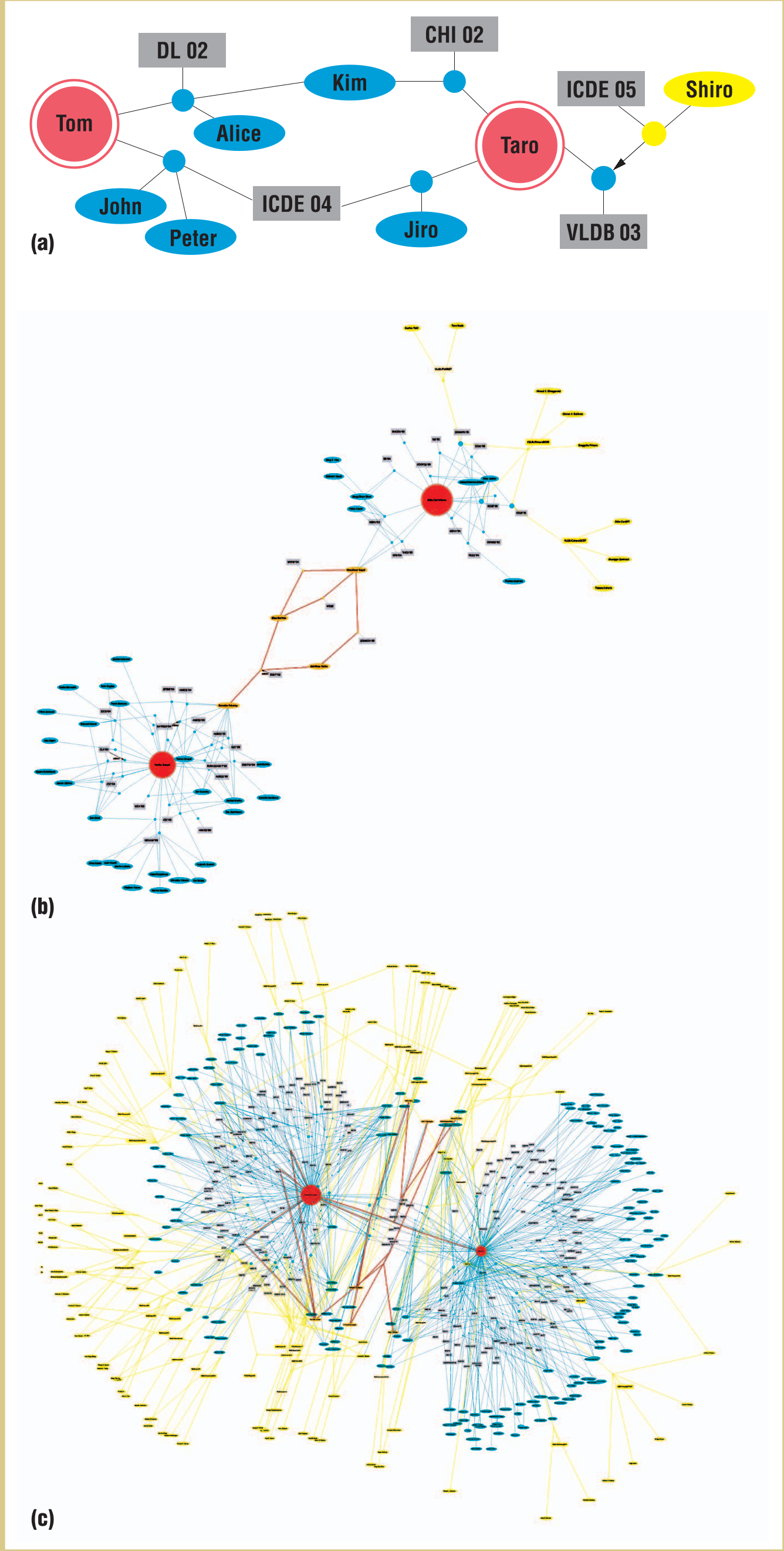 Graph nodes represent users (circles), publications (dots), and venues (rectangles).
Experiments: Real-World Deployment at ICDE 2005
The system was deployed at the 21st International Conference on Data Engineering in Tokyo.
- High Engagement: 61% of participants with RFID badges engaged with the system.
- Social Evolution: As the conference progressed, the ratio of "pair usage" (two people looking at the screen together) increased from 35% to 46%, suggesting the system became a catalyst for collaborative discussion.
- The Power of Citations: Interestingly, users were most excited to see "who cited their papers" rather than their own coauthors. This professional validation served as a powerful hook for engagement.
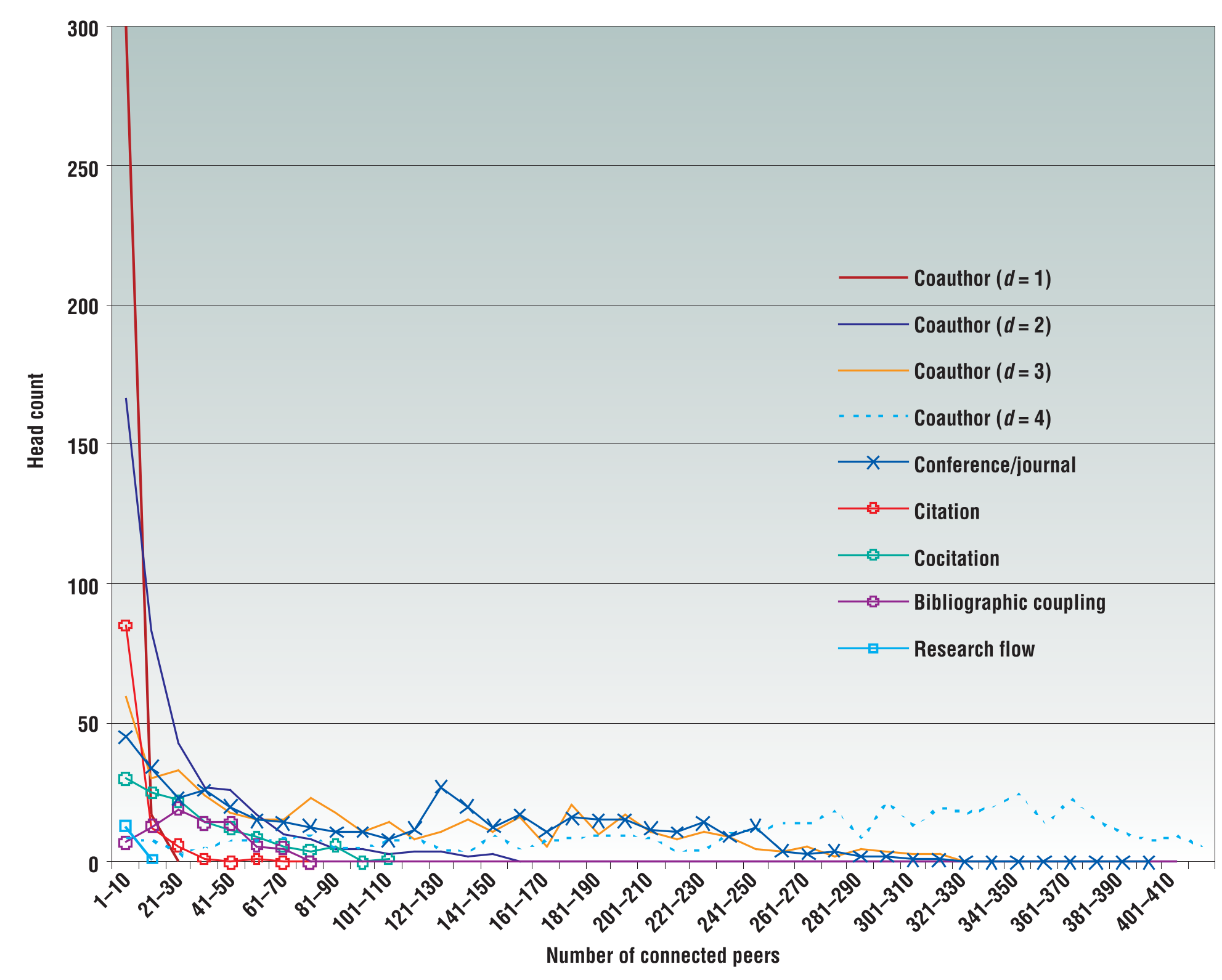 The system revealed a dense web of connections that were invisible to participants beforehand.
Critical Analysis: Privacy and the "Young Researcher" Problem
Despite its success, the study highlighted two critical hurdles for pervasive social systems:
- The "Cold Start" for Juniors: Researchers with few publications felt discouraged when the system showed a sparse graph. This suggests future systems need a "Universal Design" that incorporates other data points (e.g., interests, session attendance) to avoid alienating students.
- Privacy Thresholds: While the data was public (DBLP), seeing it aggregated and displayed on a 42-inch screen creates a "panopticon" effect for some. The authors argue for strict control over what is displayed and clear "opt-out" mechanisms.
Conclusion
DeaiExplorer proves that pervasive technology is at its best when it augments, rather than replaces, human ritual. By turning a conference hallway into a live, interactive map of the scientific community, the authors have shown a path toward more "meaningful and fun" academic exchanges.
Takeaway for the Future: As we move toward an era of AI-driven networking, the lesson from DeaiExplorer is clear: the most valuable insights come from the intersection of physical context and rich, domain-specific metadata.