
PCCA: Securing the "Where" in e-Governance Through Computational Intelligence
4832_PCCA Position Confidentiality Conserving Algorithm for Content-Protection in e-Governance Services and Applications.
The paper introduces PCCA (Position Confidentiality Conserving Algorithm), a novel computational intelligence-based framework designed to protect roaming user privacy in e-Governance services. By combining k-anonymity principles with a four-stage clustering mechanism, PCCA ensures that sensitive physical locations remain concealed from untrusted service providers while maintaining high Quality of Service (QoS).
TL;DR
As e-Governance scales, the risk of exposing citizens' real-time locations through Position-Based Services (PBS) grows. This paper presents PCCA (Position Confidentiality Conserving Algorithm), a framework that leverages Computational Intelligence (CI) and k-anonymity to hide roaming users' coordinates within "Least Cloaked Regions" (LCR), ensuring privacy without sacrificing service quality.
The Privacy Paradox in Digital Government
E-Governance aims to streamline interaction between citizens and the state. However, services that require location data (e.g., finding the nearest municipal office or emergency response) open a backdoor for attackers to track individuals. The core challenge is the Privacy-Utility Trade-off: if you hide the location too well, the service becomes useless; if you provide it accurately, the user is exposed.
Prior works like GCA or AVD-DCA often struggle with the semantic complexity of unstructured text data or the high overhead of continuous queries.
Methodology: The Four-Stage PCCA Framework
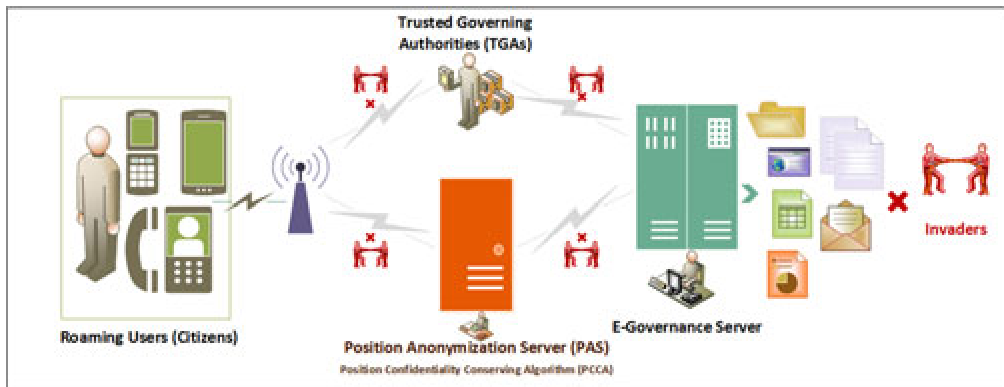
The PCCA algorithm operates as a cluster-based methodology where roaming users hide their "personal interests" and "exact coordinates" within a crowd.
1. The Architectural Flow
The system involves a Position Anonymization Server (PAS) and Trusted Governing Authorities (TGA). The PAS acts as a buffer, ensuring the e-Governance server never sees the raw position, and the PAS never sees the sensitive content.

2. The Four Stages of Anonymization
- Stage 1: Cluster Formation: Users broadcast unique IDs to neighbors within a wireless range to form a temporary peer group.
- Stage 2: Search Space Recognition: The algorithm identifies a "Wireless Search Space Area" (WSSA) based on the anonymity threshold .
- Stage 3: LCR Determination: The system calculates the minimum area required to contain at least four roaming users (defining both width and height boundaries).
- Stage 4: Scheming & Authorization: The user transforms their raw range into a "Least Cloaked Region," effectively hiding the total count of authorized neighbors from potential invaders.
3. The Role of Fuzzy Logic
Unlike rigid mathematical models, PCCA uses a rule-based IF-THEN approach. This is vital for handling the "fuzziness" of mobile signals and the uncertainty of user mobility, allowing the system to make real-time decisions about cloaking regions even with incomplete data.
Experimental Insights & SOTA Comparison
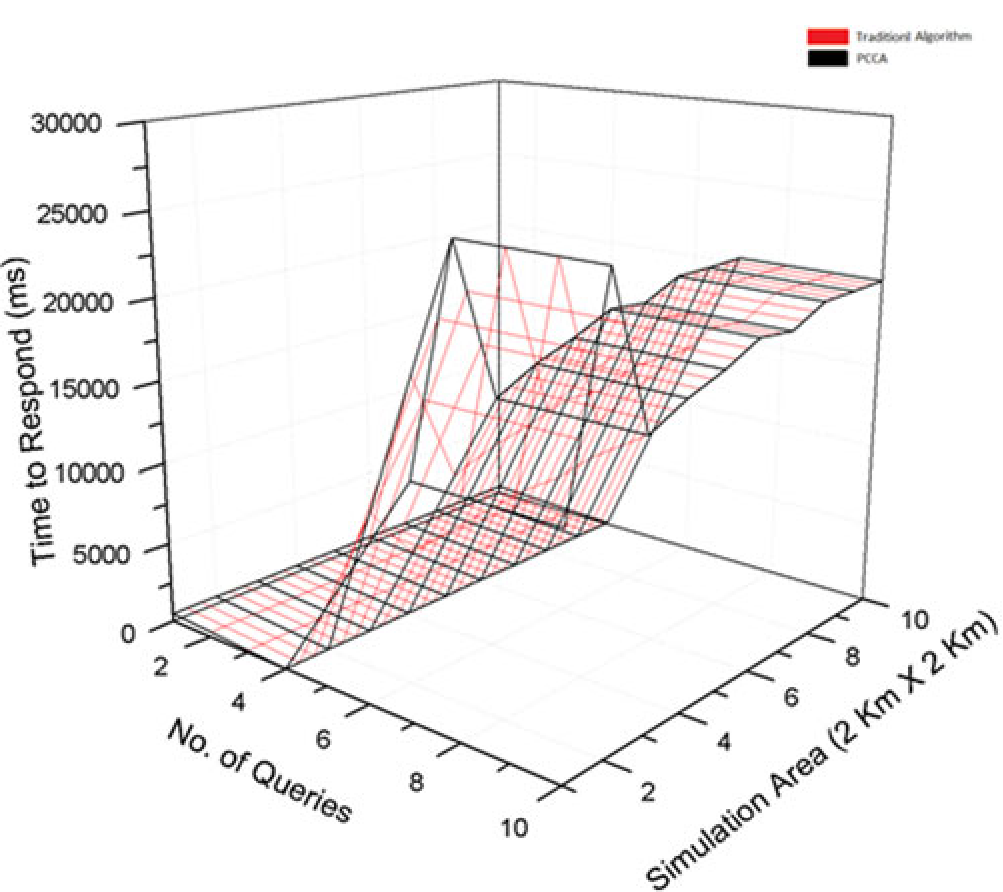
The authors simulated PCCA using Java with 500 roaming users in a 2km x 2km area.
- Quality of Service (QoS): While standard algorithms like V-DCA show static performance, PCCA adapts. As more position-based content is processed, the required search space decreases, actually improving QoS until it hits a steady state.
- Mobility Resilience: The algorithm showed high robustness against user movement, with minimal impact on the communication cost required to maintain the LCR.
- Anonymity Guarantee: The metric PCG (Position Confidentiality Guarantee) confirmed that the user's location is always masked by at least others, effectively preventing location-based query hijacking.
Critical Analysis & Professional Takeaways
PCCA represents a significant step toward Privacy-by-Design in public sector applications. Its use of O(A^4) complexity is a calculated move to keep the system scalable for mobile devices with limited processing power.
Key Insight: By separating the "Content" (managed by the e-Gov server) from the "Position" (managed by the PAS), PCCA creates a zero-trust environment where no single entity holds the full picture of a citizen's activity.
Future Directions: The authors note that the next frontier is addressing Content Overload. As the volume of e-Governance data grows, the risk of "linking attacks"—where an attacker correlates location patterns with content types—remains a secondary threat to be solved.