
PKCS: Solving the Gaussian Truncation Dilemma in Scale-Space Theory
4834_PKCS A Polynomial Kernel Family With Compact Support for Scale- Space Image Processing.
This paper introduces the Polynomial Kernel family with Compact Support (PKCS), a new class of image processing kernels designed for linear scale-space theory. PKCS replaces the traditional Gaussian kernel by utilizing a polynomial form that preserves key properties like diffusion equation approximation and non-enhancement of local extrema while being computationally efficient and avoiding truncation artifacts.
TL;DR
Scale-space theory has long relied on the Gaussian kernel, but its infinite support is a practical nightmare for digital systems. This paper introduces PKCS (Polynomial Kernels with Compact Support)—a family of polynomial functions that mimic Gaussian properties perfectly within a finite window. By avoiding truncation, PKCS eliminates boundary errors, reduces computation time, and maintains the mathematical rigor required for high-quality image segmentation and feature extraction.
Background: The Price of Infinity
In linear scale-space theory, the Gaussian kernel is unique because it satisfies the diffusion equation and ensures no "spurious structures" (new local extrema) are created as we blur an image. However, because a true Gaussian extends to infinity, engineers must "truncate" it. This leads to two critical failures:
- Border Effects: Discontinuities at the mask edges cause errors in gradient and Laplacian calculations.
- Efficiency: Large standard deviations require massive convolution masks, slowing down real-time systems.
Methodology: From Infinite Plane to Unit Ball
The authors solve this by deforming the spatial plane into a unit ball using a transformation function. Unlike previous complex attempts (like the original KCS), the proposed PKCS uses a clean logarithmic transformation that results in a simple polynomial form:
The "Physics" of the Formula
- Compact Support: The kernel is exactly zero when the distance exceeds .
- Controllable Smoothness: The parameter acts as a tuning knob. As increases, the kernel’s central peak sharpens, and its side-lobes in the frequency domain drop, behaving more like an ideal Gaussian.
- Analytical Clarity: Unlike its predecessors, PKCS has a closed-form normalization constant, making it easy to implement without numerical integration.
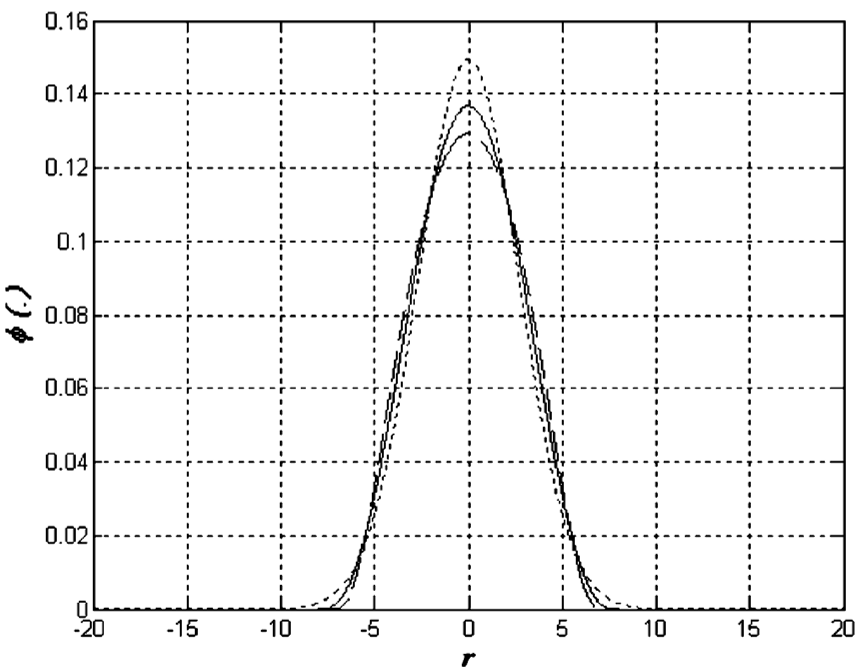 Figure 1: PKCS (solid line) shows a much closer profile to the Gaussian (dots) than previous compact kernels, ensuring the "Heisenberg Uncertainty" remains near-minimal.
Key Insights: Why It Works
The brilliance of PKCS lies in its approximation of the Diffusion Equation. The authors prove that for sufficiently large , PKCS satisfies the heat equation . This means it doesn't just "look" like a Gaussian; it functions like one by suppressing high-frequency noise without introducing artifacts.
Furthermore, PKCS exhibits a smaller Equivalent Noise Bandwidth (ENBW) than a Gaussian of the same variance. This translates to superior performance in extremely noisy environments, such as extracting faint handwriting from textured postal envelopes.
Experimental Battle: PKCS vs. LoG
The authors tested PKCS against the standard Laplacian of Gaussian (LoG) for segmenting handwritten data from the CEDAR database.
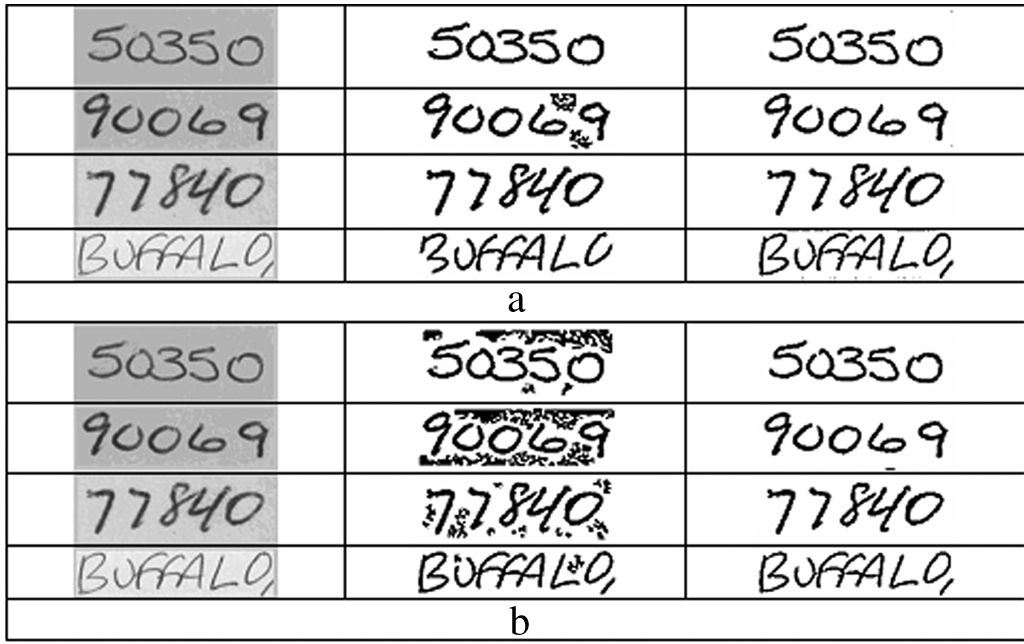 Figure 2: Qualitative comparison. Row (a) shows PKCS preserving full characters where LoG (truncated Gaussian) results in fragmented or degraded strokes due to information loss.
Key Results:
- Robustness: PKCS maintained character integrity even when reducing the number of multiscale layers, whereas LoG failed significantly.
- Efficiency: Because the mask size is strictly finite and the polynomial is computationally "cheap" to evaluate, it represents a major win for embedded vision systems.
Critical Analysis & Future Outlook
While PKCS is a breakthrough for 2D image processing, the paper notes that a separable version is the next frontier. Separability (processing rows then columns) is what makes Gaussians so fast in modern GPUs. If PKCS can be efficiently decomposed, it could replace Gaussian blurs in everything from SIFT feature detection to real-time document scanning apps.
Takeaway: If you are dealing with derivative estimation or feature extraction where boundary precision matters, stop truncating your Gaussians and start using Polynomial Kernels with Compact Support.